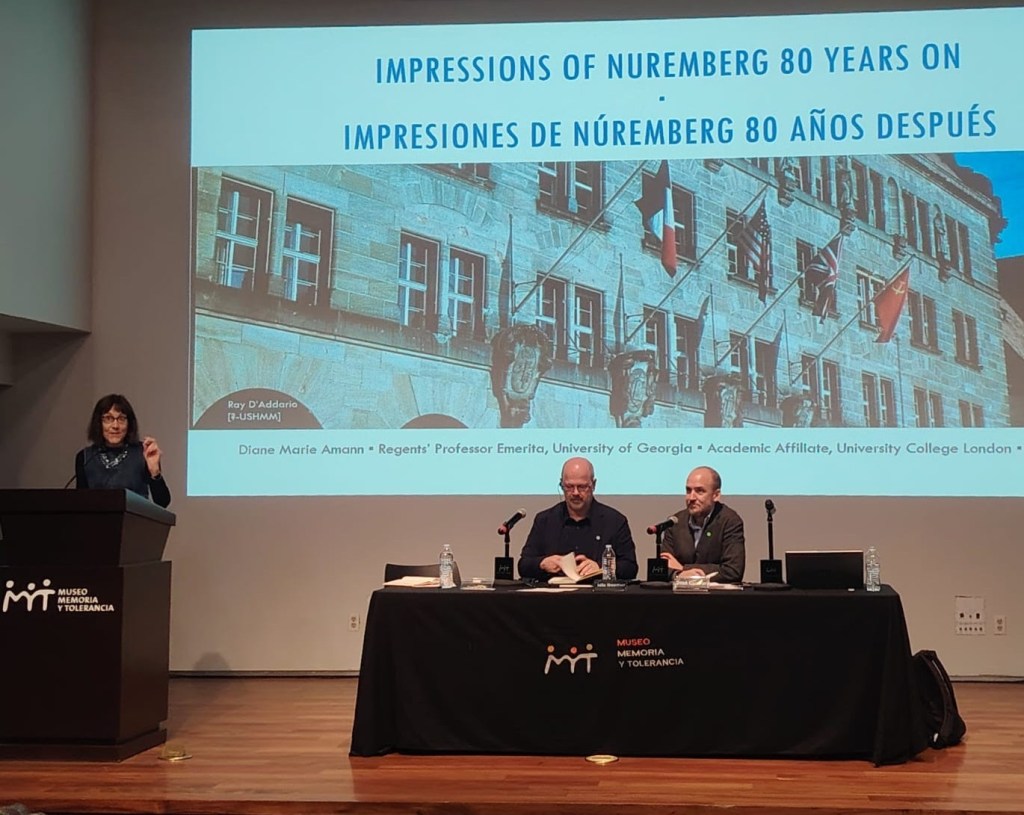
Amann examined legacies of the year-long war crimes trial which took place soon after World War II in Nuremberg, Germany, before an International Military Tribunal established by Britain, France, the Soviet Union, and the United States. After discussing some lesser known aspects, such as the roles of persons not affiliated with one of those four Allied states, Amann considered contemporary legacies of the landmark trial.
The University of Texas at Dallas joined the Museo Memoria y Tolerancia in cosponsoring the two-day conference.
Amann, who is Regents’ Professor Emerita and Emily & Ernest Woodruff Chair in International Law Emerita at Georgia Law, served for many years as a Faculty Co-Director of our Dean Rusk International Law Center. At present she is an Academic Affiliate at University College London Faculty of Laws.
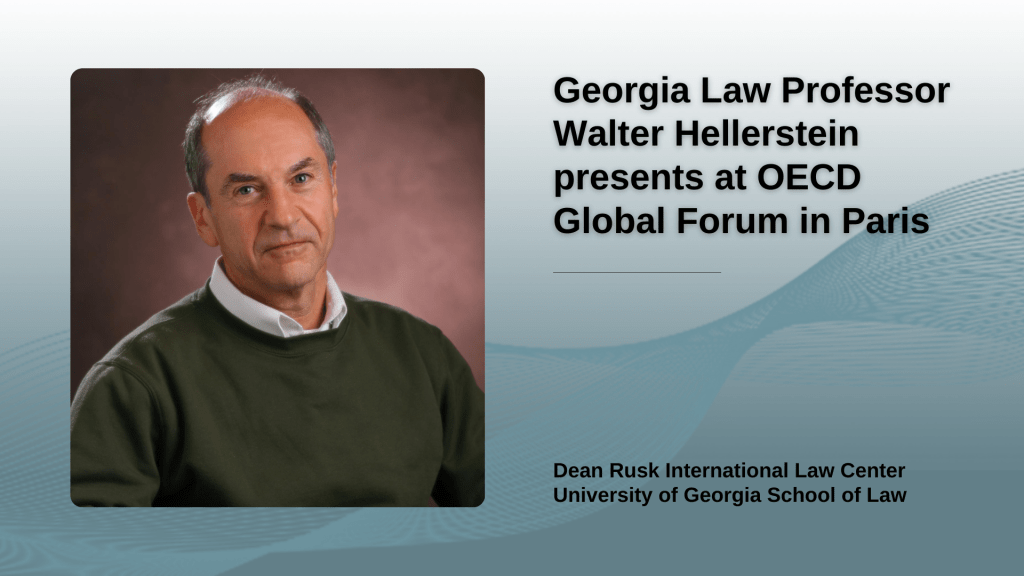
University of Georgia School of Law Professor Emeritus Walter Hellerstein presented at the Sixth Meeting of the OECDGlobal Forum on VAT in Paris, France in January. The Global Forum gathered government officials, international organizations, and business stakeholders to share approaches to building effective VAT systems.
Hellerstein is the Distinguished Research Professor & Francis Shackelford Distinguished Professor in Taxation Law Emeritus. He is a recipient of the National Tax Association’s Daniel M. Holland Medal for outstanding lifetime contributions to the study and practice of public finance, is widely regarded as the nation’s leading academician on state and local taxation. He has authored numerous books, textbooks, and law review articles, and has practiced extensively in the field. Hellerstein is currently a Visiting Professor at the Vienna University of Economics and Business, and he remains actively involved in his scholarship, consulting, and, in particular, his work as an academic advisor to the OECD.
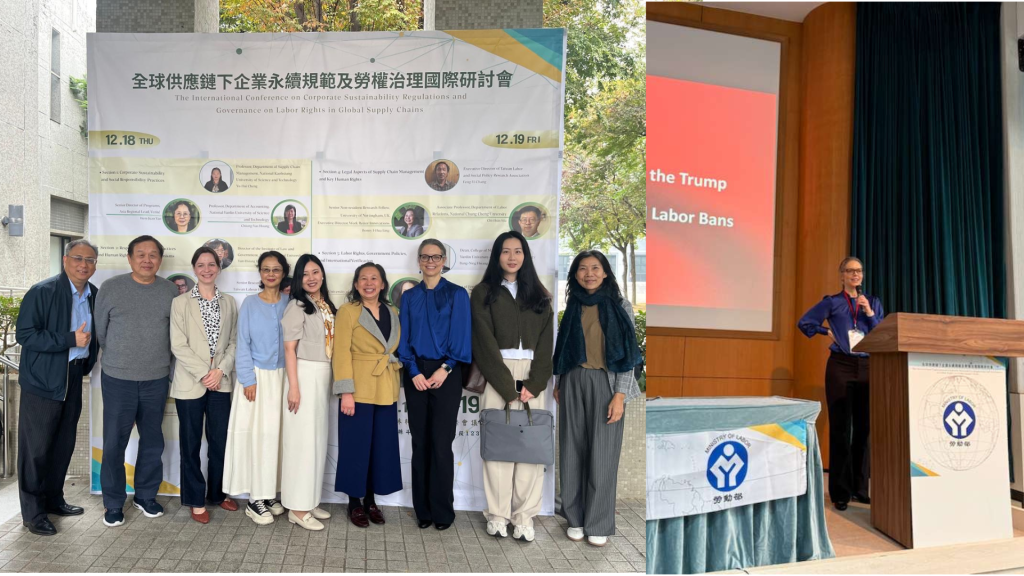
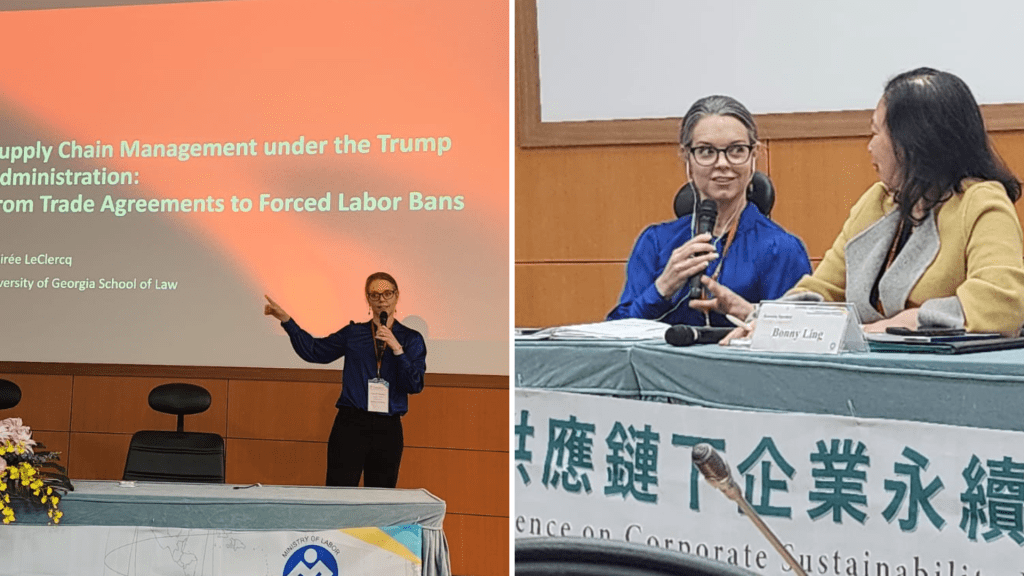
University of Georgia School of Law Professor Desirée LeClercq delivered a keynote address at the International Conference on Corporate Sustainability Regulations and Governance on Labor Rights in Global Supply Chains, held in Douliu, Taiwan, on 19 December 2025.
Her keynote, “Supply Chain Management under the Trump Administration: from Trade Agreements to Forced Labor Bans,” examined how shifting U.S. trade policy and enforcement tools shape corporate supply chain strategy, with a focus on labor rights compliance and emerging forced labor restrictions. A short video from her time in Taiwan was shared in an Instagram reel.
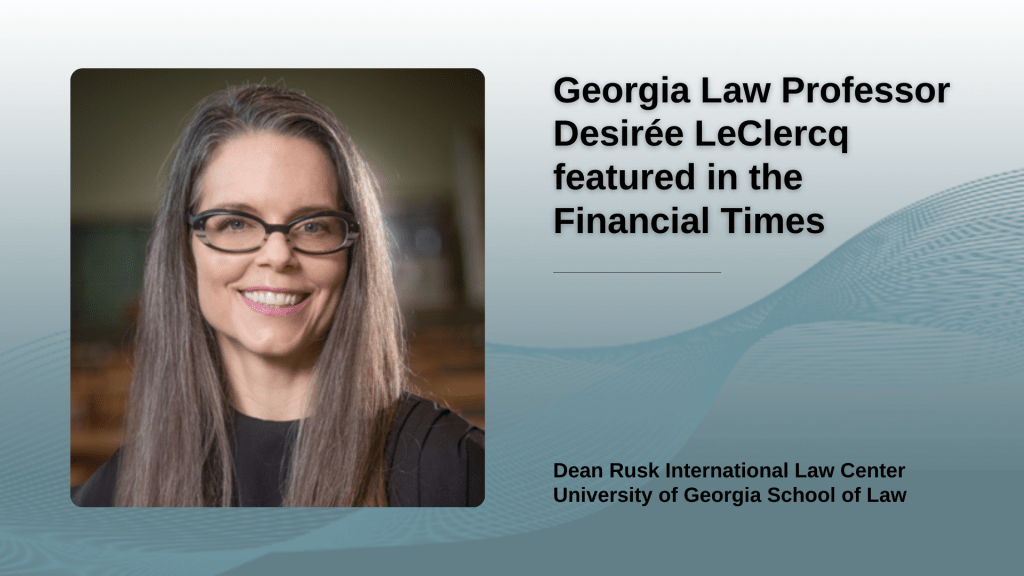
LeClercq joined the University of Georgia School of Law in 2024 as an assistant professor. She teaches Contracts, International Trade and Workers Rights, International Labor Law, U.S. Labor Law, and Public International Law. She also serves as a faculty co-director of the Dean Rusk International Law Center and as the faculty adviser for the Georgia Journal of International and Comparative Law and the Labor and Employment Student Association.
LeClercq joined the University of Georgia School of Law in 2024 as an assistant professor. She teaches Contracts, International Trade and Workers Rights, International Labor Law, U.S. Labor Law, and Public International Law. She also serves as a faculty co-director of the Dean Rusk International Law Center and as the faculty adviser for the Georgia Journal of International and Comparative Law and the Labor and Employment Student Association.
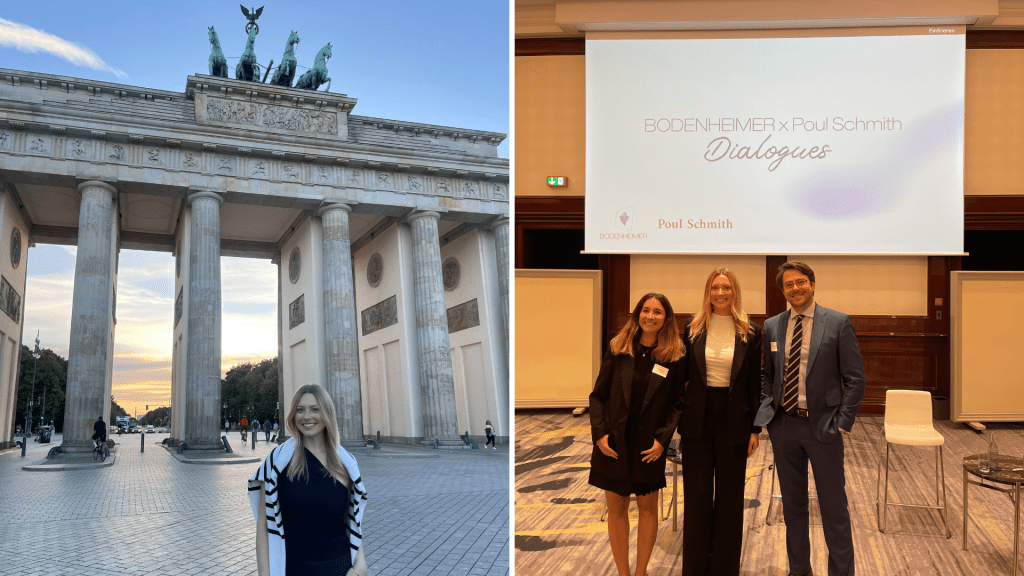
Today, we welcome a guest post by Eleanor Cox, a member of the University of Georgia School of Law class of 2026. Cox is the eleventh Georgia Law student to participate in a semester-long international externship and the third recipient of a grant from the Halle Foundation to support her externship in Germany. The semester-long externships overseas initiative is an extension of the Center’s existing Global Externships Overseas and is offered jointly between the Center and the law school’s Clinical and Experiential Program. Cox’s post describes her experience as a legal extern with Bodenheimer, a German law firm specializing in international arbitration. Cox was based in Bodenheimer’s Berlin office, where she worked under Georgia Law alumnus Dr. Christof Siefarth (LL.M., ’86). Dr. Siefarth, who is also a member of the Dean Rusk International Law Center’s Advisory Council, is a Partner at Bodenheimer.
“Do it afraid.” That simple reminder became my mantra during my semester abroad. It is an acknowledgement that discovery rarely feels comfortable at the start. Stepping into a new country, a new legal system, and a new professional culture required me to move forward even when I felt unsteady. But the very discomfort I feared became the gateway to the most meaningful growth I have experienced. During the fall 2025 semester, I externed at BODENHEIMER Law Firm in Berlin—a firm specializing in international dispute resolution with offices also in Cologne.
Living in Berlin
Berlin is a place that refuses to simplify itself. Its history is felt in every neighborhood, yet its present is defined by internationalism and constant reinvention. I met a woman who was nine years old when the wall fell, and she learned that the world had changed only when her family from the East knocked on her family’s front door for the first time. I also met a Syrian student working to adjust to the new language, culture, and that in-between feeling of starting over. Encounters like these reminded me that, as the most populated city in the European Union, Berlin cannot be described as one thing. It is one place that is also all places.
What I will miss most is the sense of community Berliners create without even trying: my morning conversations with a bakery owner on the way to the S-Bahn station, watching the city rush outside the second the sun appears, my favorite neighborhood dog Leo religiously greeting me at a local coffee shop, and never knowing whether a parade would materialize around the corner. It is both unpredictable and deeply human. One of my favorite things about Berlin is living in a city that constantly asks you to discover yourself and expand. It stretches you in small ways, like in the languages you hear, the people you meet, and the art tucked in quiet corners of the city.
Substantive Work and Office Culture
At BODENHEIMER, I worked on cross-border legal matters ranging from construction to inheritance. The international nature of the work required me to expand both my legal thinking and cultural awareness. I worked on matters involving different jurisdictions, which meant relying on machine-translated documents and learning the procedural rules of various arbitral institutions. Unsure of how much work would be available due to my limited German-language skills, I was surprised by how much opportunity being a native English speaker provided. I was able to assist in the drafting of statements of claim, attend case management conferences, and research cross-border enforcement.
With colleagues from four different continents, some of the most valuable learning happened outside of my actual assignments. Long lunches turned into lively conversations about world politics, personal histories, cultural differences, and the small absurdities that make international work so rich. These moments helped me understand the human side of international practice and reminded me how central curiosity is to this area.
Lessons to Carry Forward
The most challenging part of the placement was the constant unfamiliarity. But that challenge became the most rewarding part, too. Every day, I proved to myself, in small ways, that I could adapt and grow through trial and error. I learned to celebrate being unfamiliar rather than feel embarrassed by it. That shift in mindset is something I will carry with me.
Looking back, my semester in Berlin helped me see myself differently, personally and professionally. I became more confident, more flexible, and more willing to step into the unknown. What first felt foreign and intimidating slowly became more familiar. Living and working abroad showed me that the moments that feel uncomfortable are often the ones that push us forward the most. And for me, that made this experience not just educational, but truly transformative.
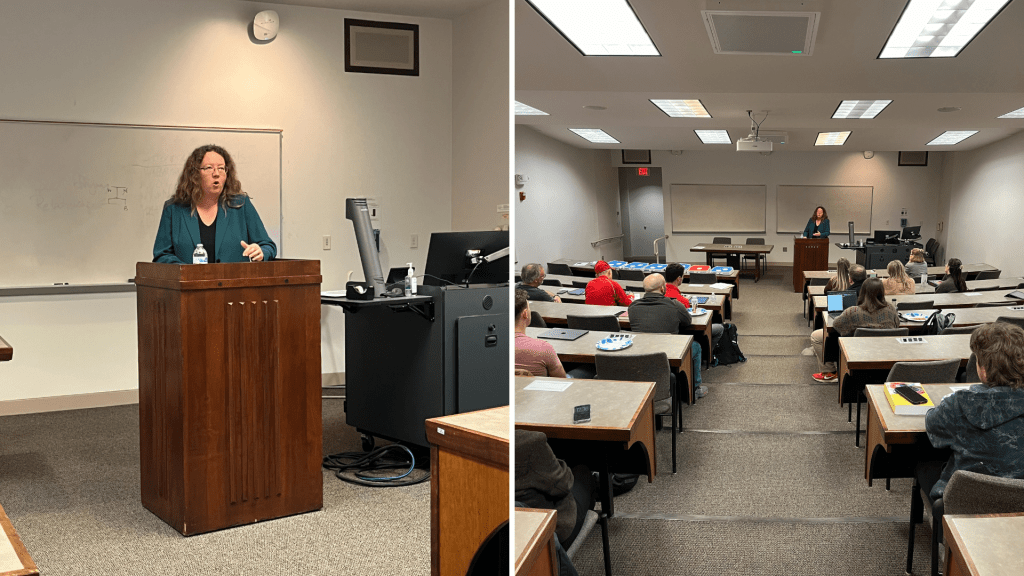
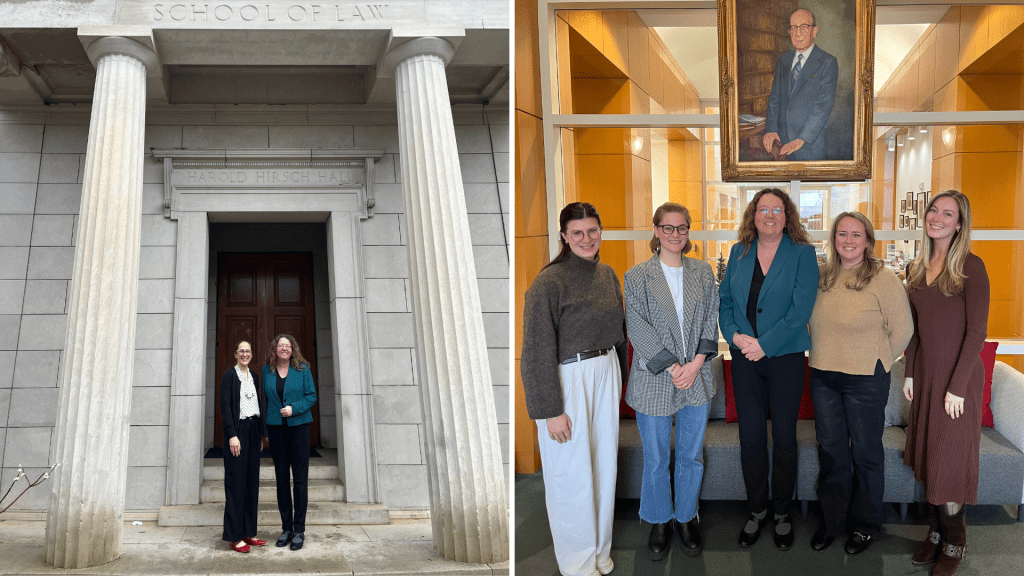
This week, the German Consul General in Atlanta, Melanie Moltmann, delivered a lecture at the University of Georgia School of Law entitled: “Germany’s Bilateral Relations with Georgia and the United States.” This event was the most recent installment of the Center’s ongoing Consular Series, which presents students, staff, and faculty with global perspectives on international trade, cooperation, development, and policy.
Moltmann spoke with students about her diplomatic career, including her previous roles in Germany, Uzbekistan, and Armenia. She discussed the historic economic and cultural ties between the United States and Germany, as well as those between the state of Georgia and Germany. Moltmann assumed her current position in Atlanta in September 2021, overseeing a consular district that includes Alabama, Georgia, Mississippi, North Carolina, South Carolina, and Tennessee. She was joined by Josephine Hertzberg, who is currently completing a legal internship at the German Consulate General in Atlanta.
After her lecture, Moltmann and Hertzberg had a lunch in the Center’s Louis B. Sohn Library with several Georgia Law students who have connections with Germany: Alexis Bartholomew (J.D. ’26), who completed a semester-long Global Externship Overseas (GEO) in fall 2025 in Stuttgart, Germany; Megan Greeley Bradford (J.D. ’26), who completed a summer 2025 GEO in Cologne, Germany; Pace Cassell (J.D. ’26), who completed a semester-long GEO in spring 2025 in Hamburg, Germany with the support of a grant from the Halle Foundation; and Daniel Köhl (LL.M. ’26), a current LL.M. student originally from Germany.
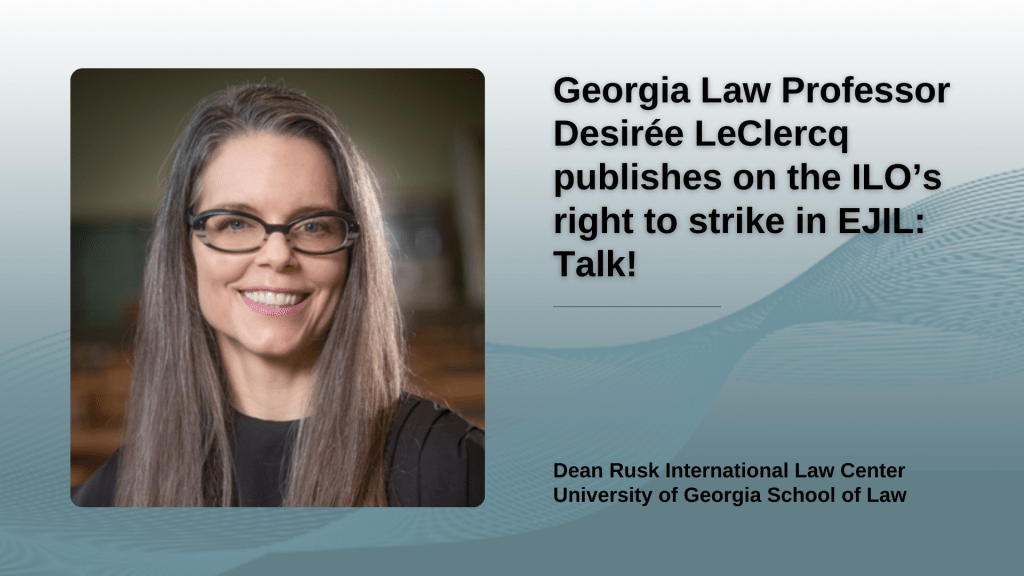
In the post, LeClercq analyzes the International Court of Justice’s proceedings connected to the International Labour Organization’s request for an advisory opinion on whether the right to strike is protected under Convention No. 87. She focuses on how non-binding ILO principles interact with binding conventions, and what that distinction could mean for interpreting Convention No. 87 in international law and in related policy contexts.
LeClercq joined the University of Georgia School of Law in 2024 as an assistant professor. She teaches Contracts, International Trade and Workers Rights, International Labor Law, U.S. Labor Law, and Public International Law. She also serves as a faculty co-director of the Dean Rusk International Law Center and as the faculty adviser for the Georgia Journal of International and Comparative Law and the Labor and Employment Student Association.
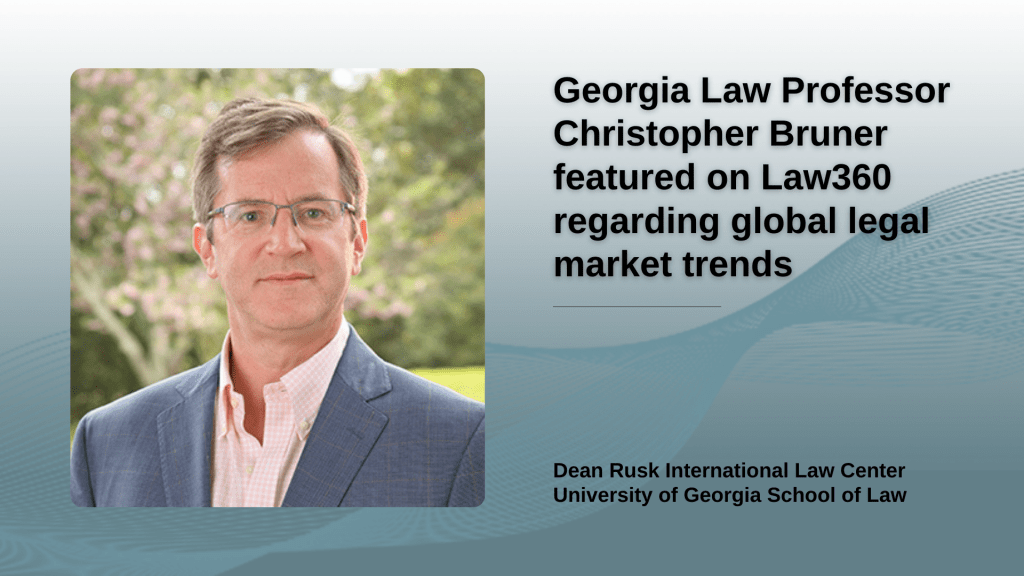
University of Georgia School of Law Professor Christopher Bruner was featured on Law360 regarding the evolving global footprint of large US law firms. The article titled “How BigLaw Is Redrawing Its Global Map For 2026” was written by Ryan Boysen and published 12/10/25.
Bruner is the Stembler Family Distinguished Professor in Business Law at the University of Georgia School of Law and serves as a faculty co-director of the Dean Rusk International Law Center.
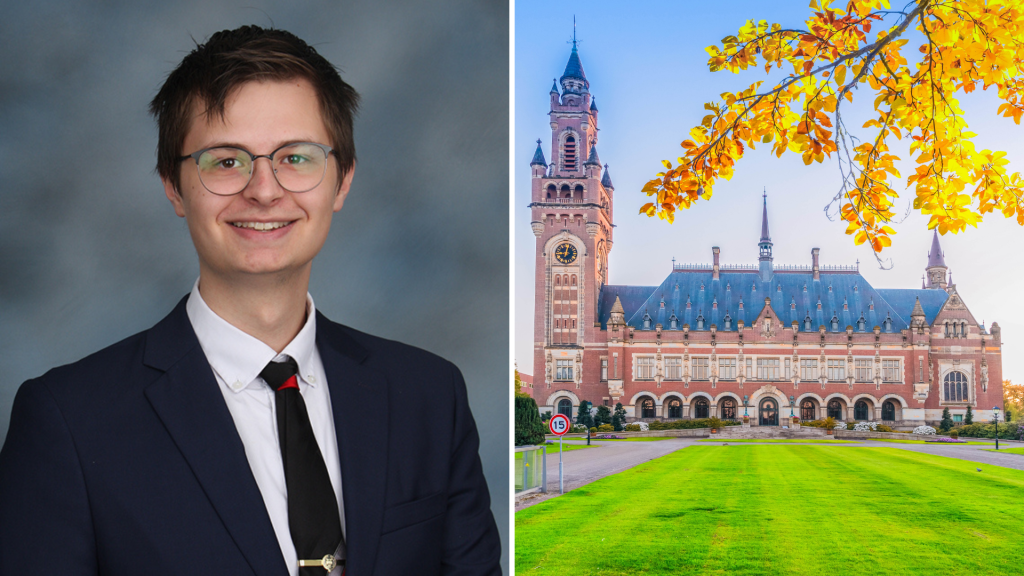
University of Georgia School of Law student Isaac Clement (J.D. ’27) was selected to participate in The Hague Academy of International Law‘s Private International Law summer course. This initiative will take place at the Peace Palace in The Hague, Netherlands.
Over the course of three weeks in the summer, Clement and others from around the world will engage in advanced study of international private law, international arbitration, and cross-border commercial transactions. These courses and lectures are taught by academics, practitioners, and diplomats from leading institutions around the world.
From The Academy’s website:
The Academy is a centre for teaching and research in public and private international law, with the aim of furthering the scientific study of the legal aspects of international relations. The United Nations General Assembly regularly expresses its appreciation “to the Hague Academy of International Law for the valuable contribution it continues to make to the Programme of Assistance, which has enabled candidates under the International Law Fellowship Programme to attend and participate in the Fellowship Programme in conjunction with courses at the Academy” and notes “the contributions of the Hague Academy to the teaching, study, dissemination and wider appreciation of international law, and calls upon Member States and interested organizations to give favourable consideration to the appeal of the Academy for a continuation of support and a possible increase in their financial contributions, to enable the Academy to carry out its activities, particularly those relating to the Summer and Winter Courses, regional courses and programmes of the Centre for Studies and Research in International Law and International relations.”
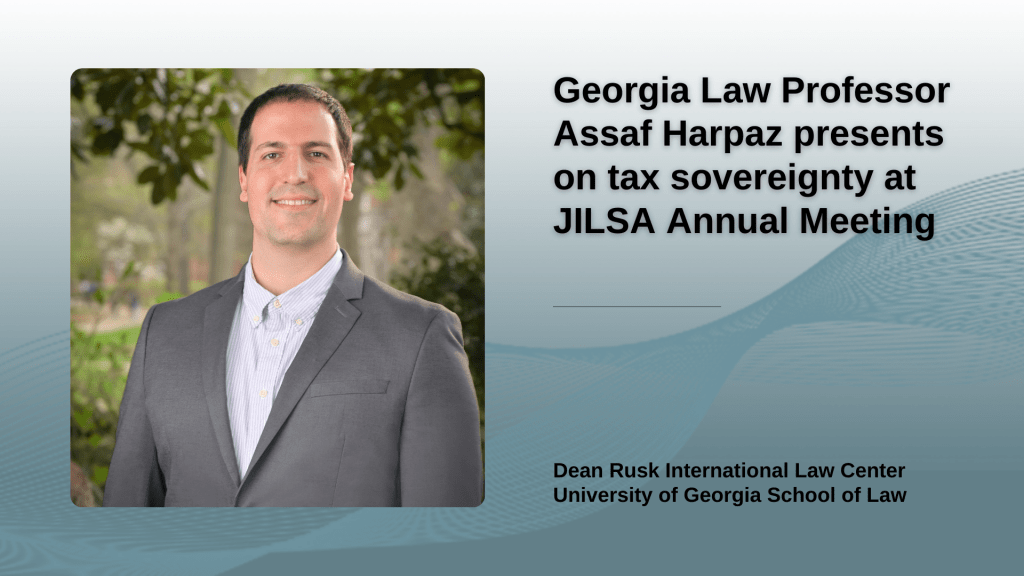
Tax sovereignty is gaining significant attention in international tax policy. The concept traditionally refers to a government’s authority to design and enforce its own tax laws, without infringement. Policymakers are increasingly invoking the principle to broaden their country’s assertions of taxing rights (e.g., on offshore profits) and to withdraw from international agreements that they deem unfavorable. While tax sovereignty has been widely debated in legal scholarship, its parameters are not clearly established. These tensions have emerged in recent negotiations on issues like the global minimum tax and the legitimacy of tax havens, highlighting the need to better conceptualize the principle. This Article explores the origins of the tax sovereignty principle and its proliferation in the current international tax discourse. It develops a doctrinal account of tax sovereignty that illuminates the obligations and limitations embedded within the concept. The Article argues that tax sovereignty operates as a legally bounded doctrine rather than an unrestricted claim of fiscal autonomy, especially if a sovereign’s policies create negative externalities to others.
In addition to presenting his own work, Harpaz served as a commentator for the presentation “Is Rule of Law Decline Rewarded in Trade? Lessons from the European Union” by Janka Deli of Stanford Law School and was a panelist for a discussion titled “Preparing for a Career in Academia.”
Harpaz joined the University of Georgia School of Law as an assistant professor in summer 2024 and teaches classes in federal income tax and business taxation. Harpaz’s scholarly focus lies in international taxation, with an emphasis on the intersection of taxation and digitalization. He explores the tax challenges of the digital economy and the ways to adapt 20th-century tax laws to modern business practices.

 exchange of notes