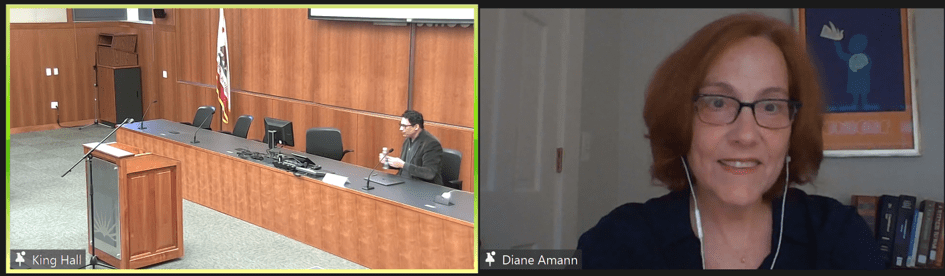
Georgia Law Professor Diane Marie Amann presents on child-taking at Hague event sponsored by Ukraine and Global Rights Compliance

University of Georgia School of Law Professor Diane Marie Amann discussed her research on child-taking at a side event occurring during the 24th annual Assembly of States Parties of the International Criminal Court, held in early December at The Hague in The Netherlands.

Entitled “Vanished Voices: The Plight of Missing Children from Ukraine, Syria and Sudan,” the event was co-sponsored by the government of Ukraine and by Global Rights Compliance, a nongovernmental organization.

In addition to Professor Amann, additional panelists included: Hala Turjman, Independent Institution on Missing Persons in the Syrian Arab Republic: Alla Perfetska, Voices of Children; and Ikhlass Ahmed Altaher Eisa, Strategic Initiatives for Women in the Horn of Africa. Ukraine’s Ambassador to The Netherlands, Andriy Kostin, provided opening and closing remarks, and Wayne Jordash KC, president of the Global Rights Compliance Foundation, moderated the panel.

Amann is Regents’ Professor of International Law, Emily & Ernest Woodruff Chair in International Law, and a Faculty Co-Director of our Dean Rusk International Law Center here at Georgia Law. During her current research-intensive semester, she is an Affiliate Academic at University College London Faculty of Laws.

From 2012 to 2021 Amann served as International Criminal Court Prosecutor Fatou Bensouda’s Special Adviser on Children in & affected by Armed Conflict. Her many publications on international child law include two that analyze the long-standing criminal phenomenon by which a state (or other powerful entity) takes a child and then endeavors to alter, erase or remake the child’s identity. These two articles are  “Child-Taking Justice and the Federal Indian Boarding School Initiative,” 119 American Journal of International Law 629 (2025), and “Child-Taking,” 45 Michigan Journal of International Law 305 (2024).

Georgia Law Professor Diane Marie Amann presents “Child-Taking” at UK’s University of Reading School of Law

University of Georgia School of Law Professor Diane Marie Amann recently gave a public lecture entitled “Child-Taking: Unlawful Transfer plus Identity Alteration, in Ukraine and Beyond,” at the University of Reading School of Law in Reading, United Kingdom, as part of that law school’s Global Law at Reading (GLAR) lecture series.

Her presentation drew upon her just-published article, “Child-Taking,” 45 Michigan Journal of International Law 305 (2024).

Amann is Regents’ Professor of International Law, Emily & Ernest Woodruff Chair in International Law, and a Faculty Co-Director of our Dean Rusk International Law Center here at Georgia Law. This fall, she is spending a research-intensive semester in the United Kingdom, where she is a Research Visitor at the Oxford Faculty of Law Bonavero Institute of Human Rights and Visiting Fellow at Exeter College Oxford.

Georgia Law Professor Diane Marie Amann quoted on proposed aggression tribunal in Portuguese paper

Professor Diane Marie Amann recently was featured in Expresso, a newspaper based in Lisbon, Portugal, regarding efforts to hold Russian officials accountable for the war in Ukraine.

The May 10 article entitled “Conselho da Europa quer julgar agressão russa num tribunal especial: é desta que Moscovo vai pagar a fatura da guerra?” – in English, “The Council of Europe Wants to Judge Russian Aggression in a Special Court: Is this How Moscow Will Pay the Bill for the War?” – was written by Mara Tribuna.

Reviewing various obstacles to these efforts, Tribuna quoted Amann as follows (in translation):

“One question, obviously, is whether this court will be able to arrest the accused leaders,” acknowledges Diane Marie Amann. Still, she points out, “this is a challenge in all criminal cases, and the magnitude of the challenge should not impede the effort to ensure justice.”

Recalling the March 17, 2023, arrest warrants issued by the International Criminal Court against Russian President Vladimir Putin and his Children’s Rights Commissioner Maria Lvova-Belova (about which Amann has written here), Tribuna wrote:

Although neither has been detained – which highlights the challenge that any legal system faces when trying to guarantee justice while the conflict is ongoing – the decision had effects, considers Amann. “It raised public awareness about the criminal allegations and encouraged states and civil society actors to call for the return of children.”

Amann is Regents’ Professor of International Law, Emily & Ernest Chair in International Law, and Faculty Co-Director of the Dean Rusk International Law Center here at the University of Georgia School of Law. She writes and teaches in areas including transnational and international criminal law, child and human rights, constitutional law, and global legal history.

Georgia Law professors, alumna, students take part in annual meeting of American Society of International Law

Many members of the University of Georgia School of Law community – professors, alumna, and students – took part in last week’s 117th Annual Meeting of the American Society of International Law, the theme of which was “The Reach and Limits of International Law to Solve Today’s Challenges.”

The annual meeting took place Wednesday-Saturday at several venues in Washington, D.C.

Representatives of Georgia Law, an ASIL Academic Partner, included three scholars affiliated with the law school’s Dean Rusk International Law Center:

The Center’s Director, Melissa J. “MJ” Durkee, who is also Associate Dean for International Programs and Allen Post Professor, moderated a panel entitled “How Does International Law Change? Theories and Concepts of Legal Change.” (photo top row left) It was sponsored by ASIL’s International Legal Theory Interest Group, for which Durkee serves as Chair. Panelists were: Benedict Kingsbury, New York University; Nico Krisch, Graduate Institute of International and Development Studies in Geneva; and Sivan Shlomo Agon, Bar-Ilan University.

Durkee additionally serves on the ASIL Executive Council and the Board of Editors of the American Journal of International Law, and took part in the meetings of both those groups.

Diane Marie Amann, Regents’ Professor of International Law, Emily & Ernest Woodruff Chair in International Law, and one of our Center’s Faculty Co-Directors (above second from left), took part in a late-breaking panel, “ICC Arrest Warrant Against Putin: Impunity in Check?” (photo above left) Amann, an international child law expert and former Special Adviser to the International Criminal Court Prosecutor on Children in & affected by Armed Conflict, spoke on the significance of the fact that crimes against children form the basis of the international arrest warrant issued March 17 against the President and the Children’s Rights Commissioner of Russia. Additional panel participants were: Javier Eskauriatza, University of Nottingham; Marko Milanovic, University of Reading; Saira Mohamed, University of California-Berkeley; and moderator Katherine Gallagher, Center for Constitutional Rights. Panel video here.

Amann also attended the ASIL Executive Council meeting, completing her term as an ASIL Counsellor.

Harlan G. Cohen, Gabriel M. Wilner/UGA Foundation Professor in International Law and Faculty Co-Director of the Dean Rusk International Law Center, took the ASIL General Assembly stage: in his capacity as Chair of the 2023 Book Awards Committee, he co-presented those honors to numerous authors. (photo top row right, from left to right: ASIL President Greg Shaffer, honoree Damilola Olawuyi, ASIL Executive Director Michael Cooper, and Cohen; video 27:09)

Like Durkee, Cohen is a member of the AJIL Board of Editors and took part in the journal’s meeting. The annual meeting completed his service as Chair of ASIL’s International Legal Theory Interest Group.

A distinguished Georgia Law graduate also was featured:

Tess Davis (JD 2009), who is the Executive Director of the D.C.-based Antiquities Coalition and Dean Rusk International Law Center Council member, served as moderator for a session at the Smithsonian National Museum of Asian Art. (photo above right) Entitled “Protecting Cultural Heritage in Conflict Zones: Multi-Disciplinary Approaches,” the discussion also included: Patty Gerstenblith, DePaul University; Brooke Cuven, Cerberus Capital Management; Richard Kurin, Smithsonian Institution; and Zaydoon Zaid, American Foundation for Cultural Research.

Rounding out the contingent were four Georgia Law students, who received Louis B. Sohn Professional Development grants to serve as volunteers at the meeting: 2L Hao Chen “Bobby” Dong, 3L Collin Douglas, LLM candidate Alexandra Lampe, and 1L Mahi Patel.
Georgia Law Prof Amann presents on children and peace agreements at California-Davis Law symposium

Georgia Law Professor Diane Marie Amann spoke on “Children, Armed Conflict, and Peace Agreements” Friday in a hybrid symposium at the University of California, Davis, School of Law.

Amann, who is Regents’ Professor of International Law, Emily & Ernest Woodruff Chair in International Law, and Faculty Co-Director of the Dean Rusk International Law Center here at the University of Georgia School of Law, gave an online presentation, as part of a panel on “Human Rights and Social Justice in the International Sphere,” which also featured Wadie E. Said, who is the Miles and Ann Loadholt Professor of Law at the University of South Carolina School of Law. Their talks were part of “Justice in War and Conflict: The Role of International and Humanitarian Law,” this year’s annual symposium of the University of California, Davis, Journal of International Law and Policy.

Professor’s Amann’s talk drew upon her research into children and peace settlement options. This research initially was conducted for a project at the Lauterpacht Centre for International Law, University of Cambridge, England, and subsequently was published as “International Child Law and the Settlement of Ukraine-Russia and Other Conflicts,” 99 International Law Studies 559 (2022). (prior posts available here)

The symposium took place on the one-year anniversary of the ongoing war which began with Russia’s invasion of Ukraine – a fact that Professor Amann noted even as she stressed that the findings of her research are applicable to settlement of any armed conflict or similar instance of extreme and protracted violence,

Georgia Law Professor Diane Marie Amann interviewed on international law and developments in Ukraine-Russia war

An international law analysis by Georgia Law Professor Diane Marie Amann on recent developments in the Ukraine-Russia war is quoted in an article published Sunday by Voice of America Russian Service.

The Russian-language article, Юристы по международному праву: аннексия, проведенная Путиным, юридически ничтожна (that is, International Lawyers: The Annexation Carried out by Putin Is Legally Null and Void), was written by Evgenii Komarov. In addition to Amann, who is Regents’ Professor of International Law, Emily & Ernest Woodruff Chair in International Law, and Faculty Co-Director of the Dean Rusk International Law Center here at the University of Georgia School of Law, Komarov interviewed international law professors Lea Brilmayer and Zakhar Tropin, from, respectively, Yale Law School and the Shevchenko National University in Kyiv, Ukraine.

The article related particularly to last week’s assertion by Russian President Vladimir Putin that his country had annexed four regions of Ukraine that Russian troops had occupied in the months following their February 2022 invasion of the country.

Amann analyzed this development in light of international law norms set out in agreements to which Ukraine and Russia both belong, including the 1945 Charter of the United Nations, the 1949 Geneva Conventions, and human rights treaties. She also discussed the potential for accountability and international pressure, through, for instance, economic sanctions and geopolitical isolation, UN treaty bodies on human rights and anti-discrimination, the International Criminal Court, and proposals for a special tribunal.

Komarov wrote:

“The effectiveness of international law ‘depends on political will, and I think that the countries that make these decisions weigh the benefits and costs,’ states Diane Marie Amann. This leads to the fact that justice is moving very slowly.”

Georgia Law Professor Amann publishes “International Child Law and the Settlement of Ukraine-Russia and Other Conflicts” in International Law Studies

Georgia Law Professor Diane Marie Amann has published, in the century-old, peer-reviewed international law journal of the U.S. Naval War College, an article analyzed international child law in order to imagine ways that peace processes may engage with children and ensure that children’s issues are addressed in future peace agreements.

Entitled “International Child Law and the Settlement of Ukraine-Russia and Other Conflicts,” the article appears at 99 International Law Studies 559-601 (2022) and is available here.

Amann, who is Regents’ Professor of International Law, Emily & Ernest Woodruff Chair in International Law, and Faculty Co-Director of the Dean Rusk International Law Center here at the University of Georgia School of Law, she served from 2012 to 2021 as the Special Adviser to the International Criminal Court Prosecutor on Children in & affected by Armed Conflict.

She undertook research on this topic while a Visiting Academic at University College London this past summer. An earlier version of her research forms part of the Ukraine Peace Settlement Project of the Lauterpacht Centre for International Law at the University of Cambridge in the United Kingdom. (prior post)

Here’s the abstract for Amann’s just-published article:

The Ukraine-Russia conflict has wreaked disproportionate harms upon children. Hundreds reportedly were killed or wounded within the opening months of the conflict, thousands lost loved ones, and millions left their homes, their schools, and their communities. Yet public discussions of how to settle the conflict contain very little at all about children. This article seeks to change that dynamic. It builds on a relatively recent trend, one that situates human rights within the structure of peace negotiations, to push for particularized treatment of children’s experiences, needs, rights, and capacities in eventual negotiations. The article draws upon twenty-first century projects that examine the lives of children in armed conflict by synthesizing international child law. The projects’ syntheses have influenced the work of certain international organizations bodies but not, to date, the work of peace settlements.

To demonstrate their relevance to conflict resolution, the article first outlines two syntheses by the United Nations and by the International Criminal Court Office of the Prosecutor. After mapping child rights and conflict harms, it examines the treatment of children in Colombia’s 2016 peace agreement and a 1999 agreement related to Sierra Leone. The article concludes by proposing child-inclusive options for peace processes and eventual peace agreements.

While Visiting Academic at University College London, Georgia Law Professor Amann presents “No Exit at Nuremberg”

Georgia Law Professor Diane Marie Amann gave a presentation yesterday at University College London Faculty of Laws, where she is a Visiting Academic for all of Summer 2022.

Her talk, entitled “No Exit at Nuremberg: The Postwar Order As Stage for 21st-Century Global Insecurity” (video here) drew upon her research on participants at the post-World War II International Military Tribunal, as well as an existentialist play written toward the end of that long war. The talk investigated the relationship of international criminal justice to security with particular reference to the ongoing Ukraine-Russia conflict.

Amann is Regents’ Professor of International Law, Emily & Ernest Woodruff Chair in International Law, and Faculty Co-Director of the Dean Rusk International Law Center here at the University of Georgia School of Law (she is pictured above at the right of the table). Chairing her talk in London yesterday, and moderating questions from in-person and online attendees was Dr. Martins Paparinskis (above left), a Reader in Public International Law at UCL who recently was elected to an upcoming term on the United Nations’ International Law Commission.

Georgia Law Professor Amann joins panel on paths to accountability in conference cosponsored by law schools at Notre Dame and Ukrainian Catholic universities

Diane Marie Amann, who is Regents’ Professor of International Law, Emily & Ernest Woodruff Chair in International Law, and Faculty Co-Director of the Dean Rusk International Law Center here at the University of Georgia School of Law, spoke yesterday at “Legal Challenges Posed by the Large-Scale Russian Invasion of Ukraine,” a conference cosponsored by the University of Notre Dame Law School and the Ukrainian Catholic University Law School.

The latter university is located in Lviv, Ukraine – also the birthplace of the late Louis B. Sohn, who was the inaugural holder of Georgia Law’s Woodruff Chair in International Law.

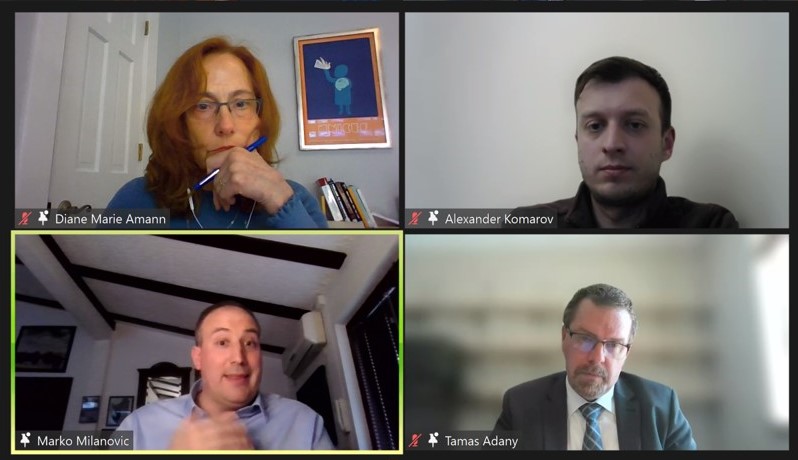
Professor Amann took part in a panel entitled “Prosecution,” along with Marko Milanovic, Professor of Public International Law at the University of Nottingham School of Law in the United Kingdom and Oleksandr Komarov of the Ukrainian Catholic University Law School. Moderating was Tamás Ádány, Fulbright Visiting Professor at Notre Dame Law this semester, and also Head of the Department of International Law at Pázmány Péter Catholic University in Budapest, Hungary.

Discussed in their panel were legal frameworks and forums that hold potential for providing measures of accountability for violations of international law reported since Russia’s February 24, 2022, invasion of Ukraine. These include the illegal resort to armed force – that is, the crime of aggression – as well as atrocity crimes committed once the armed conflict had begun. (Related prior posts here, here, here, and here.)

Participants in the online conference’s two other panels examined additional aspects of the Ukraine-Russia conflict; namely, challenges to the collective security structure, and the use of economic sanctions by states and international organizations.

Georgia Law Professor Amann post proposes considering new war crimes commission to investigate in Ukraine

Referring to Russia’s invasion last month of Ukraine, as well as the brutal attacks that followed, Georgia Law Professor Diane Marie Amann published “Time for a New War Crimes Commission?” Friday at Articles of War, the blog of the Lieber Institute for Law & Warfare, U.S. Military Academy West Point.

Amann, who is Regents’ Professor of International Law, Emily & Ernest Woodruff Chair in International Law, and Faculty Co-Director of the Dean Rusk International Law Center here at the University of Georgia School of Law, began by outlining the limitation that international law rules place on existing tribunals, such as the International Criminal Court, International Court of Justice, and European Court of Human Rights, as well as a proposed special tribunal on the crime of aggression. Having thus identified gaps in accountability, she wrote:

“Now and going forward, accountability could be enhanced by setting up a clearinghouse for gathering, cataloging, and preserving evidence, with an aim to eventual prosecutions in multiple national, regional, and international systems. The idea is not new; indeed, a useful model may be found in a Second World War-era institution known as the United Nations War Crimes Commission (UNWCC).”

Her post proceeded to sketch the history of this 1943-1948 commission, as well as its strengths and weaknesses. She concluded by calling for a body that would be empowered to carry out the UNWCC’s “core function”:

“specifically, the conduct of investigations aimed at preserving evidence and facilitating criminal prosecutions of suspects at all levels, for all potential offenses, and before any number of national, regional, and international systems willing and able to afford the persons they accuse a full and fair trial.”

The full Articles of War post is here.