Sloan was joined in conversation by two of the law school’s professors: Nathan S. Chapman, Pope F. Brock Professor of Law; and Diane Marie Amann, who is Regents’ Professor of International Law, Emily & Ernest Woodruff Chair in International Law, and the Center’s Faculty Co-Director.
By the summer of 1941, in the ninth year of his presidency, Franklin Roosevelt had molded his Court. He had appointed seven of the nine justices—the most by any president except George Washington—and handpicked the chief justice.
But the wartime Roosevelt Court had two faces. One was bold and progressive, the other supine and abject, cowed by the charisma of the revered president.
The Court at War explores this pivotal period. It provides a cast of unforgettable characters in the justices—from the mercurial, Vienna-born intellectual Felix Frankfurter to the Alabama populist Hugo Black; from the western prodigy William O. Douglas, FDR’s initial pick to be his running mate in 1944, to Roosevelt’s former attorney general and Nuremberg prosecutor Robert Jackson.
The justices’ shameless capitulation and unwillingness to cross their beloved president highlight the dangers of an unseemly closeness between Supreme Court justices and their political patrons. But the FDR Court’s finest moments also provided a robust defense of individual rights, rights the current Court has put in jeopardy. Sloan’s intimate portrait is a vivid, instructive tale for modern times.
Sloan joined Georgetown – where he teaches constitutional law, criminal justice, and death penalty litigation – following a distinguished legal career, in all three branches of the federal government, at leading law firms, and in-house at the Washington Post. He is also the author of The Great Decision: Jefferson, Adams, Marshall, and the Battle for the Supreme Court, a 2009 history of the Court’s foundational decision in Marbury v. Madison.
University of Georgia School of Law Professor Diane Marie Amann was featured in The Wall Street Journal regarding the recent order of the International Court of Justice in the Genocide Convention case which South Africa has filed against Israel.
After reporting the opinion of Utah Law Professor Amos Guiora , that both parties won something, and that, in the words of the article, “Israel avoided a legal ruling that would force it either to stop military operations or defy the world court,” Bravin then wrote:
Still, the conduct of the Gaza campaign received no pass, said Diane Marie Amann, an international-law professor at the University of Georgia. ‘Israel will need to adjust if it wishes to comply with the court’s order,’ she said.
Amann is Regents’ Professor, Emily & Ernest Woodruff Chair in International Law, and Faculty Co-Director of the Dean Rusk International Law Center here at the University of Georgia School of Law. She teaches and publishes regularly on matters relating to international law.
Christopher M. Bruner, Stembler Family Distinguished Professor in Business Law and Faculty Co-Director of the Dean Rusk International Law Center, presented his working paper, “Prospects for a US Value Chain Due Diligence Law,” at a conference hosted by Tilburg Law School in the Netherlands titled “Connecting Responsible Organizations: Legal Strategies for Sustainability in Global Value Chains.”
Bruner participated in the panel titled “Sustainable corporate governance and tax transparency.” The conference, hosted by Tilburg’s Department of Private, Business & Labour Law, aimed to provide a platform for legal experts to discuss environmental and social sustainability challenges in global value chains.
Prior posts on Bruner’s scholarship can be found here.
Vyas: I enjoyed Complex Litigation with Professor Elizabeth Burch. It was a challenging course, but Professor Burch is amazing. She has so much knowledge about the topic and structured the class around discussion so that we were all able to learn together. I also enjoyed hearing from two judges who were guest speakers.
Menon: It’s hard to pick, but before UGA Law, I never had the opportunity to learn about the field of privacy law. I enjoyed Global Data Privacy in Practice with Professor Joe Kaufmann. This is a field that I will continue to explore when I return to India.
What was the most surprising or unexpected aspect of law school in the United States?
Vyas: I was so impressed by the time management skills of my peers. One of the best pieces of advice that I received was from a 2L who recommended that I do my assigned readings daily rather than letting them accumulate, since it is very difficult to catch up. At JGLS, we of course have assigned readings, but there are smaller assessments throughout the semester that assist you with structuring your time. Here, since grades are only based on the final exams, you have to manage your assignments and your time independently of those benchmarks.
Menon: I was surprised by the fact that law school is a self-taught environment, which I experienced firsthand in my classes. Students teach themselves the material throughout the semester, and their understanding is perfected by the professors in classes. This is a markedly different approach than the pedagogical approach in Indian law schools, where I would describe the classroom experience as being more guided by the professor. At UGA Law, professors treat students as professionals right, and I think that this learning environment helped me to grow both as a law student and as a person.
What was your favorite thing about living in Athens?
Vyas: Being from New Delhi, India, I would consider myself to be a big city person. However, I fell in love with the small-town vibe of Athens. It has such a unique character and sense of community, especially on football game days and for community events like the Wild Rumpus. Everyone in Athens is also incredibly warm and welcoming.
Menon: The best thing about Athens is that it is a town full of life and character. The transformation of Athens on gamedays was something that I have never seen before. I loved the culture around college football here and how it is something that is enjoyed across generations. For example, when I was walking around campus during a home game, I came across so many families dressed up in their UGA gear and with faces painted, all equally enthusiastic about cheering on the Dawgs. In India, this sort of team spirit for professional sports is usually limited to young adults. It was refreshing and fun to see it be shared among young and old alike here in Athens.
What will you tell your JGLS classmates about your semester at UGA Law?
Vyas: The education is very challenging and helped me to break out of my comfort zone in so many ways. I would tell them that if they are seeking a challenge and opportunities for personal, academic, and professional growth, they should participate in a semester-long exchange at UGA Law.
Menon: I would tell them that academically, they will have access to incredible faculty and courses at UGA Law. Of course, the experience will be difficult, but it will be worth it. I also think that there are a lot of similarities between JGLS and UGA Law that will lessen the transitional period and will help students to maximize their time here on campus. Everything from the climate to the academic rigor is similar.
What would you like UGA Law students to know about JGLS?
Vyas: If you participate in a semester-long exchange at JGLS, you’ll have access to a wide range of courses. It’s a great place to expand your academic horizons and get a non-western perspective on legal topics. You’ll also have the opportunity to make life-long connections with students and faculty who themselves have global networks and communities. It will definitely be a cultural adjustment, but people will be very welcoming and it will be such a worthwhile experience for on all levels.
Menon: Western culture is very different from Indian or Asian culture. JGLS offers a sweet spot between the two: it is an Indian community that is very international and inclusive. I think it is the perfect opportunity for an American student to experience and learn about India and its legal system while still retaining many touchpoints of familiarity. Like our exchange experience here in the United States, it will be an opportunity for incredible growth.
* * * *
The University of Georgia School of Law offers a semester-long international exchange for J.D. students with our institutional partner, O.P. Jindal Global Law School. This exchange offers students access to a wide range of international law courses and professors, as well as unique professional development opportunities. This immersive placement allows students to take courses in English while living on campus and becoming part of an international law community. Through the tuition-exchange model, students pay their regular tuition to UGA Law for the semester, in addition to a small pre-determined fee by JGLS.
UGA Law is now accepting applications for students interested in spending the fall 2024 semester at JGLS. For more information about the exchange program, please visit our website.
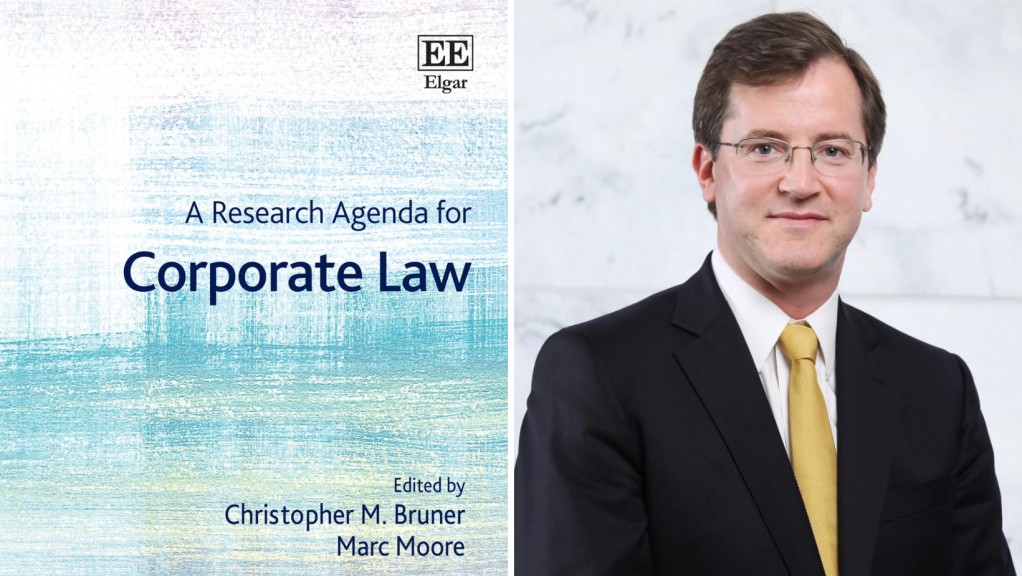
Christopher M. Bruner, Stembler Family Distinguished Professor in Business Law and Faculty Co-Director of the Dean Rusk International Law Center, recently co-edited the book A Research Agenda for Corporate Lawwith Marc Moore, Professor of Corporate/Financial Law, University College London Faculty of Laws.
This timely Research Agenda explores key dynamics and cutting-edge developments within corporate law. Bringing together a diverse range of scholars hailing from different jurisdictions, ideological perspectives, and methodological backgrounds, it provides a roadmap for future research in the field.
Through the investigation of different doctrinal and normative issues, leading scholars consider how evolving conceptual foundations, capital markets, social and cultural contexts, and technologies may impact corporate law and governance research. Ground-breaking contributions examine the increasingly global nature of corporate production and investment markets and the influence this has on the wider dynamics in the field, suggesting new directions for navigating this complex and fascinating terrain.
Students and scholars of corporate law, corporate governance, and law and business will value the innovative ideas unpacked in this state-of-the-art Research Agenda. Its forward looking and practical insights will also benefit practitioners and policymakers in corporate law, corporate governance, sustainability, and business law.
Prior posts on Bruner’s scholarship can be found here.
The Washington International Trade Association (WITA) hosted two panels last month to discuss changing attitudes toward trade in the 250 years since the Boston Tea Party. Taking part in the panel was University of Georgia School of Law alumnus and Director Emeritus of the law school’s Dean Rusk International Law Center, Ambassador C. Donald Johnson.
The two panels addressed the evolution of trade policy, trade’s present and future, and the role of the United States as a leader in global trade. The first panel (recording here), moderated by Edward Alden, Ross Dist Visiting Professor at Western Washington University and Bernard L. Schwartz senior fellow at the Council on Foreign Relations (CFR), featured the following speakers:
Elizabeth Baltzan, Senior Advisor, Office of the United States Trade Representative
Wendy Cutler, Vice President, Asia Society Policy Institute (ASPI), and Managing Director of the Washington, D.C. office; former Acting Deputy United States Trade Representative
Ambassador Donald Johnson, Director Emeritus, Dean Rusk Center for International Law and Policy, University of Georgia; former Chief Textile Negotiator, Office of the United States Trade Representative
Johnson’s comments contextualized the attitude towards trade during the era of the Boston Tea Party. He discusses the historical conflict between trade and labor, with roots in the Jefferson and Hamilton political philosophies, and moves through the industrialization of the 19th century.
Johnson’s book The Wealth of a Nation: a History of Trade Politics in America (Oxford University Press 2018) presents a history of trade politics from the 1790s through the Trump administration. He received the 2019 Certificate of Merit for High Technical Craftsmanship and Utility to Lawyers and Scholars (Honorable Mention) at the 113th American Society of International Law Annual Meeting, detailed in our previous post here.
Johnson served from 1998 to 2000 as Ambassador in the Office of the United States Trade Representative, and then specialized in international trade law as a partner at the Washington law firm Patton Boggs. Additionally, while serving from 1993 to 1995 as a U.S. Representative on behalf of Georgia’s 10th District, Johnson focused on national security and international economic policy, including legislation implementing North Atlantic Free Trade Agreement and the World Trade Organization. Johnson served as an Articles Editor for that journal while a student at the University of Georgia School of Law, from which he earned his J.D. in 1973. Thereafter, he studied at the London School of Economics and Political Science, earning an LL.M. degree in International Economic Law and International Relations.
Administered through UGA Law’s Dean Rusk International Law Center, postgraduate students from other disciplines within the university will earn this academic certificate following their successful completion, in classes alongside J.D., LL.M., and M.L.S. students, of fifteen credit hours chosen from among the law school’s rich comparative, transnational, and international law curriculum; courses include Public International Law, International Human Rights, International Trade Law, Immigration Law, International Law Colloquium, and Global Governance.
Joining the law school’s first two cohorts (introduced here and here), this third class of seven students includes:
Five doctoral students, including: Madina Bekisheva and Elizabeth Stark, both a Ph.D. students in the School of Public and International Affairs studying Political Science and International Affairs; Nathanael Mickelson and Hao Yang, both Ph.D. students in the Franklin College of Arts & Sciences, studying History and Geography, respectively; and Anastasia Marx, a Ph.D. student in the School of Engineering, studying Biomedical Engineering.
Two master’s students, including: Emilio Suarez Romero, a graduate student in the College of Agricultural and Environmental Sciences, who is pursuing a Master of Science in Horticulture, and Michael Williams, a graduate student in the School of Public and International Affairs, who is pursuing a Masters of Public Administration.
All information about the Graduate Certificate in International Law, including upcoming application cycles and upcoming virtual information sessions, can be found here.
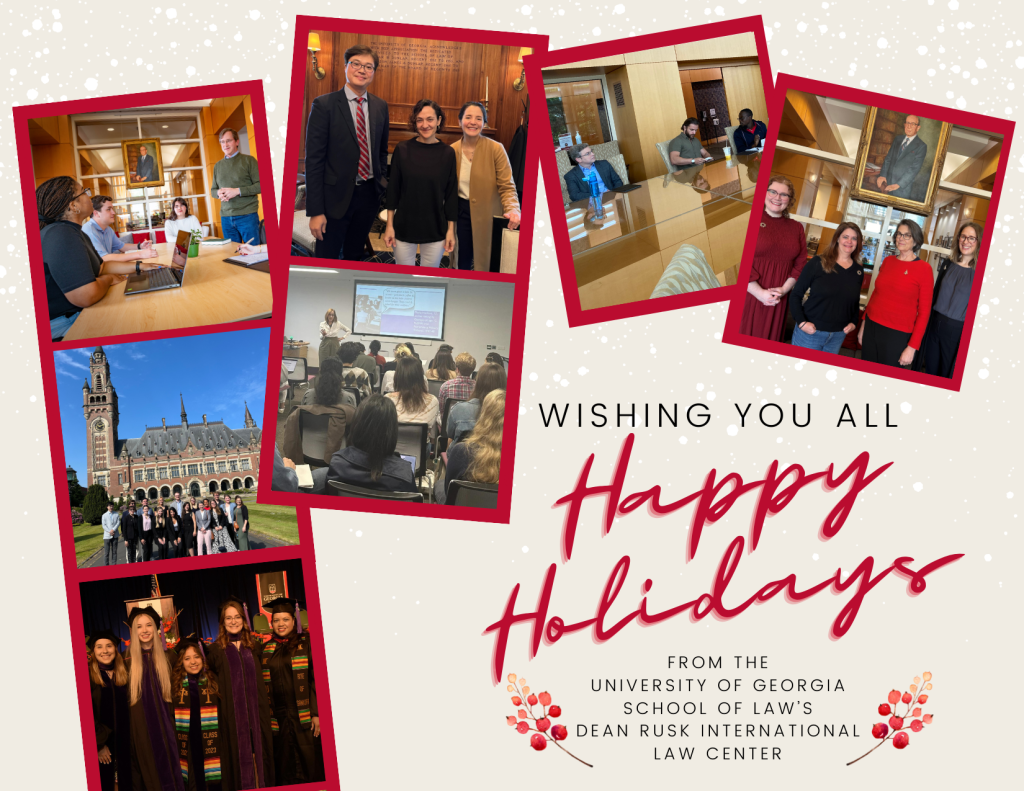
As the end of 2023 approaches, we at the University of Georgia School of Law’s Dean Rusk International Law Center want to express our gratitude. It has been a busy year full of global engagement, research, education, and service, all of which was made possible by the support of faculty, students, staff, alumni/ae, institutional partners, and friends across the globe.
If you would like to be regularly updated on our Center’s work in 2024, we invite you to subscribe to our Exchange of Notes blog and to our bi-weekly Center newsletter, which you can be added to by emailing: ruskintlaw@uga.edu
Wishing you and yours a joyful holiday season and a happy new year.
Christopher M. Bruner, Stembler Family Distinguished Professor in Business Law and Faculty Co-Director of the Dean Rusk International Law Center, recently presented working papers in Canada and Sweden.
He presented “Corporate Governance and Sustainability Incentives” at a conference titled “Addressing the Sustainability Impacts of Corporations” in October. The conference was hosted by the Nathanson Centre on Transnational Human Rights, Crime and Security at the Osgoode Hall Law School (York University) in Toronto.
Bruner also presented “Corporate Personhood, Corporate Rights, and the Contingency of Corporate Law” at “Decoding the Rights of Companies in the Technocene,” a conference hosted in December by the Lund University Faculty of Law in Lund, Sweden.
Bruner’s scholarship focuses on corporate law, corporate governance, comparative law and sustainability. He is a research member of the European Corporate Governance Institute (ECGI) and has presented his work in numerous countries around the world.
Distinguished Research Professor & Shackelford Distinguished Professor in Taxation Law Emeritus Walter Hellerstein co-presented a paper on the value added taxation of crypto-assets at the Organisation for Economic Co-operation and Development (OECD) Working Party No. 9 on Consumption Taxes in Paris, France, in November.
The Working Party No. 9 on Consumption Taxes is a forum for the discussion of consumption tax policy and administration, working with both Members and non-Members of the OECD to develop appropriate and effective taxation outcomes.
Hellerstein, a recipient of the National Tax Association’s Daniel M. Holland Medal for outstanding lifetime contributions to the study and practice of public finance, is widely regarded as the nation’s leading academician on state and local taxation. He has authored numerous books, textbooks, and law review articles, and has practiced extensively in the field. Hellerstein is currently a Visiting Professor at the Vienna University of Economics and Business, and he remains actively involved in his scholarship, consulting, and, in particular, his work as an academic advisor to the OECD.