Christopher Bruner, the Stembler Family Distinguished Professor in Business Law here at the University of Georgia School of Law, presented his scholarship at a conference on “The Future of the Firm” held last Friday in London.
Professor Bruner’s presentation was entitled “Distributed Ledgers, Artificial Intelligence, and the Purpose of the Corporation.”
Among the other speakers were scholars from the University of Oxford, University of Cambridge, University College London, and Loyola Law School-Los Angeles.
LEUVEN – Today marks the final day of classroom sessions of the Georgia Law – Leuven Global Governance School, and the final day students will be resident in Leuven. Students took part in three sessions, which focused on business and human rights, international security governance, and concluded with an overview of challenges to international law and global governance.
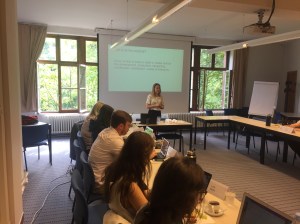
First, Dr. Axel Marx (left), Deputy Director of the Leuven Centre for Global Governance Studies, presented on business and human rights. After examining several case studies in which corporate activities adversely affected human rights, participants learned how supply chain and corporate governance structures can affect a business’ ability to manage human rights. Dr. Marx introduced key global governance instruments, such as the United Nations Guiding Principles on Business and Human Rights, that can be used to hold states and corporations accountable for human rights violations.
Second, Kathleen Doty (right), Director of the Dean Rusk International Law Center at University of Georgia School of Law, led an interactive session on global security governance. Professor Doty introduced students to global security governance, including international humanitarian law and arms control law. She explained the development of this body of law, focusing on arms control agreements, and introduced several major regimes and their common features. The students then participated in an exercise; faced with a global security crisis, students were tasked with addressing it via treaty negotiation, illustrating the difficulty of international cooperation.
The final session of the day provided an overview of international perspectives on and challenges to global governance, conducted by Professor Dr. Jan Wouters (left), Director of the Leuven Center for Global Governance Studies and the Co-Director of the Global Governance Summer School. Professor Wouters explained the history of globalization and the increase of economic, environmental, and human interdependence. He then explored challenges to the international system, such as anti-globalism, nationalism, and populism.
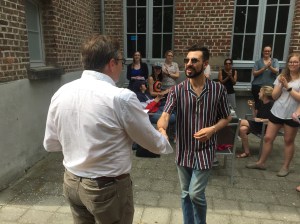
Student Ayman Tartir receives his diploma from Axel Marx.
Closing out a successful week of studies, students and faculty gathered at the Leuven Institute for Ireland in Europe for a concluding reception. Axel Marx and Kathleen Doty presented participants with attestations of completion.
Tomorrow, students from the University of Georgia School of Law will travel to The Hague, where they will visit international tribunals and organizations.
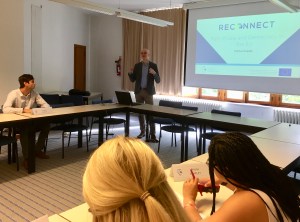
LEUVEN & BRUSSELS – The morning opened with an introduction to the European Union, presented by Michal Ovadek, a research fellow at the Leuven Centre for Global Governance Studies. An expert in the European Union legislative process, he provided an overview of the European Union architecture, and outlined the primary challenges to democracy in Europe. The session was designed to prepare students to participate fully in the rest of the day’s activities: a conference devoted to a research project aimed at reinvigorating core values of the European Union.
From left, Gamble Baffert, Charles Wells, Leila Knox, Emily Doumar, Maria Lagares Romay, Blanca Ruiz Llevot, Steven Miller, Alicia Millspaugh, and Briana Blakely.
The RECONNECT: Reconciling Europe with its Citizens through Democracy and the Rule of Law project, established by the Leuven Centre for Global Governance Studies, is supported by funds from the EU’s Horizon 2020 Research & Innovation programme. As part of the larger project, the Leven Centre convened the International Conference on Democracy and the Rule of Law in the EU. It gathered experts to discuss contemporary challenges to European Union integration, including judicial independence and rule of law, free press, and democratic institutions in countries like Poland and Hungary.
The conference featured keynote remarks by Daniel Keleman, Professor of Political Science and Law and Jean Monnet Chair in European Union Politics at Rutgers University, and Koen Lenaerts, President of the Court of Justice of the European Union (right). Two policy roundtables also featured perspectives from academics and advocates from around Europe on democracy and rule of law in the European Union, respectively.
From left, Kathleen Garnett, Holly Stephens, Steven Miller, Alicia Millspaugh, Emily Snow.
LEUVEN – After a full day of professional development briefings yesterday, students at the Georgia Law-Leuven Global Governance School returned to the classroom today. They took part in four lectures exploring developments in climate change and international commerce:
First, Professor Katja Biedenkopf (right), Assistant Professor at Leuven International and European Studies (LINES) at KU Leuven and an expert in European Union environmental and climate policy, addressed climate change. She focused on the international instruments at play, in particular the Paris Agreement. Professor Biedenkopf also highlighted challenges to climate change governance and encouraged students to consider international, regional, and local solutions.
Second, Peter B. “Bo” Rutledge (left), Dean of the University of Georgia School of Law, provided an introduction to international dispute resolution. He led students through a hypothetical cross-border dispute, thereby introducing the architecture of the international dispute resolution framework. He highlighted the differences between arbitration, mediation, and litigation.
Georgia Law professor Usha Rodrigues (right), provided the final two lectures of the day. A corporate governance scholar, she first provided an overview of international economic law and trade, and covered topics such as finance, international monetary policy, investment, tax, and transnational business transactions. She closed the afternoon with an exploration of comparative corporate governance, including how rules have developed across states, and how conflicts between management and shareholders or between majority and minority shareholders are resolved in different contexts.
Tomorrow, students will participate in an international conference on democracy and the rule of law in the European Union, as part of the RECONNECT project. In the meantime, they’ll spend the evening celebrating the 4th of July as expats in Belgium.
BRUSSELS – Students taking part in the Global Governance Summer School went to Brussels today for professional development briefings. They were exposed to a range of practice areas, from non-governmental organization advocacy, to intergovernmental work, to private law practice.
The day began with a visit to the Unrepresented Nations and Peoples Organization (UNPO). There, students were treated to a dialogue on human rights lawyering with Ralph J. Bunche (left), UNPO General Secretary and Professor Diane Marie Amann. They discussed the work of the organization — advocating for the self-determination of unrepresented peoples and nations — and the day-to-day work of advocacy in a human rights organization.
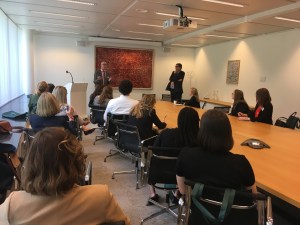
Next, the group traveled to the new headquarters of the North Atlantic Treaty Organization (NATO). Steven Hill (fifth from the right, at right), Legal Adviser and Director of the Office of Legal Affairs, took students on a tour of the facility and provided an overview of the work of the Legal Office at NATO. He particularly focused on the text of the North Atlantic Treaty, emerging technologies, and contemporary challenges to the NATO alliance.
Finally, students heard from David Hull (JD ’83) and Porter Elliot (JD ’96) (left), partners at Van Bael & Bellis about private law practice in Brussels. They discussed the practice areas of the firm – primarily European Union competition law and trade law. They shared candid career advice with students, including their personal stories of going from law school in Athens, Georgia to law practice in Brussels.
The day concluded with a reception, graciously hosted by Van Bael & Bellis. The second annual Friends of the Dean Rusk International Law Center Reception, we were pleased to reconnect with alumni/ae and other European partners of the Center.
Tomorrow, the students will return to the classroom, and celebrate the 4th of July deepening their understanding of international law.
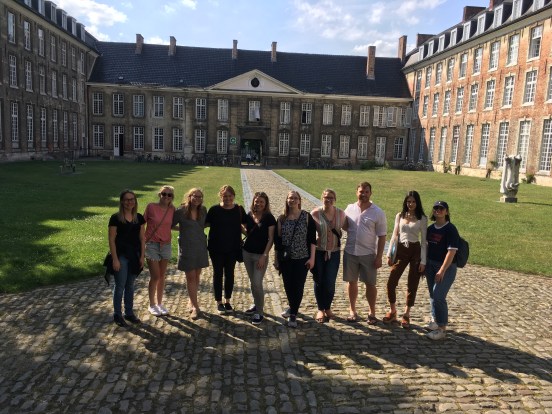
Students and faculty arrived yesterday, and were treated to a walking tour of historic Leuven and the lovely campus, one of the oldest in Europe and one of Europe’s premier research institutions. The historic European heat wave has broken, and students enjoyed the spring-like temperatures and a friendly Flemish welcome.
Many GGSS students participated in a walking tour of KU Leuven. From left, Professor Doty, Holly Stephens, Lauren Taylor, Emily Snow, Center Associate Director Amanda Shaw, Alicia Millspaugh, Jessica Parker, Steven Miller, Maria Lagares Romay, and Blanca Ruiz Llevot.
Today, students from Georgia Law and a range of other European institutions spent the day in classroom sessions. Following a welcome by Dr. Axel Marx, Deputy Director at the Leven Centre for Global Governance Studies, and Professor Diane Marie Amann, Emily & Ernest Woodruff Chair in International Law and Faculty Co-Director of both the Dean Rusk International Law Center and the Global Governance Summer School, students dove headfirst into contemporary international legal topics.
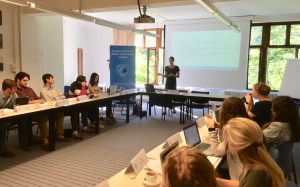
First, Professor Kolja Raube (right), Senior Researcher at the Leuven Centre for Global Governance Studies and Assistant Professor of European Studies, provided an introduction to global governance. He raised issues of globalization, transnational cooperation, and policy-making.
Second, Georgia Law alumnus and expert in the law of the sea, Professor Erik Franckx (LLM ’83) (left) from Vrije Universiteit Brussel, lectured on the Central Arctic Ocean. Addressing fishing in the Central Arctic Ocean, Professor Franckx focused on instruments and actors governing the area.
Third, Professor Geert Van Calster (left) of Leuven and Head of Leuven Law’s department of European and international law, led a discussion on the use of trade law to achieve non-trade objectives, such as human rights and the promotion of sustainable development.
Finally, Professor Diane Marie Amann (right) from the University of Georgia engaged students on regional legal systems. She explored the history, role, and place of regional systems within the larger system comprising nation-states and international organizations with a global scope.
This evening, students will take in the England-United States semi-final match of the Women’s World Cup. Tomorrow, they will travel to Brussels, Belgium’s nearby capital, for a day of professional development briefings at international organizations and a private law firm.
Peter B. “Bo” Rutledge, Dean and Herman E. Talmadge Chair of Law here at the University of Georgia School of Law, has co-authored, with 3L Katherine M. Larsen and Amanda W. Newton (JD’19), a commentary on a recent decision related to international arbitration.
It discusses the content and the implications of Achmea v. Slovakia, a May 2018 decision in which the European Court of Justice ruled a clause in a bilateral investment treaty to be incompatible with European law. Both that decisions and subsequent interpretation of it in European and US courts, the authors state, leaves “more questions than answers at this point.” (Also see prior post.)
“Victors’ Justice and the New Turn to Transnational Process” is the title of a paper that Professor Diane Marie Amann presented earlier this month in England, as part of an Oxford University conference, which took place over the course of 2 days at the Law Faculty’s Bonavero Institute of Human Rights, Mansfield College, and at St. Antony’s College.
Through the lens of the “victors’ justice” critique that some late 20th century scholars used to describe post-World War II trials at Nuremberg and Tokyo, the paper examines contemporary interest in transnational means of prosecuting international crimes.
An expert in international criminal law and human rights, Amann is the Emily & Ernest Woodruff Chair in International Law and Faculty Co-Director of the Dean Rusk International Law Center here at the University of Georgia School of Law. For a portion of 2018, she was a Research Visitor/Visiting Fellow at Bonavero/Mansfield College.
L to r, back row: students Marc Bennett, Steven Miller, Gi Jeong, Lukas Goettke, Spencer Price, Charles Wells, Gamble Baffert; front row, Amanda J. Shaw, an associate director at our Center, with students Emily Snow, Yuke Qiu, Leila Knox, Emily Doumar, Jessica Parker, Briana Blakley, Holly Stephens, Lauren Taylor, Alicia Millspaugh, and Anré Washington.
Fifteen rising 2L and 3L students at the University of Georgia School of Law have set out for summer destinations all across the world as part of our Global Externship Overseas (GEO). Administered by the Dean Rusk International Law Center, the GEO initiative places Georgia Law students in externships lasting from four to twelve weeks, and offers students the opportunity to gain practical work experience in a variety of legal settings worldwide.
These Global Externs will enhance their legal education through summer placements in law firms, in-house legal departments, nongovernmental organizations, and intergovernmental organizations, across Europe, Asia, and the Middle East. Practice areas include: dispute resolution, corporate law, international trade law, intellectual property law, international human rights law, refugee law, and international environmental law.
This year’s GEO class includes these placements in private law settings:
Gamble Baffert (2L) – PwC, Turin, Italy
Briana Blakley (2L) – GÖRG, Cologne, Germany
Emily Doumar (2L) – Araoz y Rueda, Madrid, Spain
Lukas Goettke (3L) – DLA Piper, Moscow, Russia
Gi Jeong (3L) – Al Tamimi, Dubai, United Arab Emirates
Emily Snow (2L) – Van Bael & Bellis, Brussels, Belgium
Holly Stephens (2L) – Maples Teesdale, London, UK
Anré Washington (2L) – Ferrero S.A., Luxembourg
Additionally, the following students will work in public law placements:
Leila Knox (2L) – No Peace Without Justice, Brussels, Belgium
Bailey Meyne (2L) – Open Society Justice Initiative, The Hague, Netherlands
Jessica Parker (2L) – Boat People SOS, Bangkok, Thailand
Charles Wells (2L) – No Peace Without Justice, Brussels, Belgium
In addition to the GEO initiative, thirteen Georgia Law students will take part in our Center’s long-standing summer program in Belgium. During the first week of July, students will gather in Belgium for the Global Governance Summer School, which the Center again co-presents with the Leuven Centre for Global Governance Studies. Students will spend several days in classroom sessions at the University of Leuven, and then spend two days in Brussels: one to attend a high-level policymaking event, and the other on professional development visits at a law firm, a nongovernmental organization, and an intergovernmental organization. The group will then proceed to The Hague, Netherlands, for briefings at international courts and tribunals and other cultural excursions.
Join us in wishing these students an unforgettable summer, and stay tuned for travel updates in the coming months!
Honored to have contributed on the doctrine of command responsibility to the newest edition of ICC Forum, an online publisher of essays on human rights and international criminal law. My essay was one of several responding to this question, posed by the editors:
“What does the Bemba Appeal Judgment say about superior responsibility under Article 28 of the Rome Statute?”
Specifically, it traced the development of the international-humanitarian- law/law-of-armed-conflict-doctrine that places on military commanders a burden greater than that shouldered by other combatants. It then turned to the International Criminal Court Appeals Chamber’s 2018 judgment in Bemba. The majority’s interpretation of the ICC Statute’s command-responsibility provision, my essay argued, risks tolerating “derelictions of duty” so as “to condone indiscipline,” and thus “to increase the risks of the very harms that the doctrine of command responsibility is intended to dispel.” As a result, perhaps “no one can be held to account.”
Other invited experts who contributed essays were: Miles Jackson, Associate Professor of Law, Jesus College, University of Oxford; Michael A. Newton, Professor of the Practice of Law and Political Science at Vanderbilt University Law School; Nadia Carine Fornel Poutou, Executive President Association of Women Lawyers of Central African Republic; and Leila Nadya Sadat, James Carr Professor of International Criminal Law at Washington University School of Law.
ICC Forum is supported by the Promise Institute for Human Rights at UCLA School of Law; UCLA Law Professor Richard H. Steinberg serves as Editor-in-Chief.

 First,
  Second,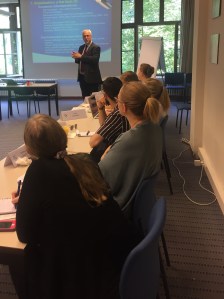
 LEUVEN & BRUSSELS – The morning opened with an introduction to the European Union, presented by
 The conference took place in the Brussels’ beautiful Academy Palace, and opened with a welcome by
  The conference featured keynote remarks by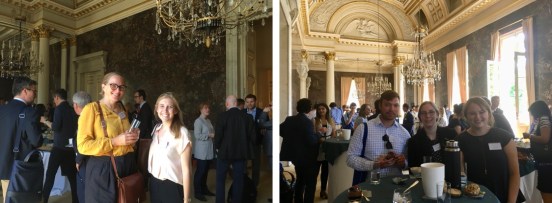
 First, Professor
  Second,
  Georgia Law professor


 First, Professor
  Second, Georgia Law alumnus and expert in the law of the sea, Professor
  Third, Professor
  Finally, Professor
  Peter B. “Bo” Rutledge
 “Victors’ Justice and the New Turn to Transnational Process” is the title of a paper that Professor

 exchange of notes