Georgia Law’s annual Advocate magazine features our Center

SAs_Spr16

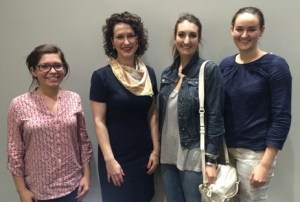
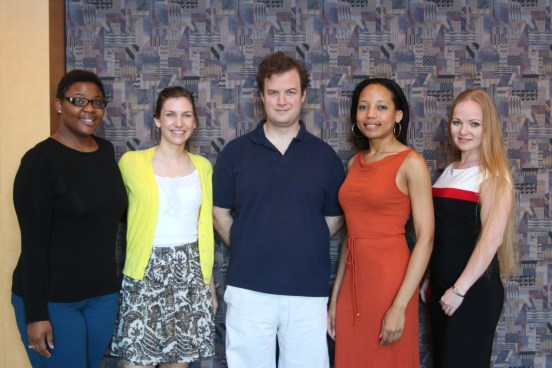
This Spring 2016 photo depicts Pedro Dorado, our Center Fellow, who earned his LLM in 2015 and is a candidate for the Georgia Law JD degree in 2017, and 4 of our Student Ambassadors. At left are Danielle Glover and Taryn Arbeiter, both now 2Ls; at right are Chanel Chauvet, now a 2L, and Olga Gambini, who earned her Georgia Law LLM in 2014 and JD in 2016.

Very pleased that our Dean Rusk International Law Center is featured in the just-released Advocate, the annual magazine of the University of Georgia School of Law. Highlights of the volume include the May 2016 commencement address of alumna Sally Yates, now Deputy Attorney General of the United States, and much more. The article recounting our 2015-16 achievements – “Center undergoes exciting changes” – appears at page 24, along with a version of the photo above. It’s reprinted here in full.

Georgia Law’s 38-year-old Dean Rusk International Law Center continues to expand its collaborative efforts and increase opportunities for both students and faculty to focus on global legal issues.

Led by Associate Dean for International Programs and Strategic Initiatives & Woodruff Chair in International Law Diane Marie Amann, the center itself has a new, modernized look that also acknowledges the rich history of international scholars who have greatly influenced the direction of the law school. Artwork is a focal point, including portraits of former U.S. Secretary of State and Sibley Professor of International Law Emeritus Dean Rusk, the center’s namesake, and the inaugural holder of the Woodruff Chair in International Law, Louis B. Sohn, namesake of the center’s Sohn Library on International Relations.
At an October rededication ceremony, Kannan Rajarathinam (LL.M.’88), who serves as head of office for the United Nations Assistance Mission for Iraq, delivered a keynote address titled “The United Nations at 70: Pursuing Peace in the 21st Century.”

New to the center this year are Director of Global Practice Preparation Kathleen A. Doty, Administrative Assistant Martica Marín and Executive Administrator Elena Williams. They join Amann and Director of International Professional Education Laura Tate Kagel (J.D.’06). Assisting them are second-year student Pedro Dorado, the Dean Rusk International Law Center Fellow, and about one dozen other student ambassadors, who provide research and other support.

In addition to hiring new staff, the center broadened its adviser base. The Dean Rusk International Law Center Council, comprising faculty, alumni/alumnae and counselors, includes lawyers practicing in a variety of international and transnational law subfields throughout the world.
Center initiatives include study abroad in Europe and opportunities to obtain practice experience through the Global Externship At-Home and Global Externship Overseas. GEA offers placements within the United States in legal departments, government offices and nongovernmental organizations, while GEO offers summer placements in a variety of law-office settings around the world.

Numerous events are planned for the 2016–17 academic year. Among them is a Sept. 23 conference – sponsored by the center, the Georgia Journal of International & Comparative Law and the International Committee of the Red Cross – at which experts will examine the new Geneva Convention Commentary edited by ICRC Legal Advisor Jean-Marie Henckaerts (LL.M.’90).

Rusk Councilmember Teri Simmons (JD89) elected to Sister Cities board

Simmons4282_Headshot_520x282Very pleased to congratulate Teri Simmons, a distinguished Georgia Law alumna and member of our Dean Rusk International Law Center Council, on her recent election to the Board of Directors of Sister Cities International.

As stated on its website,

“Sister Cities International was created at President Eisenhower’s 1956 White House summit on citizen diplomacy, where he envisioned a network that would be a champion for peace and prosperity by fostering bonds between people from different communities around the world.”

Ms. Simmons, who earned her J.D. from Georgia Law in 1989, embodies the network’s slogan, “Peace through People.” Her service to her alma mater has included appearances on careers panels as well as participation in our Center’s Council. She is a partner at the Atlanta law firm of Arnall Golden Gregory, where she leads the firm’s International Immigration and Naturalization Practice and serves as practice leader of its German Business Practice. Among her clients has been the Atlanta Committee for the 1996 Olympic Games.

60th Logo_concept 2She has chaired the Atlanta Sister Cities Commission, and also managed programs with Nuremberg, Germany, one of Atlanta’s 18 sister cities. Fluent in German, she has received honors including a Friendship Award from the German government and the Prize of Honor from the City of Nuremberg. Additionally, Ms. Simmons has chaired the state chapter and served on the board of the American Immigration Lawyers Association.

The announcement of her election appeared in the latest Diplomacy newsletter, distributed by Global Atlanta in partnership with our Center. Details on the partnership and newsletter subscription here; online Diplomacy archive here.

Henckaerts on “Locating the Geneva Conventions Commentaries in the international legal landscape”

Jean-Marie-HenckaertsIt is an honor to publish a post by our distinguished alumnus, Dr. Jean-Marie Henckaerts (LLM 1990). Based in Geneva, he is Legal Adviser in the Legal Division of the International Committee of the Red Cross and Head of the project to update the Commentaries on the 1949 Geneva Conventions and the Additional Protocols of 1977. We posted on the launch of the Commentary to the 1st Convention back in March, and are pleased to announce that on September 23, we’ll host an experts’ conference examining that volume. Proceedings to be published in our Georgia Journal of International & Comparative Law, for which Dr. Henckaerts served as Associate Editor while a Georgia Law student. We republish his post today courtesy of 3 blogs cosponsoring a series of posts on the topic, Opinio Juris, Intercross, and Humanitarian Law & Policy. Dr. Henckaerts writes:

Norms of international law develop through the adoption of treaties or through the formation of customary rules based on State practice and opinio juris. The treaty rules of international humanitarian law (IHL) are first and foremost contained in the Geneva Conventions and their Additional Protocols. In parallel, a body of customary rules govern the conduct of armed conflicts today. In 2005, the ICRC released a Study aimed at identifying customary IHL rules; it formulated 161 rules of IHL which have achieved, according to State practice compiled by the ICRC, customary status.

The ICRC Commentaries, like other commentaries, purport to clarify the meaning of treaty rules in order to facilitate their implementation: they are concerned with norm interpretation as opposed to norm identification. All laws, no matter how detailed they are, have to be interpreted when being applied. International treaties, such as the Geneva Conventions, are no different. A commentary’s purpose is to offer such interpretations and indicate where a question is not entirely settled. By their nature, they cannot amend the law.

Because the 1949 Geneva Conventions were drafted in such a way as to make them easily comprehensible by belligerents, their rules already offer a degree of specificity and practicality – see the detailed rules governing the protection of prisoners of war in the Third Convention. Yet, the scope or meaning of some of their provisions may also require further clarification – see the lack of detail governing the Conventions’ scope of application. Time had come to provide an up-to-date interpretive guide to the Conventions, to better address today’s humanitarian challenges.

Applying the rules on treaty interpretation to the Geneva Conventions

According to the 1969 Vienna Convention on the Law of Treaties, a treaty must be interpreted

“in good faith in accordance with the ordinary meaning to be given to the terms of the treaty in their context and in the light of its object and purpose”

(Art. 31(1)). The ‘object and purpose’ of the Conventions to respect and protect those affected by armed conflict while taking into consideration military necessity, has been a constant and leading compass throughout the research and drafting of the new Commentary on the First Geneva Convention (GCI). The ‘context’ to be considered for treaty interpretation comprises not only the text of the treaty, but also its preamble and annexes. As a supplementary means of interpretation (Art. 32), the preparatory work has been particularly important, when no recent practice on a topic could be found.

The Vienna Convention also reflects and foresees the need to take account the passing of time when interpreting treaties. Art. 31(3) provides that recourse may be had to

“subsequent practice in the application of the treaty which establishes the agreement of the parties regarding its interpretation”.

Other subsequent practice – for example conduct by one or more (but not all) Parties in the application of the treaty after its conclusion – may also be relevant as a supplementary means of interpretation. The weight of such practice may depend on its clarity and specificity, as well as its repetition. In the case of the Geneva Conventions, such practice – identified for example through military manuals, national legislation, case-law, reports of practice and official statements – has proved particularly useful in confirming or determining the meaning of a rule. ICRC experience and scholarly writings have also proved useful in informing the interpretation of the Conventions.

Pursuant to Art. 31(3) of the Vienna Convention, the Commentary also took into account other

“relevant rules of international law applicable in the relations between the parties”.

These include customary IHL and the three Additional Protocols, as well as other relevant branches of international law. In particular, human rights law, international criminal law and refugee law were still in their infancy when the Pictet commentary was being drafted but they have grown significantly in the meantime. In this regard, the development of case-law from international courts and tribunals since the 1990s also had to inform an up-to-date interpretation of IHL treaty rules.

An ICRC Commentary, resulting from a collaborative process

Where does the legitimacy of the ICRC to interpret the Conventions stem from? First, the ICRC benefits from a legal legitimacy as guardian and promoter of IHL, a role it was formally entrusted with by the international community through the Statutes of the International Red Cross and Red Crescent Movement, adopted by all States parties to the Geneva Conventions. Ensuring a coherent interpretation of the law is essential to enhance respect for it, and hence is at the core of the ICRC mandate. Second, the ICRC possesses an operational legitimacy, drawing from more than 150 years of experience in assisting and protecting those affected by armed conflicts, but also in engaging with weapon bearers to promote and disseminate IHL. Third, throughout the years, the ICRC has accumulated knowledge in material form: the ICRC archives have documented the practice of State and non-State actors, as well as its own. This wealth of experience and access to these materials sets the ICRC in a unique position to capture interpretations of IHL treaty rules.

At the same time, the updated Commentaries are far from an exclusively “ICRC” product. While they have been commissioned by the institution and edited by its staff lawyers, and include ICRC interpretations, they also incorporate an unprecedented level of external inputs, both in terms of process and substance. The Commentaries are the result of a collaborative process, involving external contributors as authors and reviewers. This allowed the new Commentary to take into account a wide range of perspectives, from different parts of the world, and to reflect main diverging views.

I am convinced that continuous efforts to interpret the law in a coherent manner is essential to ensure that the humanitarian spirit of the Geneva Conventions is carried forward into today’s conflicts. It is the ICRC’s hope that the new Commentaries will, like the Pictet Commentary, be a leading interpretative compass; but its ultimate authority will depend on its quality and relevance for practitioners and academics. The updated Commentaries should not be seen as the final word on the meaning of IHL treaty provisions, but rather as a picture of how the rules are interpreted today, and a contribution to continuing efforts to refine our understanding of the law and how it can best mitigate the effects of contemporary armed conflicts.

syria-crisis-1140x620

View of destruction in downtown Homs, Syria; photo courtesy of International Committee of the Red Cross. ©Jerome Session/Magnum Photos for ICRC

My family history & path to the bench

It is an honor today to publish this post by our distinguished alumna, the Honorable Carla Wong McMillian, Judge on the Georgia Court of Appeals since 2013. Born in Augusta, Georgia, she earned her Georgia Law J.D. degree summa cum laude in 1998. She is the first Asian Pacific American state appellate judge ever to be appointed in the Southeast, and, since 2014,  the first Asian American to be elected to a statewide office in Georgia. Judge McMillian also serves as President-Elect of the Georgia Asian Pacific American Bar Association (GAPABA). Reflecting on these achievements in this essay, which we reprint courtesy of and with thanks to the Georgia Asian American Times, she writes:

Carla McMillianI am proud to be an American. I am equally as proud of my Asian American heritage.
I grew up in Augusta, Georgia, where the Chinese community has had a long history. The Chinese first immigrated to the city in 1872 to help build an extension of the Augusta Canal. These Chinese men — and it was all men in those days – began sending for their wives and children, and word spread that Augusta was a good place to immigrate and to make a new life.

My father’s parents were some of those who heard from others in their villages in southern China about Augusta. They originally immigrated to San Francisco, but moved to Georgia in the 1910’s and opened a small grocery store. In those days, if you were Chinese, you had two options to make a living in the South — open a laundry or a grocery store. My father was the youngest of six children and was born in the back room of that store where the family lived.

I am sure that my grandparents never dreamed that they would have a granddaughter who is a lawyer much less a judge. And although they did not know the language or the culture, they instilled in their children a love of this country and a service mindset. I am proud that my father and uncle are veterans who did their part to protect our freedom and way of life.

That’s my father’s side of the family – the Wongs from Augusta. But I also want to talk about my mother, who emigrated from Hong Kong to marry my dad. As a result, Chinese was my first language – that is what we primarily spoke at home before my siblings and I went to school.

One of my most distinct memories as a child was going into a courtroom and watching my mother be naturalized as an American citizen. I can remember my sister and me in our best dresses, standing with my father and watching my mother take her oath of allegiance to the United States. That was a proud day for my mother and for the rest of my family.

Growing up in an Asian American family in the Deep South, there just were not too many people outside of my family who looked like me, spoke like me, or ate the same kinds of foods at home. It used to be when I was a teenager that I wanted to cover up all of those differences and blend in. But as I have grown older, I have learned to embrace those differences because that is what makes our country so great.

I want to share with you that I never aspired to be a judge. I practiced for many years with a law firm in Atlanta where I expected to be for my entire career. But some judicial positions came open in my local jurisdiction. I almost did not apply. I was comfortable with my law practice and frankly I knew that even if I got the appointment, I would then have to run for election to keep my seat. I was fearful about facing the rigors of campaigning each election cycle. So after about a week of soul-searching, I had all but decided not to apply.

But I changed my mind one night as I was looking at my young children. I thought about what I wanted to tell them twenty years from now, about seizing opportunities and about doing what I could to serve the community where they will be growing up. So I applied for the judgeship and was appointed initially to the trial court and later to the Court of Appeals.

As a judge, I have taken an oath to uphold the Constitution. The Constitution ensures that we are a nation of laws, but it begins with the simple words, “We, the people.” Therefore, we must remember that key to the concept that we are a nation of laws is the notion of equality — the belief that “all men are created equal.” No one is above the law, and no one is so low that they cannot avail themselves of the law’s protection.

We must always remind our children that the rights and privileges guaranteed by the Constitution are there for us all. Without them, I would not be in the position that I am in today. The Constitution gives everyone an opportunity to fulfill their potential, even for someone like me who came from a family of immigrants because by protecting the rights that the Declaration of Independence declares to be God-given, the Constitution provides each of us the freedom and opportunity to pursue our own destiny. I am honored to serve as the first Asian American on our Court of Appeals and as the first Asian American to be elected to statewide office in Georgia.

whole_court_2016

Honoring Judge Ward, rights pioneer

ward2crop
Horace T. Ward, a human rights pioneer, died at age 88 over the weekend in Atlanta.

Described by the New Georgia Encyclopedia as “the first African American to challenge the racially discriminatory practices at the University of Georgia.” To be precise, he sought, unsuccessfully, to study law at the university. The law school paid tribute to him by way of this statement, issued today:

“We at the University of Georgia School of Law mourn the passing of a legal giant, the Honorable Horace Taliaferro Ward. A native of LaGrange, Georgia, he earned a bachelor’s degree from Morehouse College and a master’s degree from Atlanta University before applying to Georgia Law in 1950. His application was denied, and it would be eleven years before the University of Georgia admitted African Americans as students. In 2014, the University conferred an honorary Doctor of Laws degree upon Ward – by then, a distinguished federal judge who had represented Martin Luther King, Jr. and others as a civil rights attorney, served in the U.S. Army in Korea, and been a Georgia state legislator. We at Georgia Law remain grateful for Judge Ward’s gracious acceptance of this belated and well-deserved recognition, and we express our sincere condolences to his family.”

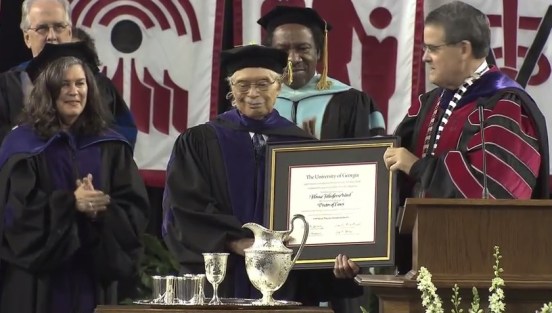
(Above, a screenshot from a video of the May 9, 2014, commencement ceremony: Judge Horace T. Ward accepts honorary Doctor of Laws degree from University of Georgia President Jere Morehead, as Rebecca White, then Georgia Law’s dean, looks on. Behind Ward is Maurice Daniels, dean of the university’s School of Social Work and author of a 2001 biography of the judge.)

Antiquities trafficking said to fuel transnational mayhem by Daesh et al.

davisetal

Alumna Tess Davis, 2d from left, met with Georgia Law 1Ls after her lecture; from left, Hannah Williams, Ava Goble & Karen Hays. Hannah will work on cultural heritage issues this summer through a Global Externship Overseas (GEO) at the Cambodia Ministry of Culture & Fine Arts, Department of Intangible Cultural Heritage.

“As long as there have been tombs, there have been tomb raiders.”

So began the terrific talk on trafficking that Tess Davis, Executive Director of the D.C.-based Antiquities Coalition, delivered to a rapt University of Georgia audience this week.

Having conceded the point quoted at top, Davis stressed that today the problem is much different and much greater. On the list of lucrative transnational organized crime, she asserted, antiquities trafficking places 3d, right behind arms trafficking and drug trafficking.

The threat is not simply one of criminal behavior, she continued. Rather, Davis stressed that profits from antiquities trafficking – profits believed to be in the millions of dollars – provide revenue vital for the nonstate actor waging armed conflict in Syria and Iraq. That entity calls itself “Islamic State” and is often labeled “ISIS” or “ISIL” in the media; taking a lead from diplomats in France and, recently, the United States, Davis preferred “Daesh,” the group’s Arabic acronym, for the simple reason that “they hate to be called that.”

Initially trained as an archeologist, Davis began to focus on legal means to combat antiquities trafficking while still a student at Georgia Law. Since earning her J.D. in 2009, she’s been a leader at the Lawyers’ Committee for Cultural Heritage and in the American Society of International Law Cultural Heritage & the Arts Interest Group, a researcher at Scotland’s University of Glasgow, a member of Georgia Law’s Dean Rusk International Law Center Council, and, as the photo above demonstrates, a mentor to Georgia Law students and other young lawyers interested in working in the field. Her efforts to help repatriate antiquities stolen from Cambodia earned multiple mentions in The New York Times.

Her talk drew links between the looting of cultural heritage during and after the 1970s Khmer Rouge reign of terror and current looting in the Middle East today. In both instances, she said, “cultural cleansing” – in the contemporary case, the destruction and thievery of monuments sacred to moderate Muslims and others – precedes and parallels efforts to erase and subjugate the humans who venerate those monuments. It’s a state of affairs documented in her Coalition’s new report, “Culture Under Threat.”

“The world failed Cambodia,”

Davis said, then expressed optimism at growing political will to do something about the Middle East. She advocated enactment of S. 1887, the Protect and Preserve International Cultural Property Act now working its way through Congress. The legislation, whose cosponsors include a Georgia U.S. Senator, David Perdue, is urgent: Davis estimated that U.S. buyers represent 43% of the current demand for looted Syrian antiquities.

Women’s voices cast in leading role at 33d annual Edith House Lecture

evansLeading Georgia Law’s annual celebration of its 1st woman law graduate this year was an extra special, and especially inspiring, alumna.
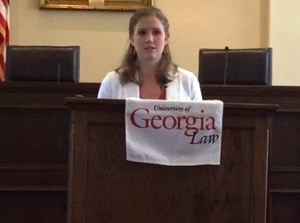
Delivering the 33d annual Edith House Lecture, Stacey Godfrey Evans (left) treated students, faculty, staff, and others in the law school community to a talk entitled “The Voice of a Woman Lawyer: Why it Matters and How to Use It.”

It’s a subject for which she’s well qualified, as 3L Hannah Byars (below right), leader of the Women Law Students Association, made clear. Byars related that after Evans earned her J.D. in 2003, she practiced as an associate at BigLaw firm, then opened a small firm with a handful of colleagues. Evans established her own firm, S.G. Evans Law LLC, in 2014. And since 2011, she’s represented District 42, in Smyrna, as a Democrat in the Georgia State Assembly.hannah

Evans opened her talk by reciting the still-low percentages of women at high levels of the legal profession and politics, then urged the women in her audience to let their voices be heard.

“When you change who is in the room, you change the conversation,”

Evans said at one point, and added that women should not fear to be controversial when the situation merits. She concluded by encouraging women to run for office.

houseIt was a fitting tribute to the namesake of this lecture series, depicted at left: Edith House (1903-1987), whose portrait hangs in the law school rotunda. She and another student in the Class of 1925 were Georgia Law’s 1st women graduates. House was co-valedictorian, and went on to a distinguished career, including a stint as the 1st woman U.S. Attorney in Florida. Thanks to a Women Law Students Association initiative (see this great online scrapbook at p. 53), lectures have been given each year in her honor since 1983.

Today in Brussels, from an alum & member of our Dean Rusk Council

David-Hull

David Hull, a member of our Dean Rusk International Law Council, today published his thoughts about this morning‘s terrorist attacks in the city with which he 1st became acquainted as a Georgia Law summer study abroad student in the early 1980s: Brussels, Belgium.

A partner and specialist in European Union law at the firm of Van Bael & Bellis, David wrote in the Atlanta legal paper, Daily Report, that he tends to be “sanguine” about bad news, but added that these attacks hit very “close to home,” even in “their sheer randomness.”

He expressed concern about “a tendency to conflate the refugee crisis with the terrorist threat,” and “hope that a settlement can be reached in Syria in the near future and a more stable situation achieved in the Middle East generally.” Both, he concluded, require “leaders with courage and vision to find workable and lasting solutions to unprecedented challenges.”

Our thoughts are with David, his family, and the many other members of the Georgia Law community in and around Belgium, a country with which we’ve partnered since the early 1970s.

Inaugural meeting, Dean Rusk International Law Center Council

SONY DSC

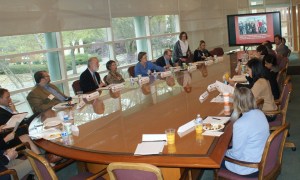
Associate Dean Diane Marie Amann reviews Center initiatives with Council members

We were delighted this weekend to welcome the alums, faculty, and friends who took part in the inaugural meeting of the Dean Rusk International Law Center Council. Some joined us for breakfast here in Athens, while others participated via videolink from as far away as the Willem C. Vis International Arbitration Moot in Vienna.

Topics included this past year’s many events and initiatives, with respect to faculty and curriculum, team-building, website and other outreach, study abroad at Leuven and Oxford, LLMs, international trainings, and research.

We concluded by giving thanks for the support and good counsel of our Council members:

Alumni/ae Division

Charles A. Hunnicutt (JD 1975), Senior Counsel, Thompson Hine, Washington, D.C. (Chair)
Charles A. “Chuck” Allen (JD 1982), Deputy General Counsel for International Affairs, U.S. Department of Defense, Washington, D.C.
Jason Carter (JD 2004), Partner at Bondurant Mixson & Elmore and Chairman of The Carter Center Board of Trustees, Atlanta, Georgia

SONY DSC

From left, Joe Miller, Charlie Hunnicutt and Mary Chaffin

Mary Chaffin (JD 1982), General Counsel, Accion, Cambridge, Massachusetts
Ertharin Cousin (JD 1982), Executive Director of the U.N. World Food Programme, Rome, Italy (invited, not yet confirmed)
Tess Davis (JD 2009), Executive Director, The Antiquities Coalition, Washington, D.C.
Thomas J. Harrold Jr. (JD 1969), Partner, Miller & Martin PLLC, Atlanta, Georgia
David Hull (JD 1983), Partner, Van Bael & Bellis, Brussels, Belgium
Ashland Johnson (JD 2011), Director of Policy & Campaigns, Athlete Ally, Washington, D.C.
Theodore W. Kassinger (JD 1978), Partner, O’Melveny & Myers, Washington, D.C.
Kenneth Klein (JD 1976), Partner, Mayer Brown, Washington, D.C.
Terry Smith Labat (JD 1977), Senior Policy Advisor to the Assistant Secretary of Commerce for Industry and Analysis in the International Trade Administration, U.S. Department of Commerce, Washington, D.C.
June Lee (JD 1996), Partner, Nelson Mullins Riley & Scarborough, Atlanta, Georgia

SONY DSC

Tom Harrold and Tiana Mykkelvedt

Tiana S. Mykkeltvedt (JD 2003), Associate, Bondurant Mixson & Elmore LLP, Atlanta, Georgia
Anita E.J. Ninan (LLM 1991), Advocate, Bar Council of Delhi, India, and Of Counsel, Arnall Golden Gregory, Atlanta, Georgia
Kannan Rajarathinam (LLM 1988), Head of Office, United Nations Assistance Mission for Iraq, Basra, Iraq
Walter Ruiz (JD 1996), Commander, U.S. Navy, Office of the Chief Defense Counsel, Military Commissions Department of Defense, Pentagon, Washington, D.C.

IMG_5257

From left, Student Ambassador Taryn Arbeiter, Christof Siefarth, Laura Tate Kagel, Center’s Director of International Professional Education, and Anita Ninan

Christof Siefarth (LLM 1986), Partner, GÖRG law firm, Cologne, Germany (ex officio election by LLM Alumni Association)
Teri A. Simmons (JD 1989), Partner, Arnall Golden Gregory, Atlanta, Georgia
Stephen O. Spinks (JD 1976), Managing Partner, Sidley & Austin, Brussels, Belgium
Alan N. Sutin (JD 1984), Greenberg Traurig LLP, New York, New York
Audrey Winter (JD 1980), Deputy Assistant U.S. Trade Representative for China, Washington, D.C.

Counselors

W. Benjamin Barkley (JD 1991), partner, Kilpatrick Townsend, Atlanta, Georgia
Kevin Conboy (JD 1979), Visiting Professor of Law, James L. Clayton Center for Entrepreneurial Law, University of Tennessee College of Law, Knoxville, Tennessee
Johnny Isakson, U.S. Senator for Georgia, Washington, D.C.
► C. Donald Johnson (JD 1973), Director Emeritus, Dean Rusk International Law Center
Adalberto Jordan, Judge, U.S. Court of Appeals for the Eleventh Circuit
Jim Marshall, Immediate Past President, U.S. Institute of Peace, Macon, Georgia
Philip Ray (JD 1978), Principal, PhilRay-IDR International Dispute Resolution, Nürnberg, Germany
Peter White, President, Southern Center for International Studies, Atlanta, Georgia

Faculty Division

Diane Marie Amann, Associate Dean for International Programs & Strategic Initiatives and Emily & Ernest Woodruff Chair in International Law; Special Adviser to the Prosecutor of the International Criminal Court on Children in & affected by Armed Conflict (public international law, international criminal law, laws of war, children’s rights)
Mehrsa Baradaran, J. Alton Hosch Associate Professor of Law (banking law, financial services regulation)

SONY DSC

Kathleen Doty, Center’s Associate Director for Global Practice Preparation, and Kent Barnett

Kent Barnett, Assistant Professor of Law (administrative law, international sales of goods)
Jason Cade, Assistant Professor of Law and Director of Community Health Partnership Clinic (immigration law)
Harlan G. Cohen, Associate Professor of Law and Managing Editor, AJIL Unbound (global governance, foreign relations law, human rights, international trade)
Joseph S. Miller, Professor of Law and Director of Oxford Spring Semester Study Abroad (intellectual property, antitrust, telecommunications)
Usha Rodrigues, Associate Dean for Faculty Development and M.E. Kilpatrick Chair of Corporate Finance & Securities Law (corporate governance, business ethics)
Peter B. “Bo” Rutledge, Dean & Herman E. Talmadge Chair of Law (international litigation, international arbitration, international business transactions)
James C. Smith, John Byrd Martin Chair of Law and President of the global Association for Law, Property and Society (property, real estate)
Larry D. Thompson, John A. Sibley Professor in Corporate & Business Law, former General Counsel of Pepsico, and former U.S. Deputy Attorney General (corporate responsibility, white collar crimes, Foreign Corrupt Practices Act)

IMG_5253

Mike Wells and Taryn Arbeiter

Michael Wells, Marion and W. Colquitt Carter Chair in Tort & Insurance Law and former co-director of Brussels study abroad

Georgia Law comments on Geneva Commentaries begin 30 March in D.C.

We’re honored to play a part of the International Committee of the Red Cross launch of its new Commentary on the First Geneva Convention for the Amelioration of the Condition of the Wounded and Sick in the Field, a volume due for release next Tuesday, March 22.

commentaryA week later, the head of Georgia Law’s Dean Rusk International Law Center, Diane Marie Amann, will take part in a panel discussion of the new Commentary at 2 p.m. Wednesday, March 30. Later in the year, we anticipate a Georgia Law conference on the same subject: it will be held on Friday, September 23, 2016.

The March 30 panel discussion will take place in the Columbia Ballroom of the Hyatt Regency Washington on Capitol Hill, 400 New Jersey Ave N.W., Washington, D.C. That’s the same hotel hosting the annual meeting of the American Society of International Law from March 30 to April 2. This is a side event, though ASIL and its international humanitarian law interest group, the Lieber Society on the Law of Armed Conflict,  are cosponsors of this event, hosted by the ICRC’s D.C.-based Regional Delegation for the US and Canada.

The Commentary is the 1st in a series of volumes intended to update earlier versions, some of which are pictured above: 4 circa-1952 volumes on the 4 Geneva Conventions of 1949, edited by Jean S. Pictet, plus a circa-1987 volume on Additional Protocols I & II of 1977, produced by multiple editors. In the words of the ICRC:

“Since their adoption, the Conventions and Protocols have been put to the test, and there have been significant developments in how they are applied and interpreted. The new Commentaries seek to incorporate these developments and provide an up-to-date interpretation of the law.”

This initial update carries particular significance because it contains commentary on Articles 1, 2, and 3 Common to all 4 Geneva Conventions. Common Article 2 and Common Article 3 have endured significant re-examination in the counterterrorism climate that’s prevailed since the attacks of September 11, 2001, readers of decisions such as Hamdan v. Rumsfeld and a plethora of academic literature well know (and as I’ve written here and elsewhere).

The discussion at the March 30 launch in D.C. will feature:

henckaerts► Dr. Jean-Marie Henckaerts (left), Head of the Commentaries Update Unit at ICRC headquarters in Geneva, Switzerland – and, we’re proud to add, a 1990 LLM alumnus of Georgia Law

► Yours truly, Diane Marie Amann (right), Associate Dean and Emily & Ernest Woodruff Chair in International Law at Georgia Law, and the International Criminal Court Prosecutor’s Special Adviser on Children in & affected by Armed Conflict

jackson► Colonel (ret.) Dick Jackson, Special Assistant to the Army Judge Advocate General for Law of War Matters, and Adjunct Professor of Law at Georgetown Law

mathesonMichael Matheson, Professorial Lecturer in Law, George Washington University Law School, and former member of the U.N. International Law Commission

RSVPs for March 30 welcome; for that and any other information on that event, contact Tracey Begley, trbegley@icrc.org.

(Cross-posted from Diane Marie Amann)