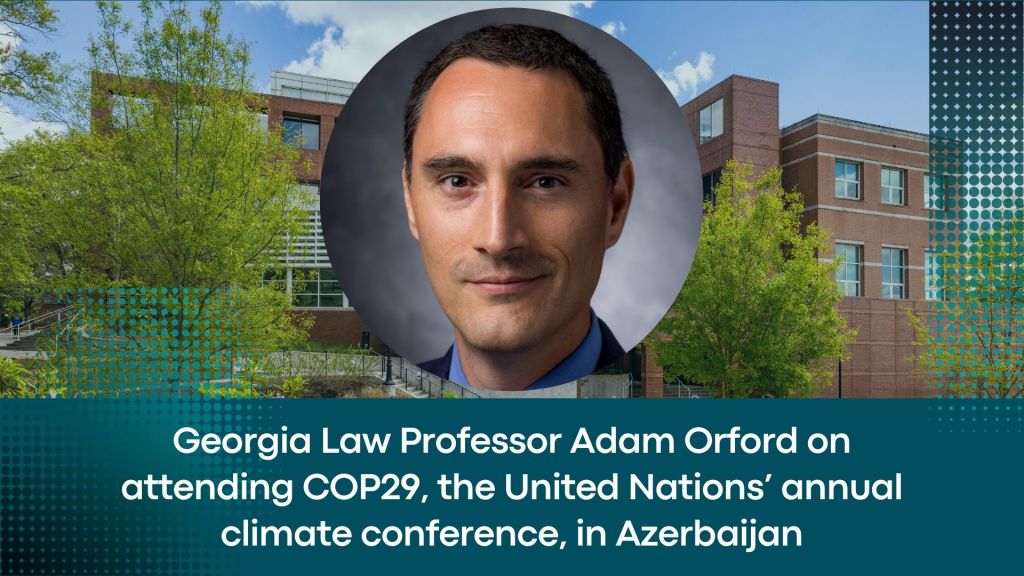
Adam D. Orford, Assistant Professor of Law at the University of Georgia School of Law, participated in the recent 29th Conference of Parties to the United Nations Framework Convention on Climate Change (COP29) in Baku, Azerbaijan. He served as an observer for the American Bar Association. Orford’s interdisciplinary research investigates legal and policy approaches to environmental protection, human health and well-being, and deep decarbonization of the U.S. economy. He also participates in collaborative research initiatives across the University of Georgia, including as lead of the Georgia element of the National Zoning Atlas and as a participant in investigations into the legal, political, environmental and social dimensions of new energy manufacturing and emerging carbon removal technologies.
In his guest post below, Orford summarizes the ABA’s role and the major outcomes at COP29. More detail on this issues can be found in the four COP primers he published at Environmental Law Prof Blog (here, here, here, and here).
ABA’s Role
I participated in COP29 as a delegate for the ABA, which has sent delegates to the climate COPs since 2021. This program followed a 2019 ABA resolution on climate change that urged
“federal, state, local, territorial, and tribal governments, and the private sector, to recognize their obligation to address climate change,”
and called on lawyers to
“engage in pro bono activities to aid efforts to reduce greenhouse gas emissions and adapt to climate change, and to advise their clients of the risks and opportunities that climate change provides.”
The focus of the ABA’s delegations has been to work with other national bar associations to educate the profession about the critical role that lawyers and law associations play in responding to climate change—an issue which may arise unexpectedly, in practices as diverse as environment and energy, human rights, corporate governance, personal injury, real estate development, trusts and estates, municipal management, international trade, and more.
Participating law associations have developed a Climate Registry that is posted on the International Bar Association’s website, providing ready tools to other lawyers and law associations for adopting climate resolutions and other guidance to address climate change. The ABA does not take positions on negotiating outcomes at the COPs, but its delegations work to assist ABA members in understanding the often complex climate COP processes and outcomes.
COP29 Outcomes
As part of my work, I tracked the progress of dozens of negotiations aimed at implementing commitments made by the parties to the UNFCCC and Paris Agreement. Here are some of the most significant outcomes of this year’s negotiations:
A contentious and chaotic COP
Azerbaijan, this year’s host and lead facilitator for the conference’s negotiations, came into COP29 with little climate leadership experience, and it often struggled to maintain trust among the parties.
From remarks praising fossil fuels to open the conference, to procedural maneuvering to achieve controversial results, to protests from many parties that they were not being sufficiency included in negotiations, to delays in the development and circulation of draft negotiating texts, to limited participation from civil society, to relatively disappointing outcomes on many important issues, COP29 highlighted just how difficult climate negotiations have become as the world has continued to warm and countries have fallen behind on taking necessary actions to abate their greenhouse gas emissions.
Disappointing climate finance commitments
This was the year that the parties were required to agree upon a so-called “New Quantified Collective Goal” for climate finance, meaning the amount of annual funding that wealthy developed countries are committed to “mobilizing” for the benefit of poorer developing countries. The prior commitment, $100 billion per year, had only ever been met once, and the actual need is estimated to exceed $1 trillion per year.
After two weeks of contentious debate that included developed countries pushing for expanding contributions from emerging economies and developing countries pushing for $1.3 trillion with a significant public finance component, developed countries only agreed to commit to achieving $300 billion per year—by 2035.
This result was so far below the developing country goals that at one point they walked out of the negotiations entirely in protest.
Procedural machinations to allow carbon credit trading
After years of controversy and delay, the parties at COP29 agreed to finalize the “Article 6 rulebook,” meaning the rules and definitions for international trade in carbon credits originally contemplated by the Paris Agreement in 2015. This outcome was achieved through an irregular procedure, however: A subsidiary implementing body had ratified the rules months before the COP and then provided them to the parties as a take-it-or-leave-it fait accompli. The parties did quickly agree to accept the new rules, but then developed lengthy further guidance intended to promote transparency and environmental integrity in the markets.
Backsliding on the commitment to transition away from fossil fuels
At last year’s COP28 in Dubai, all parties had agreed to include text indicating a goal to “transition away” from fossil fuels as part of the global climate response. However, major oil producers, including especially Saudi Arabia, have since backed away from this commitment, and they worked vigorously throughout COP29 to avoid repeating this language in any form at any point. This opposition nearly derailed several negotiations, and resulted in at least one item being deferred until COP30 next year.
In addition, although countries are supposed to submit their third voluntary climate action plans in February 2025, very few made firm commitments to reduce their climate emissions at COP29—a troubling change from the relatively robust pledges at prior COPs.
Leadership vacuum
COP29 began just days after the U.S. Presidential election. That election’s outcome will have major implications for the trajectory of United States, and therefore global, climate policy.
With the U.S. delegation largely unable to make credible future commitments, there was some speculation that this would provide an opportunity for China to take on a larger global leadership role, particularly in the development of low-carbon energy technologies necessary to respond to climate change. However, China’s most significant efforts at COP29 were quite different:
- China opposed calls for it to join developed countries and make firm climate finance commitments; and
- It pushed unsuccessfully to add international trade issues to the negotiating agenda.
With the world’s two largest greenhouse gas emitters both taking a back seat, global climate policy lacks clear leadership at a critical time. 2024 is likely to be the warmest year in human history; and 2025 is likely to be warmer still.
Nonetheless, the COP process remains the most important forum for developing international commitments to climate change response. While imperfect, the parties do continue to make progress—sometimes a little, sometimes a lot—every year.
Many parties are already pointing to the disappointing outcomes of COP29 as the basis for redoubling their efforts to strengthen commitments at future COPs. Next year’s COP30 will be held in Belém, Brazil.

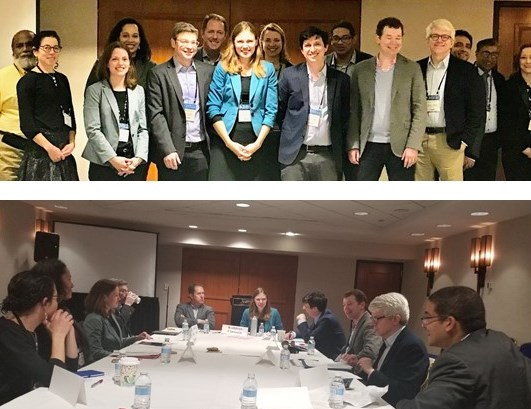
Left: The ABA delegation included (from left to right) Uma Outka, law professor at the University of Kansas; Kamran Jamil, law clerk at SD California and co-chair of the ABA International Law Division young lawyers division; and Adam D. Orford, Assistant Professor at the University of Georgia School of Law. Top Right: COP29 plenary session with Mukhtar Babayev, Minister of Ecology and Natural Resources of the Azerbaijan Republic.






 First, Professor
  Second,
  Georgia Law professor
  exchange of notes