Since the WTO’s inception in 1995, global trade has rapidly expanded and become increasingly interconnected. The international trading system has helped lift 1.5 billion people out of absolute poverty and unlocked new opportunities for businesses, workers and consumers. At the same time, the gains from trade have not always been shared equally. This needs to change.
As the WTO celebrates its 30th anniversary, the 2024 Public Forum will look to the future, exploring how re-globalization can help make trade more inclusive and ensuring that its benefits reach more people.
LeClercq will present research under the United States-Mexico-Canada agreement’s dispute settlement provisions and their effects on vulnerable workers in Mexico.
The WTO 2024 Public Forum also discussed the TradeExperettes’ report: Ten “Quick Wins” for Re-globalization and Resilience in Trade. LeClercq authored “Quick Win No. 3: Empower all workers to ensure a fair, equitable and sustainable trade policy,” which urges greater inclusion of non-union workers at the trade bargaining table.
Desirée LeClercq joined the University of Georgia School of Law as an assistant professor in summer 2024 and currently teaches International Trade and Workers Rights, International Labor Law, International Law, and U.S. Labor Law. LeClercq’s scholarly focus lies in international and labor law. She also serves as a faculty co-director of the Dean Rusk International Law Center and as the faculty adviser for the Georgia Journal of International and Comparative Law.
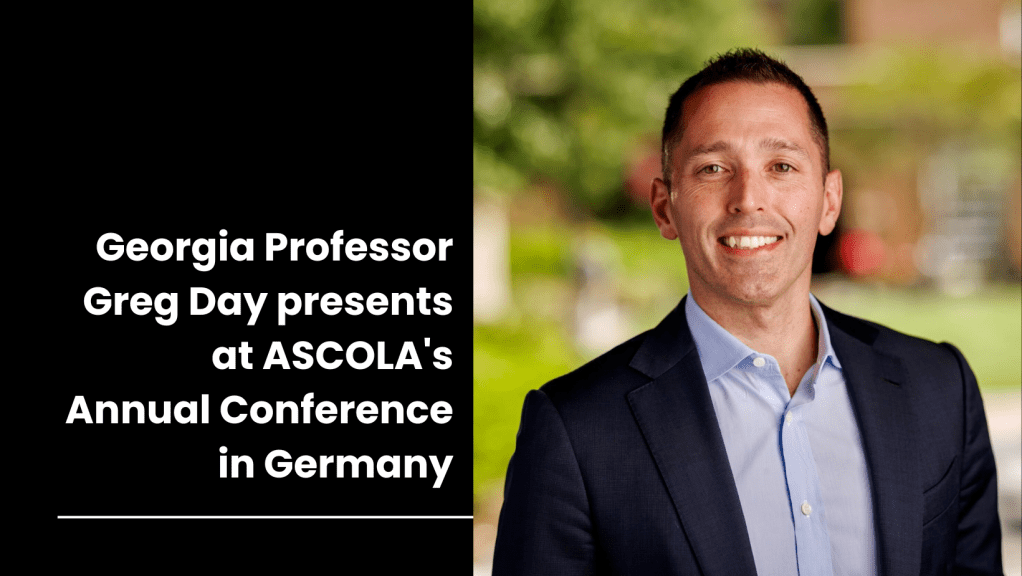
University of Georgia Associate Professor of Legal Studies Greg Day recently presented research at the 19thAmerican Society for Competition Law (ASCOLA) Annual Conference in Würzburg, Germany. The conference brings together about 120 scholars doing research in competition law, economics or policy from all over the world.
Greg Day is an Associate Professor of Legal Studies at the Terry College of Business and holds a courtesy appointment in the School of Law. He is also an Affiliated Fellow at Yale Law School’s Information Society Project as well as the University of North Carolina’s Center for Information, Technology, and Public Life. His research has primarily focused on the intersection of competition, technology, innovation, and privacy as well as the disparate impact of anticompetitive conduct.
Desirée LeClercq, Assistant Professor of Law & Faculty Co-Director of the Dean Rusk International Law Center
LeClercq teaches International Trade and Workers Rights, International Labor Law, International Law and U.S. Labor Law. She serves as a faculty co-director of the Dean Rusk International Law Center and as the faculty adviser for the Georgia Journal of International and Comparative Law. Specializing in international and labor law, LeClercq has recently published extensively in flagship and specialty law reviews, including the Fordham Law Review, the Virginia Journal of International Law, the Journal of International Economic Law, the Columbia Journal of Transnational Law, the Administrative Law Review, the American University Law Review and the Berkeley Journal of International Law. Notably, her Columbia Journal of Transnational Law article titled “A Worker-Centered Trade Policy” won the ComplianceNet Outstanding Junior Publication Award. LeClercq has also contributed several book chapters on international trade and labor, and she is a frequent contributor to Fortune.
Previously she served as a director of labor affairs in the Office of the U.S. Trade Representative from 2016 to 2020, during which time she was an adjunct professor at the American University Washington College of Law. Additionally, LeClercq worked for nearly a decade as a legal officer at the International Labor Organization in Geneva, Switzerland, and served as staff counsel for the chairman of the National Labor Relations Board.
Assaf Harpaz, Assistant Professor of Law
Harpaz’s scholarly focus lies in international taxation, with an emphasis on the intersection of taxation and digitalization. He teaches classes in federal income tax and business taxation. He explores the tax challenges of the digital economy and the ways to adapt 20th-century tax laws to modern business practices. In addition, he researches the use of tax expenditures and the historical expansion and politicization of the tax expenditure budget in the U.S. federal income tax system.
His recent scholarship includes his international tax article published in the University of Pennsylvania Journal of International Law titled “International Tax Reform: Who Gets a Seat at the Table?” His work has also been published in Law and Contemporary Problems, the Cornell Journal of Law and Public Policy, the Yale Journal of International Law and Tax Notes International. Moreover, he has contributed expert pieces for Newsweek, WalletHub, FinanceBuzz and the Maurer Global Forum.
Before joining UGA, Harpaz served as a visiting assistant professor at the Drexel University Kline School of Law teaching courses in federal income tax and enterprise tax.
University of Georgia School of Law professor Assaf Harpaz presented his draft paper “Global Tax Wars and the Shift to Source-Based Taxation” and chaired the “Jurisprudence and Enforcement” panel at the 8th International Roundtable On Taxation And Tax Policy during July.
Below is an abstract from the draft paper:
Current debates in international taxation frequently engage with the concept of global tax fairness, relating to the equitable allocation of taxing rights between jurisdictions. These questions emerge within an international tax framework at a critical juncture. In a rapidly evolving digital economy, intergovernmental organizations are battling to shape the cross-border tax agenda. Global North economies have dominated this regime through the Organisation for Economic Co-operation and Development (OECD), which has drawn backlash due to its undemocratic procedure and unfavorable outcomes for developing countries. Meanwhile, the United Nations has occupied a relatively peripheral role in global tax governance. However, its role could change with the establishment of a new Framework Convention on International Tax Cooperation – an initiative overwhelmingly supported by the world’s developing countries.
The article conceptualizes the contemporary international tax discourse as “tax wars,” contrasting the taxing powers and interests of the OECD-led Global North with those of the UN-backed Global South. It explores the standards and preferences that have underpinned the regime since its inception, focusing on residence and source taxation. The article argues for a shift towards source-based taxation, drawing on procedural and distributive justice principles. To do so, the article proposes expanding the permanent establishment standard in model treaty language, creating an opportunity for broader taxation of business profits in the source country. This transition will address longstanding disparities and is increasingly warranted in a digital economy that does not rely on physical presence.
Assaf Harpaz joined University of Georgia School of Law as an assistant professor in summer 2024 and will teach classes in federal income tax and business taxation. Harpaz’s scholarly focus lies in international taxation, with an emphasis on the intersection of taxation and digitalization. He explores the tax challenges of the digital economy and the ways to adapt 20th-century tax laws to modern business practices.
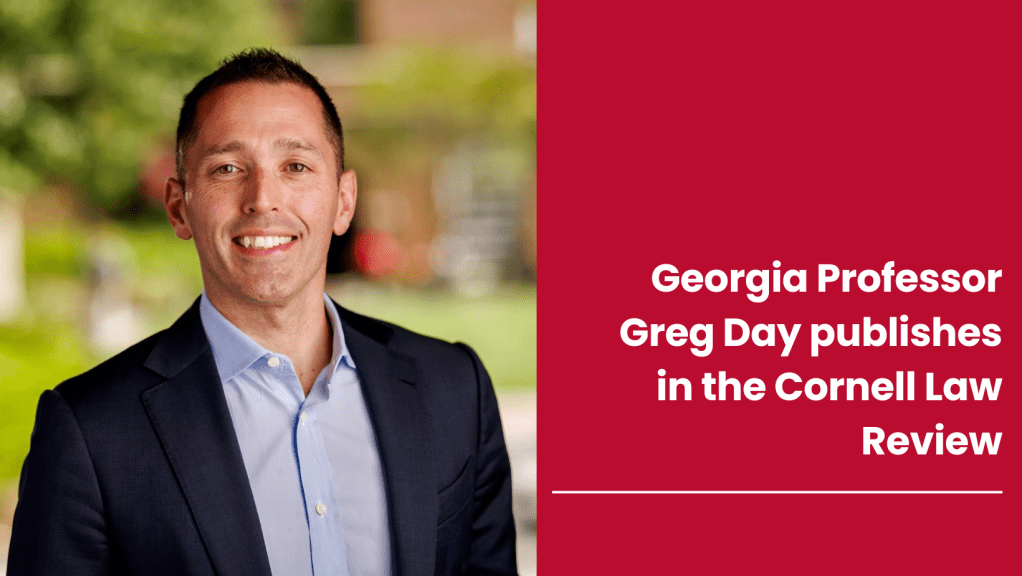
Greg Day, Associate Professor of Legal Studies at the Terry College of Business and professor (by courtesy) at the University of Georgia School of Law, published “Antitrust for Immigrants” in the Cornell Law Review.
Below is an abstract from the draft paper:
Immigrants and undocumented people have often encountered discrimination because they compete against “native” businesses and workers, resulting in protests, boycotts, and even violence intended to exclude immigrants from markets. Key to this story is government’s ability to discriminate as well: it is indeed common for state and federal actors to enact protectionist laws and regulations meant to prevent immigrants from braiding hair, manicuring nails, operating food trucks, or otherwise competing. But antitrust courts have seldom mentioned a person’s immigration status, much less offered a remedy.
This Article shows that antitrust’s “consumer welfare” standard has curiously ignored the plight of immigrants. Part of the reason is that antitrust law is characterized as a “colorblind” regime benefitting consumers collectively, meaning that it isn’t supposed to prioritize insular groups such as immigrants. Courts and scholars have also described matters of inequality and discrimination as “social harms” existing beyond antitrust’s scope. In fact, antitrust lawsuits have successfully sought to drive immigrants out of markets, alleging that competitors gained an “unfair” advantage from employing undocumented workers. Under this view of antitrust law, the exclusion of immigrants is an appropriate way of promoting competition.
This Article argues that anti-immigrant discrimination creates the exact types of harms that antitrust was meant to remedy. Since excluding immigrants can misallocate resources on citizenship or racial lines as opposed to their most productive usages, certain acts of discrimination should entail “conduct without a legitimate business purpose,” even when based solely on racial animus. A hidden type of market power is revealed in that foreign-born people are less able to employ self-help remedies to correct market failures. In addition to analyzing antitrust’s purpose and economic foundation, this Article delves into antitrust’s history to show that an original function of competition law was to protect foreigners. By demonstrating how incumbents can inflict greater levels of harm on immigrants while wielding less market power, this Article reimagines the consumer welfare standard and its colorblind approach as well as reveals how marginalized communities defy antitrust’s assumptions of self-help remedies.
Greg Day is an Associate Professor of Legal Studies at the Terry College of Business and holds a courtesy appointment in the School of Law. He is also an Affiliated Fellow at Yale Law School’s Information Society Project as well as the University of North Carolina’s Center for Information, Technology, and Public Life. His research has primarily focused on the intersection of competition, technology, innovation, and privacy as well as the disparate impact of anticompetitive conduct.
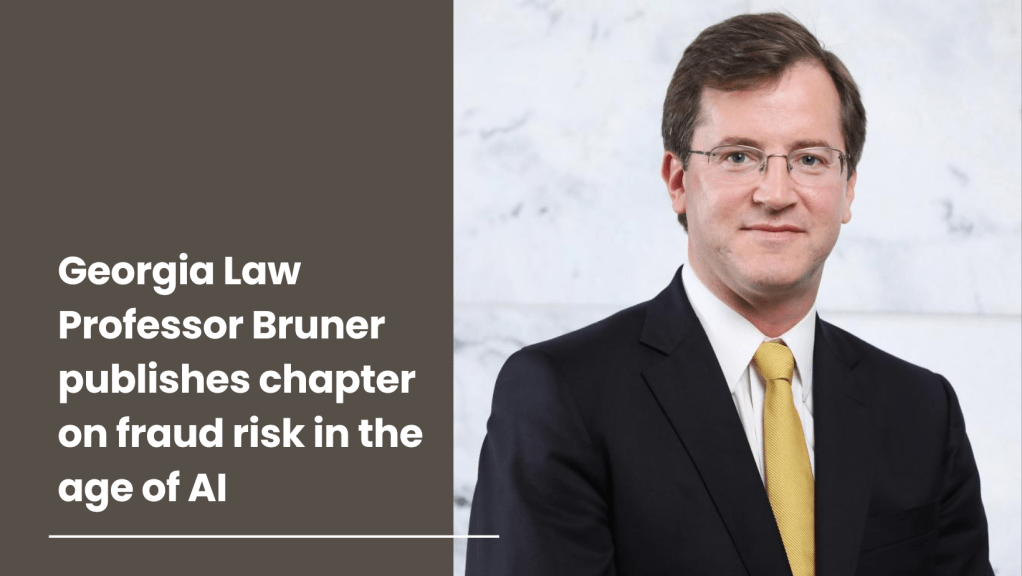
University of Georgia School of Law professor Christopher M. Bruner published a chapter titled “Managing Fraud Risk in the Age of AI” in a book titled Fraud and Risk in Commercial Law (Hart 2024), edited by professor Paul S. Davies of University College London and professor Hans Tjio of the National University of Singapore (NUS).
This book focuses on contemporary problems related to fraud and risk in commercial law.
It has been said by some that we are in a ‘golden age of fraud’. In part this has been caused by globalisation, technological changes and the financialisation of business. This has resulted in the creation of automated linkages with integrated supply chains and the creation of systemic risks, which have been exacerbated by new forms of intangible assets like tokens and their ease of movement. While regulation has ebbed and flowed given the desire of governments to generate economic growth, as well as the distrust of their coercive powers, the courts have sought to strike a balance between considerations such as commercial certainty and fairness.
The book provides an analysis of key contemporary issues on the theme of fraud and risk in commercial law, including: technology and fraud, secondary liability and ‘failure to prevent’ economic crime, abuse of business entities, insolvency and creditor protection, injunctions and other orders, cross-border issues, the relationship between regulation and private law, and solutions for policy makers.
Christopher M. Bruner is the Stembler Family Distinguished Professor in Business Law at the University of Georgia School of Law and serves as a faculty co-director of the Dean Rusk International Law Center.
The International Visitor Leadership Program (IVLP) is the U.S. Department of State’s premier professional exchange program. Through short-term visits to the United States, current and emerging foreign leaders in a variety of fields experience this country firsthand and cultivate lasting relationships with their American counterparts.
Clare R. Norins is a clinical associate professor and the inaugural director of the University of Georgia School of Law’s First Amendment Clinic, which represents clients in federal and state court on a range of First Amendment and media law issues. Representative matters include challenges to jail censorship, social media blocking by government officials, retaliatory arrest, defending the right to record, opposing unconstitutional permit requirements, and defamation defense/anti-SLAPP.
University of Georgia School of Law student, rising 3L Erin Nalley, recently attended the University of Liverpool School of Law and Social Justice’s second annual Summer School in partnership with the Council of Europe. This year’s Summer School took place in Liverpool, UK from July 8-19 and centered on the theme “Council of Europe at 75: Protecting Human Rights, Democracy, and the Rule of Law in a Rapidly Changing World.“ Below, Nalley reflects on her experience as the first Georgia Law student to attend the Summer School. The University of Georgia and the University of Liverpool are institutional partners.
I have been very fortunate this summer to have the opportunity to represent the University of Georgia School of Law at the University of Liverpool’s second Summer School in the Law of the Council of Europe. This year, the Summer School celebrated the 75th anniversary of the Council of Europe and focused on Protecting Human Rights, Democracy, and the Rule of Law in a Rapidly Changing World. This included focusing on emerging technologies, such as Artificial Intelligence and Neurotechnology, and their interaction with human rights. This is only the second year the University of Liverpool has hosted this Summer School. Still, their unique connection and work with the Council of Europe allows them to provide students and working professionals from around the world with an amazing opportunity to learn not only about the Council of Europe but also about emerging human rights challenges.
As this Summer School focuses on issues that come before the Council of Europe and other European Committees and Tribunals, attendees are mainly from European countries, although not all are European Union countries. I met colleagues from over 20 different countries including Italy, Switzerland, Germany, Ireland, and more. This year there was especially great representation of Balkan states like Bosnia and Herzegovina, Kosovo, North Macedonia, Romania, and Serbia. There were also other participants from countries outside of Europe, including India. This experience was truly diverse and allowed me to make many connections and friendships with those around the world.
For two weeks, I attended lectures on a variety of issues including topics such as AI technology, organ trafficking, the Venice Commission, and counter-terrorism laws. Our lectures were given by practicing lawyers, judges, and academic professionals. There were around 3-4 lectures a day from Monday through Friday. The last day included closing remarks and talks about the future of the Council of Europe and the European Court of Human Rights. All attendees were awarded a certificate for our participation in the Summer School as well.
Although I was the only participant from the United States, I found a lot of common ground with my cohort. I was able to travel around the city and try new restaurants with the same people I could sit with and have a deep and meaningful discussion on human rights issues around the world. My experience was not just academic, but it was also cultural and communal.
Within the city of Liverpool, there are many museums and landmarks. There are many connections to American history, Irish culture, and of course, the Beatles throughout the city. Liverpool is also a great location for trying new foods and drinks. Because of their proximity to Ireland, Irish culture and food is very prominent in Liverpool which means you can experience both English and Irish cuisine in one town. Because of its location on the western coast of England, Liverpool also situated visitors well for additional travel. I was able to take a day trip over one of my weekends to Dublin, and some of my colleagues traveled to Wales and Scotland in their free time.
The University of Liverpool Summer School has been a wonderful experience. Liverpool’s location is great not only for learning more about European and international law, but for getting to experience other countries and cultures as well. The University of Liverpool works hard to use its connections with the Council of Europe to promote and help build the networks of its Summer School participants. It is a fantastic opportunity to build relationships with legal professionals from all over the world in a short amount of time.
I hope to pursue a career in international law after graduation, and this experience will assist me in reaching that goal in many ways. It has allowed me to network with professionals and learn about human rights issues I may hope to work on after law school.
***
For more information about attending Liverpool Summer School, please email the Center: ruskintlaw@uga.edu
University of Georgia School of Law professor Laura Phillips-Sawyer recently presented her work “Reassessing Vertical Restraints: How Global Value Chains Have Rewritten the Boundaries of the Firm” at the Rethinking Economic Regulation conference at King’s College, London. The conference is organized by the Competition Law Center at the George Washington University, as well as by the Dickson Poon School of Law and the Faculty of Social Science & Public Policy at King’s College London.
Below is the conference precis:
In the 1980s and 1990s, countries in Europe and elsewhere embraced a model of the political economy characterised by privatisation, market competition, and politically-insulated economic regulation. Yet, whilst this model may have performed well on some narrow and aggregate-level objectives, it has raised concerns about unequal outcomes, lack of investment, and market failure, especially in the utility sectors. These concerns have prompted ad hoc policy changes and calls for select re-nationalisation. Yet, what is missing from the debate is a wider systemic analysis of the underlying causes of the disappointing outcomes. This two-day workshop brings together an inter-disciplinary group of established and emerging scholars – in particular, lawyers, economists, historians, and political scientists – who centre on the different causes of the failings of the now dominant political-economic model. The workshop facilitates knowledge production and exchange and will contribute to the production of a special issue on the wider theme.
Phillips-Sawyer is an expert in U.S. antitrust law and policy. Broadly, she is interested in questions of economic regulation, which intersect with legal history, economic thought, business strategy and structure, and political organization. She currently holds the Jane W. Wilson Associate Professorship in Business Law at the University of Georgia School of Law.
Distinguished Research Professor & Shackelford Distinguished Professor in Taxation Law Emeritus Walter Hellerstein co-presented “Global Summary of Jurisdictions’ VAT/GST Treatment of Services Connected to the Trade in Crypto-Assets” at a meeting of the Organization for Economic Cooperation and Development’s Working Party No. 9 on Consumption Taxes in Paris, France, during June.
The Working Party No. 9 on Consumption Taxes is a forum for the discussion of consumption tax policy and administration, working with both Members and non-Members of the OECD to develop appropriate and effective taxation outcomes.
Hellerstein, a recipient of the National Tax Association’s Daniel M. Holland Medal for outstanding lifetime contributions to the study and practice of public finance, is widely regarded as the nation’s leading academician on state and local taxation. He has authored numerous books, textbooks, and law review articles, and has practiced extensively in the field. Hellerstein is currently a Visiting Professor at the Vienna University of Economics and Business, and he remains actively involved in his scholarship, consulting, and, in particular, his work as an academic advisor to the OECD.





 exchange of notes