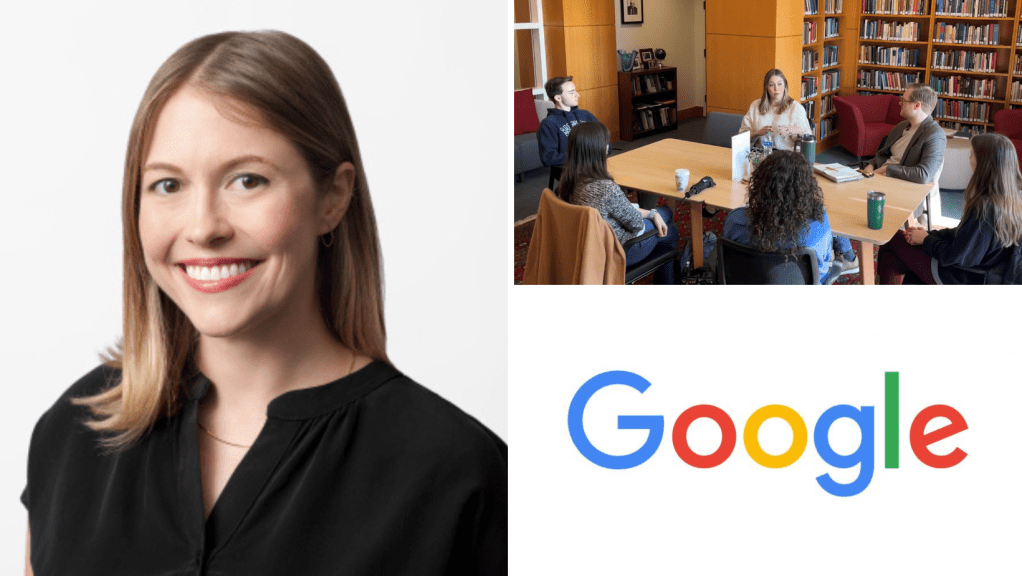
University of Georgia School of Law alumna Ellen Clarke (J.D., ’14), security counsel at Google, recently spoke to students about her career in data protection law at the Dean Rusk International Law Center’s Louis B. Sohn Library.
Students from Georgia Law’s International Law Society and Privacy, Security, and Technology Law Society attended the talk. Clarke began by discussing her professional background and explaining how her experience prosecuting white collar crime at the U.S. Department of Justice provided her with the skills and experiences to successfully transition into her current role at Google. As security counsel, Clarke advises on global data security and law enforcement issues. Students asked Clarke about her opinions on Artificial Intelligence, her decision to become a licensed solicitor in England and Wales, and about the realities of her day-to-day work at Google.
Before joining Google, Clarke prosecuted competition crimes as a trial attorney in the Washington Criminal I Section of the Antitrust Division of the U.S. Department of Justice. She joined the DOJ through the Attorney General’s Honors Program. Clarke previously served as a law clerk to Judge Richard W. Story of the U.S. District Court for the Northern District of Georgia. She received an Advanced Diploma in Data Protection Law from the Honorable Society of King’s Inns, a J.D. degree magna cum laude from the University of Georgia School of Law, and a B.S. in Foreign Service from Georgetown University. She is licensed as an attorney in Georgia and Washington, D.C., as registered in-house counsel in California, and as a solicitor in England and Wales. Clarke is currently an Adjunct Professor of Law at Georgia Law, where she teaches a mini-course entitled Cybercrime.
University of Georgia School of Law Professor Diane Marie Amann spoke last week at a conference which paid tribute to Professor Megan A. Fairlie (1971-2022), an international criminal law scholar who had presented her own work at our law school’s Dean Rusk International Law Center.
Most recently, Dr. Fairlie had taken part in a 2019 symposium entitled “International Criminal Court and the Community of Nations,” and she published her presentation, “Defense Issues at the International Criminal Court,” in the Georgia Journal of International and Comparative Law symposium issue.
In recognition of Fairlie’s scholarship on persons accused by international criminal tribunals, Amann chose to present “Inge Viermetz, Woman Acquitted at Nuremberg,” at Friday’s conference.
Amann, who is Regents’ Professor of International Law, Emily & Ernest Woodruff Chair in International Law, and Faculty Co-Director of the Dean Rusk International Law Center here at Georgia Law, has published frequently on women professionals during the post-World War II trials at Nuremberg and elsewhere.
Christopher M. Bruner, Stembler Family Distinguished Professor in Business Law and Faculty Co-Director of the Dean Rusk International Law Center, published a review of a book titled Innovating Business for Sustainability: Regulatory Approaches in the Anthropocene (edited by B. Sjåfjell, C. Liao and A. Argyrou), in the Cambridge International Law Journal in December.
Challenging current attitudes to governance and regulation in business, this timely book ascertains how regulatory approaches can innovate to ensure sustainable business that contributes to social justice for current and future generations within ecological limits.
Combining a research-based approach with a gendered perspective of how sustainability goals are shaped and how businesses should engage with them, this pioneering book creates a comprehensive and contemporary understanding of what sustainability means for business. Identifying the limitations of current approaches to gender and equality alongside the weaknesses of current regulatory and theoretical approaches in business, chapters seek to enhance the practical understanding and embeddedness of sustainability into business within legal and regulatory landscapes. Insights from an international collection of expert scholars in fields ranging from sustainability science to law offer meaningful alternatives to the sustainable business status quo on both conceptual and concrete levels.
Providing a regulatory analysis of business positioned in a systems-based sustainability research framework, this book will prove an invaluable resource for students and scholars of sustainability science, business and management, and law and regulation. With practical insights, it will also prove essential for policymakers working in business regulation and sustainability in business.
Prior posts on Bruner’s scholarship can be found here.
Sloan was joined in conversation by two of the law school’s professors: Nathan S. Chapman, Pope F. Brock Professor of Law; and Diane Marie Amann, who is Regents’ Professor of International Law, Emily & Ernest Woodruff Chair in International Law, and the Center’s Faculty Co-Director.
By the summer of 1941, in the ninth year of his presidency, Franklin Roosevelt had molded his Court. He had appointed seven of the nine justices—the most by any president except George Washington—and handpicked the chief justice.
But the wartime Roosevelt Court had two faces. One was bold and progressive, the other supine and abject, cowed by the charisma of the revered president.
The Court at War explores this pivotal period. It provides a cast of unforgettable characters in the justices—from the mercurial, Vienna-born intellectual Felix Frankfurter to the Alabama populist Hugo Black; from the western prodigy William O. Douglas, FDR’s initial pick to be his running mate in 1944, to Roosevelt’s former attorney general and Nuremberg prosecutor Robert Jackson.
The justices’ shameless capitulation and unwillingness to cross their beloved president highlight the dangers of an unseemly closeness between Supreme Court justices and their political patrons. But the FDR Court’s finest moments also provided a robust defense of individual rights, rights the current Court has put in jeopardy. Sloan’s intimate portrait is a vivid, instructive tale for modern times.
Sloan joined Georgetown – where he teaches constitutional law, criminal justice, and death penalty litigation – following a distinguished legal career, in all three branches of the federal government, at leading law firms, and in-house at the Washington Post. He is also the author of The Great Decision: Jefferson, Adams, Marshall, and the Battle for the Supreme Court, a 2009 history of the Court’s foundational decision in Marbury v. Madison.
University of Georgia School of Law Professor Diane Marie Amann was featured in The Wall Street Journal regarding the recent order of the International Court of Justice in the Genocide Convention case which South Africa has filed against Israel.
After reporting the opinion of Utah Law Professor Amos Guiora , that both parties won something, and that, in the words of the article, “Israel avoided a legal ruling that would force it either to stop military operations or defy the world court,” Bravin then wrote:
Still, the conduct of the Gaza campaign received no pass, said Diane Marie Amann, an international-law professor at the University of Georgia. ‘Israel will need to adjust if it wishes to comply with the court’s order,’ she said.
Amann is Regents’ Professor, Emily & Ernest Woodruff Chair in International Law, and Faculty Co-Director of the Dean Rusk International Law Center here at the University of Georgia School of Law. She teaches and publishes regularly on matters relating to international law.
Christopher M. Bruner, Stembler Family Distinguished Professor in Business Law and Faculty Co-Director of the Dean Rusk International Law Center, presented his working paper, “Prospects for a US Value Chain Due Diligence Law,” at a conference hosted by Tilburg Law School in the Netherlands titled “Connecting Responsible Organizations: Legal Strategies for Sustainability in Global Value Chains.”
Bruner participated in the panel titled “Sustainable corporate governance and tax transparency.” The conference, hosted by Tilburg’s Department of Private, Business & Labour Law, aimed to provide a platform for legal experts to discuss environmental and social sustainability challenges in global value chains.
Prior posts on Bruner’s scholarship can be found here.
University of Georgia School of Law alumnus Alexander White (J.D., ’09), Privacy Commissioner of Bermuda, spoke to students about current developments and careers in the field of data privacy and cybersecurity in the Dean Rusk International Law Center’s Louis B. Sohn Library this week.
Students from UGA Law’s International Law Society and Privacy, Security, and Technology Law Society attended the talk and asked questions regarding recent data privacy and cybersecurity regulations and comparative privacy regimes, such as Europe’s General Data Protection Regulation. White provided insight into the various ways students can enter into this rapidly-evolving field at both the domestic and international level, emphasizing the importance of taking related coursework and participating in international programming during law school. He mentioned the transformative impact of his own Global Externship Overseas experience in Cambodia, work that he believes mirrors his current position’s mandate to “create laws around the proper and ethical way to do something.” White also offered his perspective on emerging concepts such as Artificial Intelligence and how they impact data privacy, specifically for regulators.
White started his career in insurance and became certified in multiple jurisdictions under the International Association of Privacy Professionals. In 2014, he transitioned into the privacy field with his appointment as the State Deputy Chief Privacy Officer for the South Carolina Department of Administration, tasked with developing a statewide privacy program. White was appointed by former Secretary Jeh Johnson to the U.S. Department of Homeland Security Data Privacy and Integrity Advisory Committee (DPIAC) for a three-year term in 2017. Three years later, the Governor of Bermuda appointed White as founding head of the country’s data protection authority as Bermuda’s first Privacy Commissioner in 2020. White also teaches a Comparative Privacy Law course at UGA Law.
Christopher M. Bruner, Stembler Family Distinguished Professor in Business Law and Faculty Co-Director of the Dean Rusk International Law Center, recently co-edited the book A Research Agenda for Corporate Lawwith Marc Moore, Professor of Corporate/Financial Law, University College London Faculty of Laws.
This timely Research Agenda explores key dynamics and cutting-edge developments within corporate law. Bringing together a diverse range of scholars hailing from different jurisdictions, ideological perspectives, and methodological backgrounds, it provides a roadmap for future research in the field.
Through the investigation of different doctrinal and normative issues, leading scholars consider how evolving conceptual foundations, capital markets, social and cultural contexts, and technologies may impact corporate law and governance research. Ground-breaking contributions examine the increasingly global nature of corporate production and investment markets and the influence this has on the wider dynamics in the field, suggesting new directions for navigating this complex and fascinating terrain.
Students and scholars of corporate law, corporate governance, and law and business will value the innovative ideas unpacked in this state-of-the-art Research Agenda. Its forward looking and practical insights will also benefit practitioners and policymakers in corporate law, corporate governance, sustainability, and business law.
Prior posts on Bruner’s scholarship can be found here.
Applications are now open for the summer 2024 Global Governance Summer School, jointly presented by the University of Georgia School of Law’s Dean Rusk International Law Center and KU Leuven’s Leuven Centre for Global Governance Studies. Each summer, this short-term study abroad takes UGA Law students to Belgium and the Netherlands to explore global governance: the interaction of state, regional, and international legal regimes, plus individuals, corporations, intergovernmental and nongovernmental organizations, networks, and other non-state actors.
In summer 2023, the first summer GGSS ran since 2019, 17 students traveled to Europe for a week of lectures with KU Leuven professors. The first week of this for-credit course also included professional development briefings in Brussels at the European Parliament, where students were able to watch the final vote of the session cast, and a private law firm specializing in EU competition law. The programming then shifted to The Hague, Netherlands, where students received briefings at the International Criminal Court, the International Court of Justice, the International Residual Mechanism for Criminal Tribunals, and Leiden University.
The students in attendance had a variety of professional and academic motivations for participating in GGSS. For some, the professional connections, international experience, and expanded academic network will continue to benefit them as they pursue employment internationally. Erin Nalley, a current 2L who aims to work in international environmental law, stated how important the experiences of GGSS are for someone interested in an international career:
“The cultural, academic, and international experiences on this program were priceless and once in a lifetime. I made new friendships and professional connections on this trip that I most likely would not have made without GGSS.”
For others focusing their professional pursuits domestically, GGSS served as a unique professional development opportunity that will set them apart in their job search. Megan Jones, a current 2L interested in a business law career, reflected on the value of the knowledge she gained through her participation in GGSS:
“GGSS was a great opportunity for someone who sees themselves practicing domestically early in their legal career but still has an interest or desire to incorporate international aspects into their professional future. They say the best way to learn something is to immerse yourself in it, and that is exactly what GGSS is: an immersive experience that introduces you to the wide array of global opportunities the legal field has to offer.“
In addition to the UGA Law students, several graduate students at UGA in the law school’s Graduate Certificate in International Law participated in GGSS. Jasmine Underwood-Starling, a Ph.D. student in the Department of Sociology, noted that the benefits of GGSS are truly interdisciplinary:
“For any student interested in international, foreign, and comparative law, the GGSS is definitely worthwhile. The ability to go from classroom learning to then seeing the knowledge and practices in action the very next day is an invaluable experience. The program was truly inspiring.”
***
Applications for the summer 2024 Global Governance Summer School are now open. Current 1Ls, 2Ls, and graduate students are encouraged to apply. This 12-day, 3-credit summer school will explore global governance through the lens of comparative administrative law led by Kent Barnett, Associate Dean for Academic Affairs & J. Alton Hosch Professor of Law. GGSS will take place from May 20 – June 1, 2024. Students are encouraged to reference this instructional video for step-by-step information regarding how to create and successfully complete an application for GGSS in UGA’s Study Away Portal by the March 1 deadline. For more information, please plan to attend the Center’s International Opportunities Information Session on Tuesday, February 13 at 12pm, or email: ruskintlaw@uga.edu
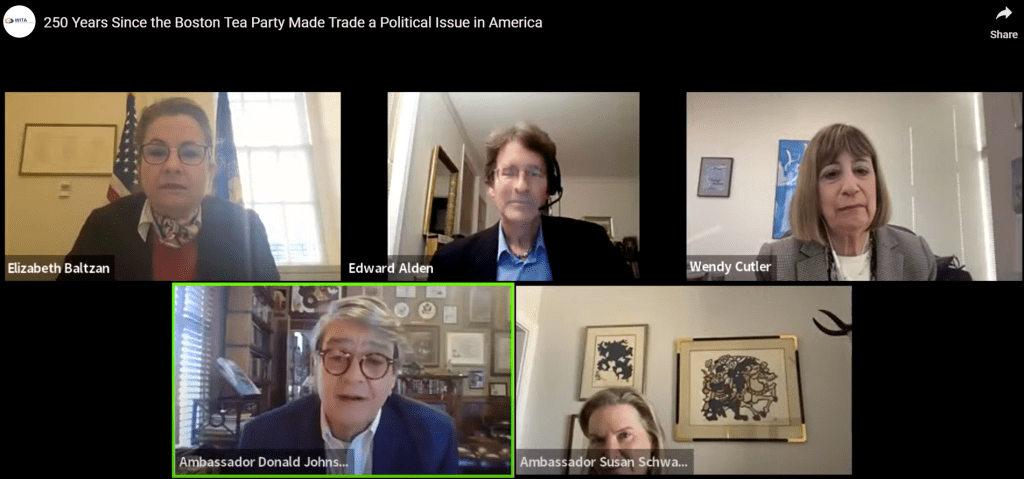
The Washington International Trade Association (WITA) hosted two panels last month to discuss changing attitudes toward trade in the 250 years since the Boston Tea Party. Taking part in the panel was University of Georgia School of Law alumnus and Director Emeritus of the law school’s Dean Rusk International Law Center, Ambassador C. Donald Johnson.
The two panels addressed the evolution of trade policy, trade’s present and future, and the role of the United States as a leader in global trade. The first panel (recording here), moderated by Edward Alden, Ross Dist Visiting Professor at Western Washington University and Bernard L. Schwartz senior fellow at the Council on Foreign Relations (CFR), featured the following speakers:
Elizabeth Baltzan, Senior Advisor, Office of the United States Trade Representative
Wendy Cutler, Vice President, Asia Society Policy Institute (ASPI), and Managing Director of the Washington, D.C. office; former Acting Deputy United States Trade Representative
Ambassador Donald Johnson, Director Emeritus, Dean Rusk Center for International Law and Policy, University of Georgia; former Chief Textile Negotiator, Office of the United States Trade Representative
Johnson’s comments contextualized the attitude towards trade during the era of the Boston Tea Party. He discusses the historical conflict between trade and labor, with roots in the Jefferson and Hamilton political philosophies, and moves through the industrialization of the 19th century.
Johnson’s book The Wealth of a Nation: a History of Trade Politics in America (Oxford University Press 2018) presents a history of trade politics from the 1790s through the Trump administration. He received the 2019 Certificate of Merit for High Technical Craftsmanship and Utility to Lawyers and Scholars (Honorable Mention) at the 113th American Society of International Law Annual Meeting, detailed in our previous post here.
Johnson served from 1998 to 2000 as Ambassador in the Office of the United States Trade Representative, and then specialized in international trade law as a partner at the Washington law firm Patton Boggs. Additionally, while serving from 1993 to 1995 as a U.S. Representative on behalf of Georgia’s 10th District, Johnson focused on national security and international economic policy, including legislation implementing North Atlantic Free Trade Agreement and the World Trade Organization. Johnson served as an Articles Editor for that journal while a student at the University of Georgia School of Law, from which he earned his J.D. in 1973. Thereafter, he studied at the London School of Economics and Political Science, earning an LL.M. degree in International Economic Law and International Relations.






 exchange of notes