University of Georgia School of Law alumnus Dr. Kannan Rajarathinam (LL.M., ’88) spoke to students last week about the future of the United Nations in a multipolar world in a lecture entitled, “The UN at a Crossroads.”
Rajarathinam used his decades of experience working at the UN to frame his central question of what lies ahead for the international organization. Founded in 1945, the UN’s main focus over the past 80 years has remained the same: to provide all nations with the opportunity to work together to find shared solutions to shared challenges. From supporting refugees to providing food and vaccines globally, the UN has many ongoing campaigns that realize this vision.
One area where he felt the UN had been particularly successful is in building awareness of and consensus around the global challenge of climate change. He noted that the UN has led over twenty conferences on climate change, and, as a direct result of their commitment to this topic, climate security is a top concern for many western nations. Although there is still much work to be done, Rajarathinam stated that shared solutions, like a fund being developed to aid the Global South in managing the disproportionately-felt effects of climate change and technology-sharing to establish renewable energy systems worldwide, are more likely to find consensus due to the inclusive design of the UN.
There are many challenges to the UN’s role in the new multipolar landscape, including the emergence of regionally-focused forums like BRICS and the G20, international development initiatives like China’s Belt and Road Initiative, and ongoing conflicts like Russia’s invasion of Ukraine and the Israel-Hamas war. Rajarathinam believes that the ability of the UN to offer all 193 Member States from India to Nauru an equal vote is its main strength in withstanding this contemporary power shift. He concluded his talk by observing that, now that we are entering into a multipolar global landscape, no one country has the ability to control history anymore – and that, as a result, the world will be more colorful.
After his afternoon lecture, Rajarathinam met with current LL.M. students to discuss his career in the UN. Students shared their backgrounds and professional aspirations and were able to get advice from Rajarathinam and his wife, Usha.
Rajarathinam recently retired after nearly three decades of UN peace keeping and political work in the former Yugoslavia, Cyprus, Afghanistan, Iraq, Sudan and Somalia. Prior to the UN, he briefly practiced and taught law in India. A commentator of international and political affairs in India, he is the author of two political biographies of Indian leaders and his next work, on the political history of his state of Tamil Nadu in India is due next summer.
This year’s annual conference of the Georgia Journal of International and Comparative Law will address “ESG and Corporate Sustainability: Global Perspectives on Regulatory Reform.” Featured will be a keynote discussion by Jill E. Fisch, the Saul A. Fox Distinguished Professor of Business Law and Co-Director of the Institute for Law and Economics at the University of Pennsylvania Carey Law School, as well as panels including more than a dozen experts from around the world.
The daylong conference will take place on Monday, October 16, in the Larry Walker Room of Dean Rusk Hall at the University of Georgia School of Law.
Sponsoring along with GJICL, a student-edited journal established more than 50 years ago, is the law school’s Dean Rusk International Law Center. GJICL Editor in Chief, 3L Jack Schlafly, worked with Professor Christopher M. Bruner, who is the Stembler Family Distinguished Professor in Business Law and a newly appointed Faculty Co-Director of the Dean Rusk International Law Center; Center staff Sarah Quinn, Interim Director; Catrina Martin, Global Practice Preparation Assistant; and with the GJICL’s Faculty Advisor, Professor Harlan Grant Cohen, who is Gabriel M. Wilner/UGA Foundation Professor in International Law and one of the Center’s Faculty Co-Directors.
Below is the concept note of the conference:
We live in an era marked by complex and interconnected environmental, social, and economic crises, including climate change and various forms of destabilizing inequalities. Efforts to grapple with these realities are rapidly evolving and taking shape through a host of private and public institutions, both domestically and internationally, and an array of novel reform efforts aim to curb harmful corporate practices that have contributed to such crises.
Global asset managers have increasingly prioritized “environmental, social, and governance” (ESG) factors – emphasizing their relation to investment risk and investment return – and have taken up existing tools available to them through corporate law, securities regulation, and capital market structures to push for change. Meanwhile, various types of domestic regulatory reforms have been adopted, or are under consideration, in jurisdictions around the world to promote “corporate sustainability,” understood to include environmental, social, and economic dimensions. Some reform initiatives focus on disclosure, reflecting confidence that investors, consumers, and other constituencies armed with sufficient information could differentiate between sustainable and unsustainable companies, and that these private actors would effectively reward the former and punish the latter. Other reform initiatives take more direct aim at decision-making incentives of managers and investors alike, through corporate governance structures creating novel – and potentially powerful – liability regimes intended to force both domestic and multinational businesses to internalize costs that would otherwise be externalized to society and the environment. At the same time, a host of international organizations have sought to promote ESG and corporate sustainability through a range of global standard-setting and coordination efforts.
This symposium will grapple with the array of ESG and corporate sustainability initiatives taking shape today, mapping this rapidly evolving global landscape and engaging with the host of complex international and comparative legal challenges they raise. Speakers offering a diverse range of doctrinal, institutional, and jurisdictional perspectives will tackle these issues through presentations and panel discussions focusing on capital market developments, corporate governance reform initiatives, and efforts to constrain multinational businesses.
The day’s events are as follows:
9:00-9:15am | Welcome Messages
Peter B. “Bo” Rutledge, Dean and Talmadge Chair of Law, University of Georgia School of Law
Sarah Quinn, Interim Director, Dean Rusk International Law Center
9:15-10:30am | Panel 1: ESG and Sustainable Finance
George S. Georgiev, Associate Professor of Law, Emory University School of Law
Virginia Harper Ho, Professor of Law, City University of Hong Kong (Zoom)
Stephen Park, Associate Professor of Business Law and Satell Fellow in Corporate Social Responsibility, University of Connecticut School of Business
Anne Tucker, Professor of Law, Georgia State University College of Law
Moderator: Usha Rodrigues, University Professor and M.E. Kilpatrick Chair of Corporate Finance and Securities Law, University of Georgia School of Law
10:30-10:45am | Break
10:45-12:00pm | Panel 2: Corporate Law, Corporate Governance and Sustainability
Matthew T. Bodie, Robins Kaplan Professor of Law, University of Minnesota Law School
Andrew Johnston, Professor of Company Law and Corporate Governance, University of Warwick School of Law (UK) (Zoom)
Lindsay Sain Jones, Assistant Professor, University of Georgia Terry College of Business
Omari Scott Simmons, Professor of Law, George Washington University Law School
Moderator: Christopher M. Bruner, Stembler Family Distinguished Professor in Business Law and Faculty Co-Director of the Dean Rusk International Law Center, University of Georgia School of Law
12:00-1:00pm | Lunch
1:00-2:15pm | Panel 3: Multinational Corporations and Global Value Chains
Sarah Dadush, Professor of Law, Rutgers Law School (Zoom)
David Hess, Professor of Business Law and Business Ethics, University of Michigan Stephen M. Ross School of Business
Kish Parella, Class of 1960 Professor of Ethics and Law, Washington and Lee University School of Law (Zoom)
Jaakko Salminen, Associate Senior Lecturer, Department of Law, Lund University (Sweden) (Zoom)
Moderator: Harlan G. Cohen, Gabriel M. Wilner/UGA Foundation Professor in International Law and Faculty Co-Director of the Dean Rusk International Law Center, University of Georgia School of Law
2:15-2:30pm | Break
2:30-2:35pm | Keynote Introduction
Christopher M. Bruner, Stembler Family Distinguished Professor in Business Law and Faculty Co-Director of the Dean Rusk International Law Center, University of Georgia School of Law
2:35-3:15pm | Keynote Address
Jill E. Fisch, Saul A. Fox Distinguished Professor of Business Law and Co-Director of the Institute for Law and Economics, University of Pennsylvania Carey Law School
3:15 | Closing Remarks
Jack Schlafly, Editor in Chief, Georgia Journal of International and Comparative Law
The University of Georgia School of Law clinics’ faculty and students, including Jason A. Cade, Associate Dean for Clinical Programs and Experiential Learning, and Kristen Shepherd, Community Health Law Partnership Clinic Staff Attorney of the Community HeLP Clinic, have continued their advocacy on behalf of women clients who are challenging the abuses they endured while in U.S. immigration detention.
As previously posted UGA Law’s Community HeLP Clinic and First Amendment Clinic have pursued administrative, judicial, and advocacy paths in support of women who had been in the custody of U.S. Immigration and Customs Enforcement (ICE) at the Irwin Detention Center, a privately run facility in south Georgia. While there, the women were subjected to nonconsensual medical procedures. Those who spoke out were met with retaliatory acts, including attempted or actual removal from the United States. For more than two years, the UGA Law clinics have represented these women in judicial and administrative proceedings.
The Community HeLP Clinic made significant progress in recent months on behalf of several women who experienced nonconsensual medical procedures while detained by ICE. These efforts included ongoing advocacy before a State Clemency Office, representation before immigration court on behalf of a woman who was unjustly deported, and successful advocacy before the Board of Immigration Appeals to reopen a third woman’s removal proceedings. The Clinic continues to represent these women and others in a putative class action lawsuit relevant to their allegations of medical abuse and retaliation. More information on these successes and engagements can be found here.
The Community HeLP Clinic is centered around interdisciplinary advocacy that focuses on immigration status and health, noncitizen workers and detainees, and public education. Along with overseeing the law school’s 11 in-house clinics and 7 externship programs, Cade directs the Clinic and aids law students in undertaking an interdisciplinary approach to immigrants’ rights through individual client representation, litigation, and project-based advocacy before administrative agencies and federal courts. Shepherd supervises students as they engage in a variety of services including interviewing and advising clients, conducting research and drafting legal documents, advocating in court proceedings and administrative hearings, and collaborating with legal and medical professionals in the community.
James Martin Center for Nonproliferation Studies (CNS) Research Fellow Nomsa Ndongwe spoke to students about careers in international law and contemporary security challenges Wednesday here at the University of Georgia School of Law.
Joined by UGA alumna and CNS Research Associate Tricia White, Ndongwe discussed her own career trajectory and current work in nonproliferation at CNS. Both Ndongwe and White identified several skills aspiring international lawyers can work towards in law school, including learning languages and developing subject matter expertise. Ndongwe championed the importance of professional networking, building relationships with peers, and making use of the resources available to students at UGA Law, like the Career Development Office and the Dean Rusk International Law Center. She also answered student questions about the Russian war in Ukraine, space law, maritime law, and global nuclear security challenges.
Ndongwe is a Co-founder of the WCAPS West Coast Chapter, and an N-Square Innovators Network Fellow 2020 – 2021. As of January 2022, she co-leads the CNS Young Women in Nonproliferation Initiative, is a School of International Futures Mentor 2023, and served as a Girl Security mentor. She is also a part of the P5 –Young Professionals Network (YPN) 2022-2023 cohort. She has a Master of Arts in Nonproliferation, Terrorism Studies, and Financial Crime Management from the Middlebury Institute of International Studies. She obtained her first degree, an LLB Single (Hons) degree at Brunel University, and her Postgraduate Diploma in Legal Practice (LPC) from the University of Law in Guildford, UK.
Previously, she served as diplomat for the Zimbabwe Permanent Mission to the United Nations Office at Geneva, focusing mainly on the Disarmament portfolio and International Telecommunication Union (ITU). Nomsa is a featured non-proliferation panelist/moderator for the Ploughshares Foundation, Harvard Belfer Center, Trinity College DC, United Nations Office for Disarmament Affairs (UNODA) New York, Naval Postgraduate School, United Nations Institute for Disarmament Research (UNIDIR), N Square Innovators Network and Royal United Services Institute (RUSI).
This event was cosponsored by the International Law Society and the UGA Law Career Development Office.
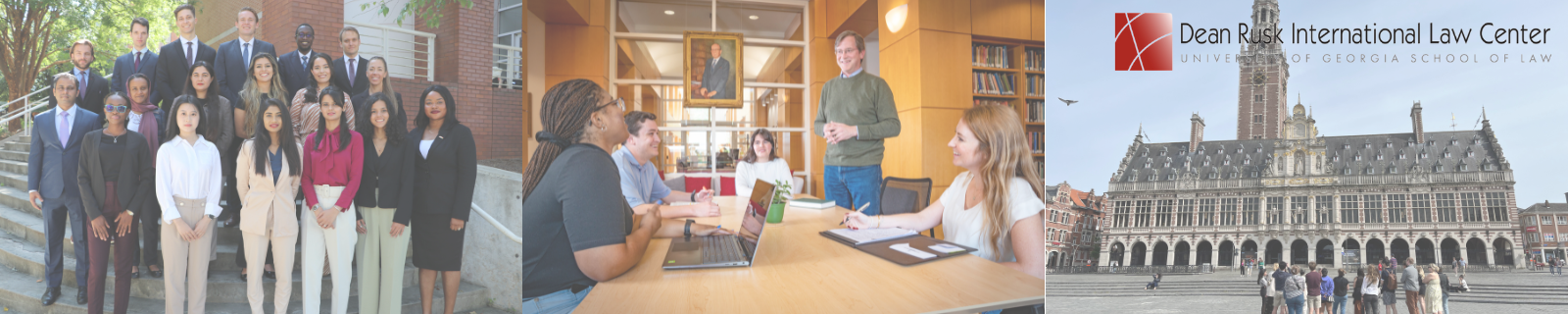
The group of 18 hails from 14 different countries in Africa, Asia, Europe, and the Americas, including Nigeria, Ethiopia, India, Germany, Argentina, Romania, Brazil, Russia, Côte d’Ivoire, Ukraine, Ghana, China, Bangladesh, and Afghanistan. Among them are lawyers and other professionals specializing in a wide range of fields including corporate law, alternative commercial dispute resolution, immigration law, bankruptcy law, family law, corporate sports law, international trade, business law, cybersecurity and digital fraud, refugee and asylum law, technology law, tax law, and criminal law.
They are pictured above, standing on the steps of Dean Rusk Hall. From the left to right – top row: Daniel Danca, Bohdan Krivuts, Savelii Elizarov, Cornelius Bulanov, N’guessan Clément Kouame, Jonas Römer; middle row: Md Mushfiqur Rahman, Eman Abdella Ali, Quraisha Sherzad, Raissa dos Santos Bastos Rolim, Gracia Varinia Rojas Mina Bogliotti, Agostina Calamari; bottom row: Victoria Agbakwuru, Xinyi Nie, Shivani Ravi Prakash, Naina Bishnoi, Amanda Pinto, and Lydia Lartey.
This Class of 2024 joins a tradition that began at the University of Georgia School of Law in the early 1970s, when a Belgian lawyer became the first foreign-trained practitioner to earn a UGA Law LL.M. degree. In the ensuing four decades, the law school and its Dean Rusk International Law Center have produced nearly 600 LL.M. graduates, with ties to nearly 100 countries and every continent in the world.
Side by side with J.D. candidates, LL.M.s follow a flexible curriculum tailored to their own career goals – goals that may include preparation to sit for a U.S. bar examination, or pursuit of a concentration affording advancement in their home country’s legal profession or academic institutions.
The application for the LL.M. Class of 2025 is now open; for information or to apply for LL.M. studies, see here.
For more than century before World War II, traders, merchants, financiers, and laborers steadily moved between places on the Indian Ocean, trading goods, supplying credit, and seeking work. This all changed with the war and as India, Burma, Ceylon, and Malaya wrested independence from the British empire. Set against the tumult of the postwar period, Boats in a Storm centers on the legal struggles of migrants to retain their traditional rhythms and patterns of life, illustrating how they experienced citizenship and decolonization. Even as nascent citizenship regimes and divergent political trajectories of decolonization papered over migrations between South and Southeast Asia, migrants continued to recount cross-border histories in encounters with the law. These accounts, often obscured by national and international political developments, unsettle the notion that static national identities and loyalties had emerged, fully formed and unblemished by migrant pasts, in the aftermath of empires.
Drawing on archival materials from India, Sri Lanka, Myanmar, London, and Singapore, Kalyani Ramnath narrates how former migrants battled legal requirements to revive prewar circulations of credit, capital, and labor, in a postwar context of rising ethno-nationalisms that accused migrants of stealing jobs and hoarding land. Ultimately, Ramnath shows how decolonization was marked not only by shipwrecked empires and nation-states assembled and ordered from the debris of imperial collapse, but also by these forgotten stories of wartime displacements, their unintended consequences, and long afterlives.
On September 21 at 4:00 pm, at the University of Georgia Zell Miller Learning Center, a book release and reception will be held in honor of Professor Ramnath’s work. This event is open to the public.
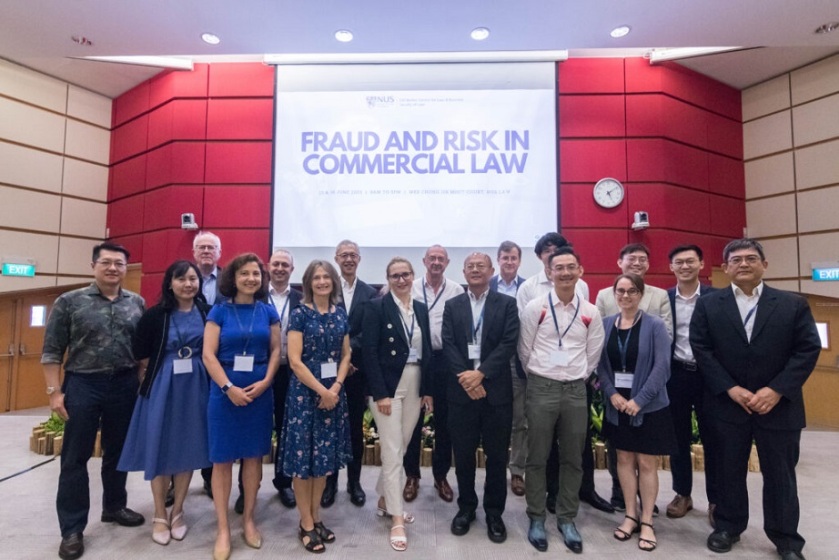
Professor Christopher Bruner, the Stembler Family Distinguished Professor in Business Law and a newly appointed Faculty Co-Director of the Dean Rusk International Law Center, presented “Managing Fraud Risk in the Age of AI” at the National University of Singapore (NUS) in June.
Artificial Intelligence (AI) applications are widely expected to revolutionize every dimension of business. This paper explores current and potential impacts of AI on corporate management of fraud risk in both operational and compliance contexts. Much attention has been paid to the operational efficiencies that AI applications could enable in numerous industry settings, and such systems have already become central to a range of services in certain industries – notably finance. Heavy reliance on algorithmic processes can be expected to give rise, however, to a range of risks, including fraud risks. New forms of internal fraud risk, emanating from intra-corporate actors, as well as external fraud risk, emanating from extra-corporate actors, are already placing greater demands on the compliance function and requiring greater corporate investment in responsive AI capacity to keep pace with the evolving risk management environment. At the same time, these developments have already begun to prompt reevaluation of conventional legal theories of fraud that took shape, in commercial and financial contexts alike, by reference to human actors, as opposed to algorithmic processes.
The paper begins with an overview of growing operational reliance upon increasingly sophisticated AI applications across various industry settings, reflecting the increasingly data-intensive nature of modern business. It then explores forms of internal and external fraud risk that may arise from efforts to exploit weaknesses in operational AI, which efforts may themselves involve sophisticated deployment of malicious extra-corporate AI applications – ‘offensive AI’, as the cyber security industry describes it. This can in turn be expected to require responsive corporate efforts in the form of ‘defensive AI’, and the paper describes burgeoning efforts along these lines, as well as the increasing pressure to devote substantial resources and managerial attention to these dynamics that may arise from both corporate law and commercial realities. Finally, the paper analyzes shortcomings of conventional legal theories of fraud in this context. Here the paper assesses the difficulty of applying concepts such as deception, scienter, reliance, and loss causation to algorithmic processes lacking conventional capacity for intentionality and defying conventional explanation as to how inputs and outputs logically relate – a reflection of the AI ‘black box’ problem. The paper concludes with proposals to reform corporate oversight duties to incentivize managerial attention to these issues, and to reform conventional legal theories of fraud to disincentivize malicious AI applications.
University of Georgia School of Law Professor Diane Marie Amann, an expert on child and human rights, international criminal law, and the laws of war, presented a lecture entitled “Child-Taking and the International Criminal Arrest Warrant” at University College London Faculty of Laws in June.
News that the International Criminal Court is seeking the arrest of Russia’s President, Vladimir Putin, and Child Rights Commissioner, Maria Lvova-Belova, drew attention to the war crimes charged: “unlawful deportation of population (children)” and “unlawful transfer of population (children) from occupied areas.” Professor Amann’s lecture examined these and similar crimes, which she labels “child-taking.” International child-taking trials date to the Nuremberg tribunals, and have continued in modern forums like the ICC. Court records demonstrate that child-taking is no minor crime. Its present gravity and future consequences are heavy; so too, the prosecutorial burdens of securing indictments, conviction, and redress.
This presentation was chaired by UCL Professor of Public International Law, Martins Paparinskis.
Amann is the Regents’ Professor of International Law, the Emily & Ernest Woodruff Chair in International Law, and a Faculty Co-Director of the Dean Rusk International Law Center.
We at the University of Georgia School of Law Dean Rusk International Law Center are pleased to welcome a new Visiting Research Scholar: Mine Turhan, Assistant Professor of Administrative Law in the Faculty of Law at the Izmir University of Economics in Türkiye. She holds an LL.M. degree and a Ph.D. in Public Law from Dokuz Eylül University in Izmir, Türkiye.
Professor Turhan plans to conduct research on comparative administrative procedure between the United States and the European Union during her stay at the Dean Rusk International Law Center. Her project will focus on procedural due process rights, in particular the right to be heard before administrative agencies, and it will analyze how individual rights are protected by different procedures in the U.S. and the European Union against arbitrary actions on the part of administrative agencies.
Professor Turhan is sponsored as a Visiting Research Scholar by UGA Law Professor David E. Shipley, the Georgia Athletic Association Professor in Law. Professor Shipley teaches administrative law and civil procedure.
Turhan’s research is supported by a fellowship from the Scientific and Technological Research Council of Türkiye (TÜBİTAK) within the scope of the International Postdoctoral Research Fellowship Program. Her visit continues our Center’s long tradition of hosting scholars and researchers whose work touches on issues of international, comparative, or transnational law. Details and an online application to become a visiting scholar here.






 exchange of notes