University of Georgia School of Law student and Dean Rusk International Law Center Student Researcher Adoris M. Gibbs (J.D. ’26) received the Law School Student Excellence in Access to Justice Award from the State Bar of Georgia. Gibbs was nominated for “her passion and commitment to advocating for justice and increasing access to legal services.”
In her role at the Center, Gibbs assists with integral Center tasks, including: researching Center history, drafting blog posts, conducting research on peer and aspirational institutions, designing social media graphics, assisting with Center event setup and cleanup, and promoting the law school’s international programs at law school and university-wide events. Gibbs participated in Global Governance Summer School in summer 2025, which is administered by the Center.
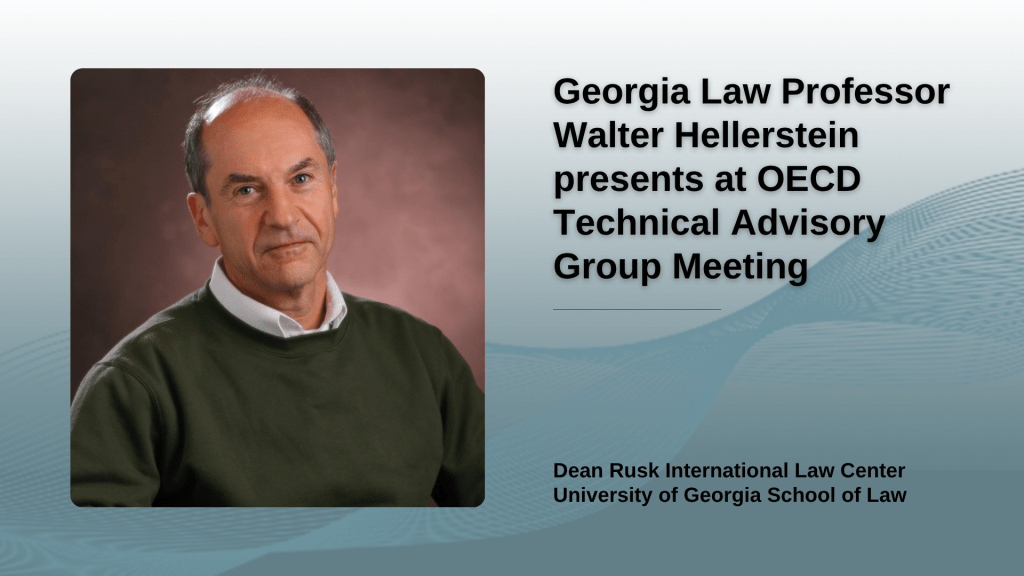
University of Georgia School of Law Professor Emeritus Walter Hellerstein presented at the Organisation for Economic Cooperation and Development Technical Advisory Group to Working Party No. 9 on Consumption Taxes meeting in October in Paris, France.
The Working Party No. 9 on Consumption Taxes is a forum for the discussion of consumption tax policy and administration, working with both Members and non-Members of the OECD to develop appropriate and effective taxation outcomes.
Hellerstein is the Distinguished Research Professor & Francis Shackelford Distinguished Professor in Taxation Law Emeritus. He is a recipient of the National Tax Association’s Daniel M. Holland Medal for outstanding lifetime contributions to the study and practice of public finance, is widely regarded as the nation’s leading academician on state and local taxation. He has authored numerous books, textbooks, and law review articles, and has practiced extensively in the field. Hellerstein is currently a Visiting Professor at the Vienna University of Economics and Business, and he remains actively involved in his scholarship, consulting, and, in particular, his work as an academic advisor to the OECD.
Amann is Regents’ Professor of International Law, Emily & Ernest Woodruff Chair in International Law, and a Faculty Co-Director of our Dean Rusk International Law Center here at Georgia Law. During her current research-intensive semester, she is an Affiliate Academic at University College London Faculty of Laws.
Her chapter appears in The Oxford Handbook on Women and International Law, co-edited by Professors J. Jarpa Dawuni (Howard University), Nienke Grossman (University of Baltimore), Jaya Ramji-Nogales (Temple University), and Hélène Ruiz Fabri (Université Paris 1 Panthéon-Sorbonne). The thirty-five-chapter volume spans many topics – topics that its four dozen authors explore through a variety of methods, including substantive legal analysis, legal history, and global critical race feminism.
Amann’s chapter draws from research that she had presented online as part of “In/ex-clusiveness of the Legal Construction of Justice,” a panel of the 17th Annual Conference of the European Society of International Law, held in 2022 at Utrecht University in The Netherlands.
Women seldom surface in conventional accounts of the many war crimes trials that took place after World War II. Yet as this chapter shows, hundreds of women lawyers and other professionals were present, thus helping to lay the foundations of an international criminal justice project that continues to this day. Combining methodologies of narrative with theories sounding in global legal history and feminist scholarship and discussing what it reveals as dances of absence-presence, visible-invisible, and inclusion-exclusion, this chapter first examines how and why women were absented and then surfaces their contributions. It concludes with a look at contemporary international legal practice.
The University of Georgia School of Law’s Dean Rusk International Law Center is pleased to announce that our Master of Laws (LL.M.) degree program will be represented at several upcoming recruiting events in Europe this month.
The LL.M. degree at Georgia Law offers foreign-educated law graduates opportunities to learn about the U.S. legal system, deepen knowledge of an area of specialization, and explore new legal interests at one of the nation’s top law schools. The ten-month program provides individualized support through the Center and prepares internationally trained students for a globalized legal market.
In Brussels, Belgium, Georgia Law’s Mandy Dixon, International Professional Education Manager, will participate in the EducationUSA LL.M. Fair on Monday, November 4, from 6:00 to 8:00 p.m. The event will take place at the Deloitte Legal offices at the Brussels Airport, offering prospective students the opportunity to learn more about legal study in the United States and at Georgia Law in particular.
In Paris, France, Dixon will join the EducationUSA LL.M. Fair on Tuesday, November 5, from 6:00 to 8:30 p.m. The fair will be held at Sciences Po Paris. The fair will be preceded by a country briefing for university representatives featuring remarks from a Sciences Po faculty member. While in Paris, Dixon will also visit the Maison Internationale at Université Paris 1 Panthéon-Sorbonne to share information and materials about Georgia’s LL.M. program.
Finally, Dixon’s travels will conclude in Frankfurt, Germany, where she will participate in LL.M. Days, a recruiting event organized by e-fellows.net, on Friday, November 15, from 10:30 a.m. to 4:30 p.m. at IHK Frankfurt. Georgia Law alumna Franzisca Heinze (LL.M. ’21) will join Dixon to share her experiences as a student in the program. While in Frankfurt, Dixon will also meet with another alumna, Fabienne Taller (LL.M. ’25).
Georgia Law looks forward to meeting talented lawyers and law graduates from across Europe who are interested in advancing their legal education in the United States. For information about upcoming virtual and in-person recruiting events, visit our webpage.
University of Georgia School of Law Professor Desirée LeClercq was featured in Inside U.S. Trade regarding rapid-response mechanism petitions under the U.S.-Mexico-Canada Agreement. The article titled “RRM ‘black boxing’ spurs solidarity among tri-national labor reps” was written by Margaret Spiegelman and published 10/14/25.
LeClercq joined the University of Georgia School of Law in 2024 as an assistant professor. She teaches Contracts, International Trade and Workers Rights, International Labor Law, International Law and U.S. Labor Law, and Public International Law. She also serves as a faculty co-director of the Dean Rusk International Law Center and as the faculty adviser for the Georgia Journal of International and Comparative Law.
Mine Turhan, who was a Visiting Researcher at the University of Georgia School of Law’s Dean Rusk International Law Center during the 2023-2024 academic year, recently published a book, The Right to Be Heard in Administrative Procedure. Her book, written in Turkish, draws upon the research Turhan conducted during her time as a Visiting Researcher at the Center.
Turhan is an assistant professor of administrative law in the Faculty of Law at the Izmir University of Economics in Türkiye. While at Georgia Law, Turhan was sponsored by Professor David E. Shipley. Her project focused on procedural due process rights, in particular the right to be heard before administrative agencies, and it analyzed how individual rights are protected by different procedures in the U.S. and EU against arbitrary actions on the part of administrative agencies. Turhan’s research was supported by a fellowship from the Scientific and Technological Research Council of Türkiye (TÜBİTAK) within the scope of the International Postdoctoral Research Fellowship Program.
Regarding how her experience as a Visiting Researcher at Georgia Law contributed to her book, Turhan reflected:
The United States possesses a highly developed system of administrative procedure and adjudication. My experience as an observer in administrative hearings at the Georgia Office of State Administrative Hearings and in the Immigration Court in Atlanta provided an invaluable opportunity to examine the functioning of the administrative hearing process within American administrative law firsthand. This experience significantly strengthened the empirical foundation of my research by allowing me to gain direct insight into the practical implementation of administrative procedure in the United States.
Below is the introduction of the book, translated into English by Turhan:
The right to be heard is one of the most fundamental principles of administrative procedure. This right allows individuals whose legal status may be adversely affected by an administrative act to express themselves before the decision is taken. Limiting this right to judicial proceedings is not sufficient to protect individuals against the administration. In accordance with the principle of the rule of law, individuals must also be protected before an administrative act is taken. The right to be heard provides individuals with the opportunity to actively participate in the administrative decision-making process, thereby serving as an important procedural safeguard that prevents the administration from making unlawful decisions. In this respect, the right to be heard is directly linked to several principles at the core of administrative procedure law, such as good administration, participation, transparency, accountability, and legal certainty. This book examines the right to be heard in administrative procedure both within the framework of Turkish administrative procedure law and from a comparative law perspective. The main objective of the book is to offer recommendations for ensuring the effective regulation and implementation of the right to be heard in Türkiye, taking into account examples from other countries, particularly the United States. To this end, the right to be heard in administrative procedure law has been analyzed in all its aspects.
In conversation with Georgia Law student Isaac Clement (J.D. ’27), Mullins discussed her career trajectory in national security. She provided law students with an overview of her educational background as well as her work in the Army, on Capitol Hill, with the U.S. Department of Defense, and in academia. She answered questions from law students about military and national security law, the intersections of law and policy, considerations for political and apolitical work, the importance of international education and language learning, and general advice for students interested in national security careers.
This talk was co-sponsored by the International Law Society, Armed Forces Association, Middle Eastern Law Students Association, and Law Democrats.
Mullins is the Director of Public Options and Governance at the Vanderbilt Policy Accelerator, where she researches and writes on defense acquisition and civil service reform. She is also an Assistant Adjunct Professor at Georgetown University’s Center for Security Studies.
Previously, Mullins served as Senior Advisor to the Deputy Secretary of Defense and as Senior Advisor for National Security to the Chair of the U.S. Export-Import Bank. Earlier in her career, she worked in the U.S. Senate on defense and foreign policy issues, including as national security advisor to Georgia Senator Raphael Warnock, and served as an intelligence officer in the U.S. Army, deploying to Afghanistan in 2013.
Mullins holds a BSFS from Georgetown University’s School of Foreign Service, an MPA from Princeton University’s School of Public and International Affairs, and a JD from Georgetown University Law Center. She has been a Council on Foreign Relations Term Member and is a member of the Truman National Security Project.
University of Georgia School of Law Professor Desirée LeClercq recently delivered a presentation for the Foreign, Commonwealth & Development Office’s Trade & Economic Diplomacy Faculty entitled “Growing Employment Through Trade: The Role of Fair Labour Standards.”
LeClercq discussed the evolution of international labor standards, noting how rules once designed to protect workers and improve living conditions are now used by countries such as the United States to enforce rights abroad and reshape global supply chains. Drawing on her experience as director of labour affairs at the Office of the U.S. Trade Representative and as a legal officer at the International Labour Organization, she illustrated this trend through examples from the United States-Mexico-Canada Agreement (USMCA).
LeClercq joined the University of Georgia School of Law in 2024 as an assistant professor. She teaches Contracts, International Trade and Workers Rights, International Labor Law, International Law and U.S. Labor Law, and Public International Law. She also serves as a faculty co-director of the Dean Rusk International Law Center and as the faculty adviser for the Georgia Journal of International and Comparative Law.
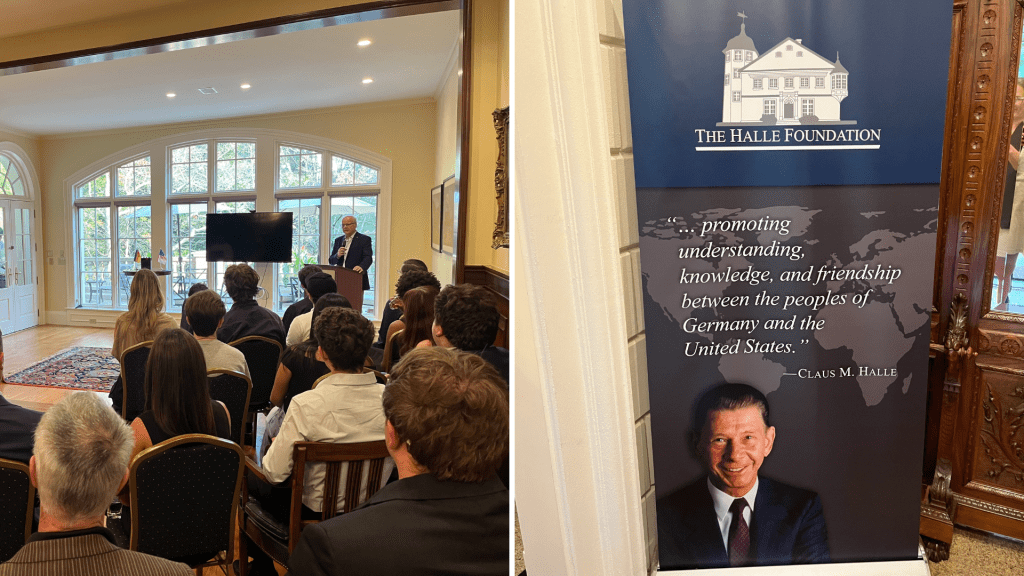
Last week, the University of Georgia School of Law’s Dean Rusk International Law Center participated in a dinner reception celebrating global education and the philanthropic generosity of the Halle Foundation, supporting American-German educational exchange. This event was jointly sponsored by the University of Georgia’s Department of Germanic and Slavic Studies and the Office of Global Engagement.
The mission of The Halle Foundation is to promote understanding, knowledge, and friendship between the people of Germany, as seen in its European context, and those of the United States. In furtherance of this mission, the Foundation supports, primarily through grantmaking, initiatives and activities with a preference to organizations and institutions operating within, or with some discernable connection to, the state of Georgia. UGA has several international mobility initiatives, including Georgia Law’s semester-long Global Externships Overseas (GEO) initiative, that are beneficiaries of the Halle Foundation.
The evening program began with welcoming remarks by Dr. Eike Jordan, Chairman of the Board of Trustees of the Halle Foundation and Dr. Martin Kagel, Associate Provost for Global Engagement, UGA Office of Global Engagement. Then, faculty and administrators at UGA who oversee initiatives benefitting from the Halle Foundation’s support spoke about the impact that their grants have on students. Speakers included: Dr. Jan Uelzmann, Co-Director of Film, Art, and Cultural History in Berlin program; Dr. Heide Crawford, Co-Coordinator of ENGR-GRMN Dual Degree Program, Director of the Freiburg Study Abroad program; and Sarah Quinn, Director of the Dean Rusk International Law Center.
Then, UGA students shared reflections about what their time abroad in Germany meant to them academically, professionally, and personally. Georgia Law student Pace Cassell (J.D. ’26) spoke about her experience as a legal extern at Baker Tilly in Hamburg, Germany during the spring 2025 semester through the semester-long GEO initiative, jointly administered by the Center and the DC Semester in Practice. Cassell is the recipient of a grant from the Halle Foundation, awarded to the law school in summer 2024 to support six students over three years participate in semester-long externships in Germany.
***
Applications are open for fall 2027 semester-long Global Externships Overseas (GEOs). All current 1Ls and 2Ls are invited to submit an application by February 15. For more information and the application, please email: ruskintlaw@uga.edu
Today, we welcome a guest post by Georgia Law alumnus Alexandre Jorge Fontes Laranjeira, who graduated with his Master of Laws (LL.M.) degree in 2023. Laranjeira recently represented the law school at the EducationUSA LL.M. Fair held in Brasília, Brazil. Laranjeira is currently a Federal Court of Appeals Judge for the First Region in Brazil. In this role, he sits on a three-judge panel that primarily handles appeals related to the role of Federal Regulatory Agencies, and appeals concerning Education Law, Health Law, Patent Law, Environmental Law, and Banking Law. Prior to his current appointment, Laranjeira served as a Federal District Court Judge for nearly 31 years. His extensive judicial career includes overseeing Federal District Courts in four different states across Brazil, with a notable tenure of four and a half years in the Amazon Region. His experience in these diverse jurisdictions has endowed him with a profound understanding of environmental and indigenous populations matters. Before ascending to the bench, Laranjeira was a Career Prosecutor for the Federal District in Brazil, where he honed his legal acumen and prosecutorial skills. Despite residing in Brazil, he is a registered mediator with the Georgia Office of Dispute Resolution, a credential he obtained through the Georgia Law Mediation Clinic course.Laranjeiraserves as a member of the Dean Rusk International Law Center’s Advisory Council.
On October 9, 2025, I represented the University of Georgia School of Law at the EducationUSA LL.M. Fair held in Brasília, Brazil. The event was part of the EducationUSA Latin America LL.M. Tour Fall 2025, which included visits to Mexico, Brazil, Paraguay, Uruguay, Argentina, Chile, Peru, and Colombia. The Brazilian portion of the tour covered four major cities (Brasília, Rio de Janeiro, Curitiba, and São Paulo), all of which are among the most significant cultural and academic centers in my home country.
As a member of the Dean Rusk International Law Center Council, I volunteered for this opportunity to engage directly with Brazilian candidates interested in Georgia Law’s Master of Laws (LL.M.) degree program. My goal was not only to connect with prospective students, but also to promote Georgia Law’s international programs within my hometown and among members of the local legal community.
Representing Georgia Law at an international fair was an enriching experience on both personal and professional levels. I interacted with numerous law students eager to pursue international academic opportunities and met many talented and motivated individuals seeking to enhance their legal education abroad. As a Georgia Law LL.M. alumnus, I was able to share firsthand insights about the academic excellence, vibrant community, and welcoming environment that characterize life in Athens, Georgia.
I am deeply grateful to Anelise Hofmann, EducationUSA Country Coordinator, and Jefferson Couto, the local EducationUSA representative in Brasília, for their invaluable support throughout the fair. I also extend my thanks to Mandy Dixon, International Professional Education Manager, and Sarah Quinn, Director of the Dean Rusk International Law Center, for their guidance and for providing all the materials necessary to represent UGA at this important event.
***
MASTER OF LAWS (LL.M.) APPLICANTS:The application for Georgia Law’s LL.M. class of 2027 is now open. Detailed information about the degree program and how to apply can be found here. Recruiting events, both virtual and in-person, are listed here.







 exchange of notes