Georgia Law Professor Assaf Harpaz presents at International Roundtable on Taxation and Tax Policy

University of Georgia School of Law professor Assaf Harpaz presented his draft paper “Global Tax Wars and the Shift to Source-Based Taxation” and chaired the “Jurisprudence and Enforcement” panel at the 8th International Roundtable On Taxation And Tax Policy during July.

Below is an abstract from the draft paper:

Current debates in international taxation frequently engage with the concept of global tax fairness, relating to the equitable allocation of taxing rights between jurisdictions. These questions emerge within an international tax framework at a critical juncture. In a rapidly evolving digital economy, intergovernmental organizations are battling to shape the cross-border tax agenda. Global North economies have dominated this regime through the Organisation for Economic Co-operation and Development (OECD), which has drawn backlash due to its undemocratic procedure and unfavorable outcomes for developing countries. Meanwhile, the United Nations has occupied a relatively peripheral role in global tax governance. However, its role could change with the establishment of a new Framework Convention on International Tax Cooperation – an initiative overwhelmingly supported by the world’s developing countries.

The article conceptualizes the contemporary international tax discourse as “tax wars,” contrasting the taxing powers and interests of the OECD-led Global North with those of the UN-backed Global South. It explores the standards and preferences that have underpinned the regime since its inception, focusing on residence and source taxation. The article argues for a shift towards source-based taxation, drawing on procedural and distributive justice principles. To do so, the article proposes expanding the permanent establishment standard in model treaty language, creating an opportunity for broader taxation of business profits in the source country. This transition will address longstanding disparities and is increasingly warranted in a digital economy that does not rely on physical presence.

Assaf Harpaz joined University of Georgia School of Law as an assistant professor in summer 2024 and will teach classes in federal income tax and business taxation. Harpaz’s scholarly focus lies in international taxation, with an emphasis on the intersection of taxation and digitalization. He explores the tax challenges of the digital economy and the ways to adapt 20th-century tax laws to modern business practices.
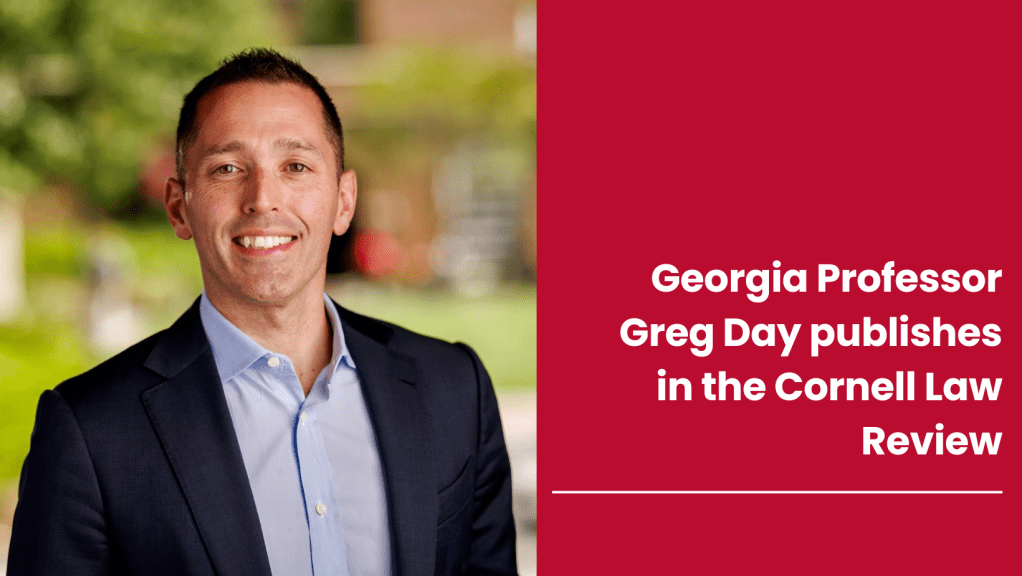
Georgia Professor Greg Day publishes in the Cornell Law Review

Greg Day, Associate Professor of Legal Studies at the Terry College of Business and professor (by courtesy) at the University of Georgia School of Law, published “Antitrust for Immigrants” in the Cornell Law Review.

Below is an abstract from the draft paper:

Immigrants and undocumented people have often encountered discrimination because they compete against “native” businesses and workers, resulting in protests, boycotts, and even violence intended to exclude immigrants from markets. Key to this story is government’s ability to discriminate as well: it is indeed common for state and federal actors to enact protectionist laws and regulations meant to prevent immigrants from braiding hair, manicuring nails, operating food trucks, or otherwise competing. But antitrust courts have seldom mentioned a person’s immigration status, much less offered a remedy.

This Article shows that antitrust’s “consumer welfare” standard has curiously ignored the plight of immigrants. Part of the reason is that antitrust law is characterized as a “colorblind” regime benefitting consumers collectively, meaning that it isn’t supposed to prioritize insular groups such as immigrants. Courts and scholars have also described matters of inequality and discrimination as “social harms” existing beyond antitrust’s scope. In fact, antitrust lawsuits have successfully sought to drive immigrants out of markets, alleging that competitors gained an “unfair” advantage from employing undocumented workers. Under this view of antitrust law, the exclusion of immigrants is an appropriate way of promoting competition.

This Article argues that anti-immigrant discrimination creates the exact types of harms that antitrust was meant to remedy. Since excluding immigrants can misallocate resources on citizenship or racial lines as opposed to their most productive usages, certain acts of discrimination should entail “conduct without a legitimate business purpose,” even when based solely on racial animus. A hidden type of market power is revealed in that foreign-born people are less able to employ self-help remedies to correct market failures. In addition to analyzing antitrust’s purpose and economic foundation, this Article delves into antitrust’s history to show that an original function of competition law was to protect foreigners. By demonstrating how incumbents can inflict greater levels of harm on immigrants while wielding less market power, this Article reimagines the consumer welfare standard and its colorblind approach as well as reveals how marginalized communities defy antitrust’s assumptions of self-help remedies.

Greg Day is an Associate Professor of Legal Studies at the Terry College of Business and holds a courtesy appointment in the School of Law. He is also an Affiliated Fellow at Yale Law School’s Information Society Project as well as the University of North Carolina’s Center for Information, Technology, and Public Life. His research has primarily focused on the intersection of competition, technology, innovation, and privacy as well as the disparate impact of anticompetitive conduct.

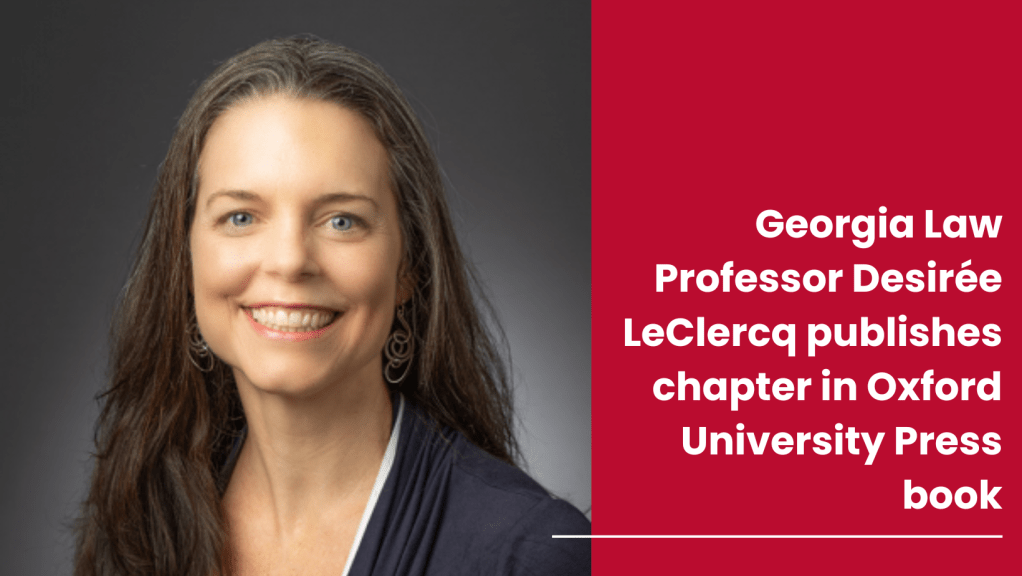
Georgia Law Professor Desirée LeClercq publishes chapter in Oxford University Press book

Assistant Professor Desirée LeClercq published “Enforcing International Sustainability Standards on International and National Platforms” in The Sustainability Revolution in International Trade Agreements (G. Vidigal and K. Claussen, eds.) (Oxford University Press, 2024).

Below is a description of the book:

Once seen as aspirational and relatively innocuous, ‘sustainability’ or ‘sustainable development’ provisions are now changing the face of international trade agreements. The Sustainability Revolution in International Trade Agreements gathers fundamental, first-hand analyses of these novel commitments across dozens of agreements, considering their legal, political, and economic aspects.

Drawing on perspectives from different parts of the world and engaging experts in the law and practice of sustainability provisions, this volume offers a comprehensive assessment of the latest developments and innovations in international trade agreements. It also evaluates the development challenges that sustainability requirements pose for countries with limited resources and capacity, for whom lower labour and environmental regulatory costs have been a competitive asset.

The present volume explores the intersectional aspects of sustainability – such as gender equality, biodiversity, animal welfare, and Indigenous rights – in addition to the more traditional dimensions of sustainability, namely economic development, environmental conservation, and improvement of labour standards.

There is little doubt that a sustainability revolution in global production patterns is needed. Considering the details of its operation – how it can come into being, who will bear the increased production costs, and how decisions on difficult trade-offs will be made – reveals the immense challenges involved in developing a new international law for sustainable trade. Read together, the chapters in this volume outline the contours this emerging legal framework, examine its practical operation, and offer important reflections upon the real extent and the foreseeable consequences of this sustainability revolution in international trade agreements.

Desirée LeClercq joined the University of Georgia School of Law in 2024 as an assistant professor. She teaches International Trade and Workers Rights, International Labor Law, International Law and U.S. Labor Law. She also serves as a faculty co-director of the Dean Rusk International Law Center and as the faculty adviser for the Georgia Journal of International and Comparative Law.

Georgia Law Professor Bruner presents at London School of Economics and Political Science (LSE)

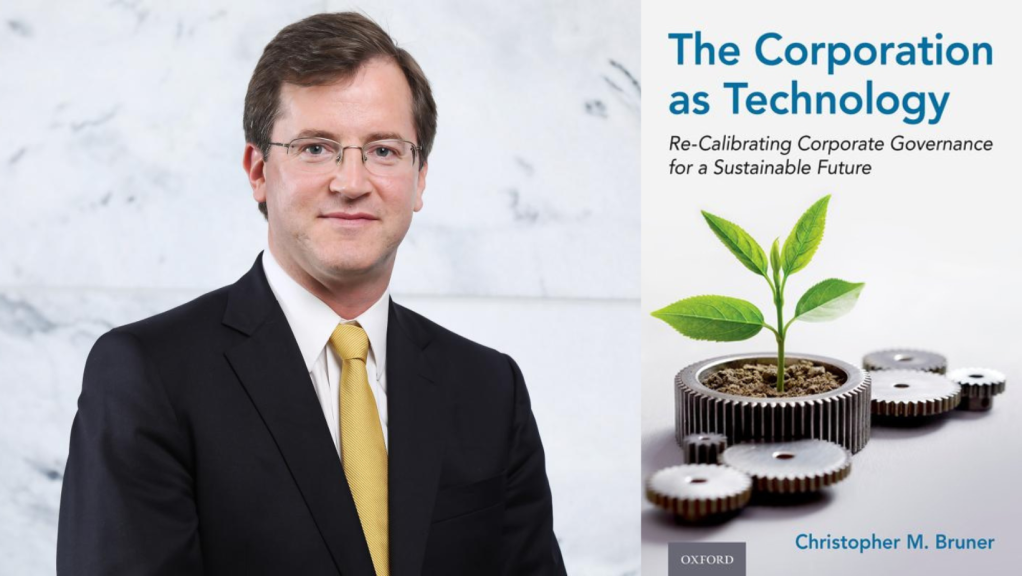
Christopher M. Bruner, Stembler Family Distinguished Professor in Business Law and Faculty Co-Director of the Dean Rusk International Law Center, presented his book, The Corporation as Technology: Re-Calibrating Corporate Governance for a Sustainable Future (Oxford University Press 2022) at the London School of Economics and Political Science (LSE) in June.

Below is a description of the book:

Recent decades have witnessed environmental, social, and economic upheaval, with major corporations contributing to a host of interconnected crises. The Corporation as Technology examines the dynamics of the corporate form and corporate law that incentivize harmful excesses and presents an alternative vision to render corporate activities more sustainable.

The corporate form is commonly described as a set of fixed characteristics that strongly prioritize shareholders’ interests. This book subverts this widely held belief, suggesting that such rigid depictions reinforce harmful corporate pathologies, including excessive risk-taking and lack of regard for environmental and social impacts. Instead, corporations are presented as a dynamic legal technology that policymakers can re-calibrate over time in response to changing landscapes.

This book explores the theoretical and practical ramifications of this alternative vision, focusing on how the corporate form can help secure an environmentally, socially, and economically sustainable future.

Rachel Galloway, British consul general in Atlanta, speaks at Georgia Law

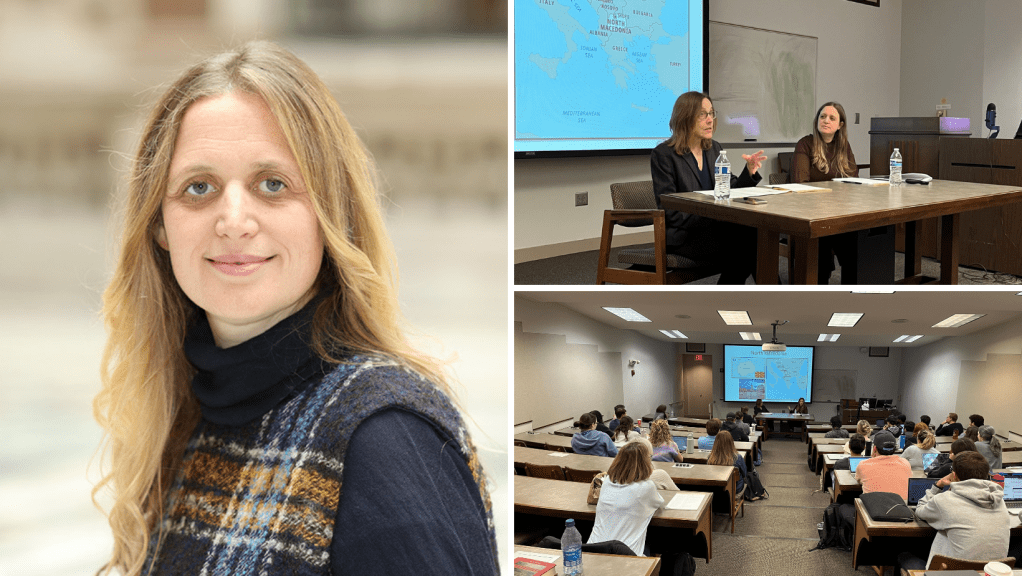
In March, the British consul general in Atlanta, Rachel Galloway, delivered a lecture at the University of Georgia School of Law, “From Alexander the Great to NATO, reflections on four years as the UK’s Ambassador to North Macedonia.”

Galloway spoke with students about her diplomatic career, including her post as the United Kingdom’s Ambassador to North Macedonia. She was joined in conversation by Diane Marie Amann, Regents’ Professor of International Law, Emily & Ernest Woodruff Chair in International Law, Faculty Co-Director of the Dean Rusk International Law Center. Galloway’s talk was the most recent installment of the Dean Rusk International Law Center’s ongoing Consular Series, which presents students, staff, and faculty with global perspectives on international trade, cooperation, development, and policy.

Galloway assumed her current post as the British consul general in Atlanta in 2022, replacing former consul general Andrew Staunton. Staunton gave a presentation at Georgia Law in 2019 as part of the Center’s ongoing Consular Series. Galloway has more than 20 years of diplomatic experience; she started her career with the Foreign, Commonwealth and Development Office in 2000 and spent three years chairing the Maghreb working group at the European External Action Service. She has also held roles as the U.K. Permanent Representation to Brussels (2012-15), deputy head of the FCO’s International Organisations Department (2008-11) and head of the Darfur section of the Sudan unit in the FCO’s international development department (2007-08). Galloway spent a brief stint on a provincial reconstruction team in Helmand, Afghanistan, in 2006, that same year serving on the counter-terrorism review team in Her Majesty’s Treasury. Her only prior posting in the U.S. prior to her current role was a four-year assignment in Washington as second secretary in the political section at the British Embassy from 2002-06.

Community HeLP Clinic receives pledge from Thorpe family

The University of Georgia School of Law has announced the creation of the Community Health Law Partnership Clinic Fund. The Thorpe family, which includes 2014 alumnus Benjamin W. “Ben” Thorpe and his mother Dr. Barbara Williams, has pledged $350,000 to enable the clinic to build on its tradition of interdisciplinary advocacy at the intersection of immigration status and health.

Under the direction of Associate Dean for Clinical Programs and Experiential Learning and J. Alton Hosch Associate Professor of Law Jason A. Cade, more than 100 individuals received legal services from the clinic last year. This included clients who were granted asylum, secured immigration relief, and those challenging the abuses they endured while in U.S. immigration detention.

The clinic’s first post-graduate fellow, Thomas Evans, will join the Community HeLP team in July, 2024. Evans is a 2022 magna cum laude graduate of the law school who participated in both the Community HeLP clinic and the Jane Wilson Family Justice Clinic and received the Ellen Jordan Award for Outstanding Public Interest Student. He is currently a staff attorney in the pro se office at the 11th Circuit Court of Appeals.

To learn more about the Community HeLP Clinic and their advocacy work in immigration, click here.

Ellen Clarke (J.D., ’14), security counsel at Google, speaks at Georgia Law

University of Georgia School of Law alumna Ellen Clarke (J.D., ’14), security counsel at Google, recently spoke to students about her career in data protection law at the Dean Rusk International Law Center’s Louis B. Sohn Library.

Students from Georgia Law’s International Law Society and Privacy, Security, and Technology Law Society attended the talk. Clarke began by discussing her professional background and explaining how her experience prosecuting white collar crime at the U.S. Department of Justice provided her with the skills and experiences to successfully transition into her current role at Google. As security counsel, Clarke advises on global data security and law enforcement issues. Students asked Clarke about her opinions on Artificial Intelligence, her decision to become a licensed solicitor in England and Wales, and about the realities of her day-to-day work at Google.

Before joining Google, Clarke prosecuted competition crimes as a trial attorney in the Washington Criminal I Section of the Antitrust Division of the U.S. Department of Justice. She joined the DOJ through the Attorney General’s Honors Program. Clarke previously served as a law clerk to Judge Richard W. Story of the U.S. District Court for the Northern District of Georgia. She received an Advanced Diploma in Data Protection Law from the Honorable Society of King’s Inns, a J.D. degree magna cum laude from the University of Georgia School of Law, and a B.S. in Foreign Service from Georgetown University. She is licensed as an attorney in Georgia and Washington, D.C., as registered in-house counsel in California, and as a solicitor in England and Wales. Clarke is currently an Adjunct Professor of Law at Georgia Law, where she teaches a mini-course entitled Cybercrime.

Georgia Law Professor Bruner publishes book review in Cambridge International Law Journal

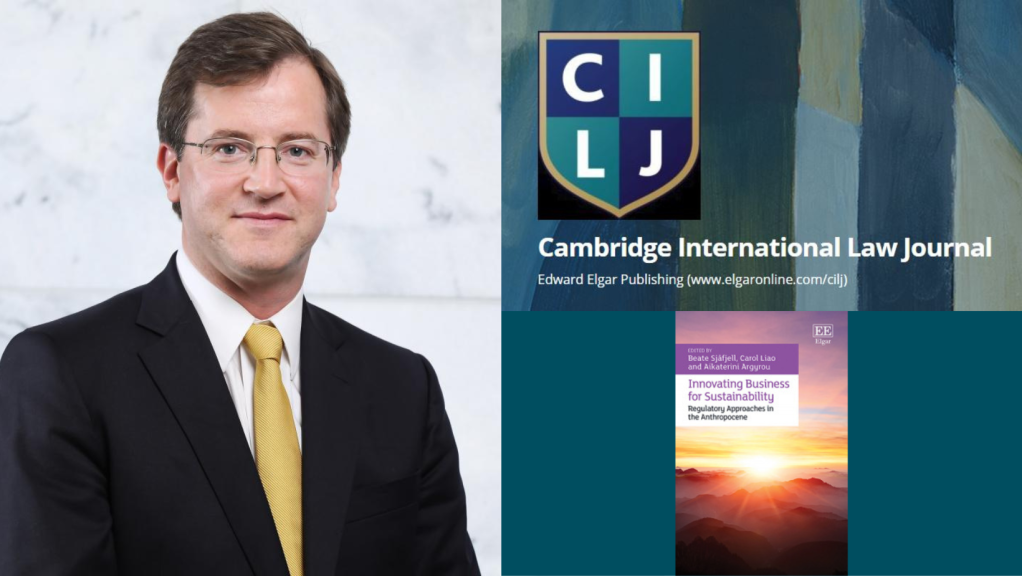
Christopher M. Bruner, Stembler Family Distinguished Professor in Business Law and Faculty Co-Director of the Dean Rusk International Law Center, published a review of a book titled Innovating Business for Sustainability: Regulatory Approaches in the Anthropocene (edited by B. Sjåfjell, C. Liao and A. Argyrou), in the Cambridge International Law Journal in December.

Below is a description of the book:

Challenging current attitudes to governance and regulation in business, this timely book ascertains how regulatory approaches can innovate to ensure sustainable business that contributes to social justice for current and future generations within ecological limits.

Combining a research-based approach with a gendered perspective of how sustainability goals are shaped and how businesses should engage with them, this pioneering book creates a comprehensive and contemporary understanding of what sustainability means for business. Identifying the limitations of current approaches to gender and equality alongside the weaknesses of current regulatory and theoretical approaches in business, chapters seek to enhance the practical understanding and embeddedness of sustainability into business within legal and regulatory landscapes. Insights from an international collection of expert scholars in fields ranging from sustainability science to law offer meaningful alternatives to the sustainable business status quo on both conceptual and concrete levels.

Providing a regulatory analysis of business positioned in a systems-based sustainability research framework, this book will prove an invaluable resource for students and scholars of sustainability science, business and management, and law and regulation. With practical insights, it will also prove essential for policymakers working in business regulation and sustainability in business.

Prior posts on Bruner’s scholarship can be found here.

Georgia Law Professor Amann featured in The Wall Street Journal on Gaza ruling by International Court of Justice

University of Georgia School of Law Professor Diane Marie Amann was featured in The Wall Street Journal regarding the recent order of the International Court of Justice in the Genocide Convention case which South Africa has filed against Israel. 

The article titled “World Court Rejects Demands for Gaza Cease-Fire” was written by Jess Bravin and was published on January 26.

After reporting the opinion of Utah Law Professor Amos Guiora , that both parties won something, and that, in the words of the article, “Israel avoided a legal ruling that would force it either to stop military operations or defy the world court,” Bravin then wrote:

Still, the conduct of the Gaza campaign received no pass, said Diane Marie Amann, an international-law professor at the University of Georgia. ‘Israel will need to adjust if it wishes to comply with the court’s order,’ she said.

Amann is Regents’ Professor, Emily & Ernest Woodruff Chair in International Law, and Faculty Co-Director of the Dean Rusk International Law Center here at the University of Georgia School of Law. She teaches and publishes regularly on matters relating to international law.

UGA Law Professor Bruner presents on global value chains at Tilburg Law School in the Netherlands

Christopher M. Bruner, Stembler Family Distinguished Professor in Business Law and Faculty Co-Director of the Dean Rusk International Law Center, presented his working paper, “Prospects for a US Value Chain Due Diligence Law,” at a conference hosted by Tilburg Law School in the Netherlands titled “Connecting Responsible Organizations: Legal Strategies for Sustainability in Global Value Chains.”

Bruner participated in the panel titled “Sustainable corporate governance and tax transparency.” The conference, hosted by Tilburg’s Department of Private, Business & Labour Law, aimed to provide a platform for legal experts to discuss environmental and social sustainability challenges in global value chains.

Prior posts on Bruner’s scholarship can be found here.