“Crimmigration as Paradigmatic Migration Control in the United States: Exploring the Impact on Communities, Courts, and Attorneys” November 7 Georgia Journal of International and Comparative Law and Georgia Criminal Law Review annual conference

This year’s annual conference of the Georgia Journal of International and Comparative Law will present “Crimmigration as Paradigmatic Migration Control in the United States: Exploring the Impact on Communities, Courts, and Attorneys“. The conference will be offered jointly by the GJICL and the Georgia Criminal Law Review.

The daylong conference will take place on Friday, November 7 in the Larry Walker Room of Dean Rusk Hall at the University of Georgia School of Law. CLE credit is available for both in-person and virtual attendance. Registration information can be found on the conference webpage.

Sponsoring along with GJICL, a student-edited journal established more than 50 years ago, is the law school’s Dean Rusk International Law Center. GJICL Editor in Chief, Casey Smith (J.D. ’26) and Executive Conference Editor Kellianne Elliot (J.D. ’26) worked Georgia Criminal Law Review Editor in Chief Kerolls Gadelrab (J.D. ’26); Professor Jason A. Cade, J. Alton Hosch Professor of Law & Community Health Law Partnership Clinic Director; Center staff Sarah Quinn, Director; Catrina Martin, Global Practice Preparation Assistant; Taher S. Benany, Center Associate Director; and with the GJICL’s Faculty Advisor, Professor Desirée LeClercq, who is Assistant Professor of Law & Faculty Co-Director of the Dean Rusk International Law Center.

Below is the concept note of the conference:

Political and legal developments have precipitated a convergence of the fields of criminal law and immigration law. Now commonly referred to as crimmigration, this merger of previously distinct practice areas already has profoundly reshaped the legal and social terrain for migrants in the United States. While entry and removal decisions remain essentially administrative, enforcement practices and rhetoric increasingly embrace the punitive logic and carceral reach of the criminal legal system, but with fewer due process protections. As new legislation vastly expands detention authorization and other enforcement resources, it seems apparent that the rhetoric and mechanics of crimmigration will continue to dominate immigration policy in the United States for the foreseeable future. 

This symposium, jointly sponsored by the Dean Rusk International Law Center, the Georgia Journal of International and Comparative Law, and the Georgia Criminal Law Review, invites scholars, immigration attorneys and judges to engage with these developments. We hope panelists will collectively address a number of important questions, such as the following: How does the new crimmigration landscape impact immigrants and communities in the Southeast and beyond? What new burdens does it put on the judiciary, and what role do federal courts have today in determining and upholding constitutional and statutory protections for migrants? Does the durability and continued expansion of crimmigration pose new challenges for immigration and criminal law attorneys; and, if so, how are the immigration and criminal law bars responding to those challenges? As crimmigration tactics expand, what new legal threats face U.S. citizens, including family members, employers, and immigrant advocates? Does the crimmigration paradigm contend with or obscure the structural forces that drive migration, particularly from the global south? Are there reasons to hope or expect the emergence of alternatives to crimmigration as the governing paradigm for the regulation of immigrants in the United States? 

These conversations will occur through three panels and a lunchtime keynote speaker. 

The day’s events are as follows:

9:30am | Opening Remarks

Usha Rodrigues, Dean, University Professor & M.E. Kilpatrick Chair of Corporate Finance and Securities Law

9:35am | Panel 1: Introduction to Crimmigration & the Current State of Affairs

  • Abel Rodríguez, Assistant Professor of Law, Wake Forest Law
  • Shalini Ray, Associate Professor of Law and Director of Faculty Research, Alabama Law
  • Gracie Willis, Attorney, National Immigration Project
  • Moderator: Christian Turner, Associate Professor of Law, University of Georgia School of Law

10:35am | Break

10:45am| Panel 2: The Impact of Crimmigration Policies on Communities and Advocates 

  • Jessica Vosburgh, Senior Staff Attorney, Center for Constitutional Rights
  • Jenny R. Hernandez, Lead Senior Attorney at Immigration Defense Unit, City of Atlanta Office of the Public Defender
  • Carolina Antonini, Founding Partner, Antonini & Cohen Immigration Law
  • Moderator: Elizabeth Taxel, Clinical Associate Professor & Criminal Defense Practicum Director, University of Georgia School of Law

12:00pm | Keynote Introduction

Jason A. Cade, J. Alton Hosch Professor of Law & Community Health Law Partnership Clinic Director, University of Georgia School of Law

12:05     Keynote Address

Judge Ana C. Reyes, United States District Court, District of Columbia

1:00pm | Panel 3: Challenging the Legality of Migration Controls & Envisioning Reform

  • Daniel I. Morales, Associate Professor of Law; Dwight Olds Chair, The University of Houston Law Center
  • Rebecca A. Sharpless, Associate Dean for Experiential Learning, Professor of Law, Director, Immigration Clinic, University of Miami School of Law
  • Emily Torstveit Ngara, Director of Clinical Programs, Associate Clinical Professor and Director, Immigration Clinic, Center for Access to Justice, Immigration Law Clinic, Georgia State University College of Law
  • Moderator: Jason A. Cade J. Alton Hosch Professor of Law & Community Health Law Partnership Clinic Director, University of Georgia School of Law

2:00 | Closing Remarks

Casey Smith, Editor in Chief, Georgia Journal of International and Comparative Law
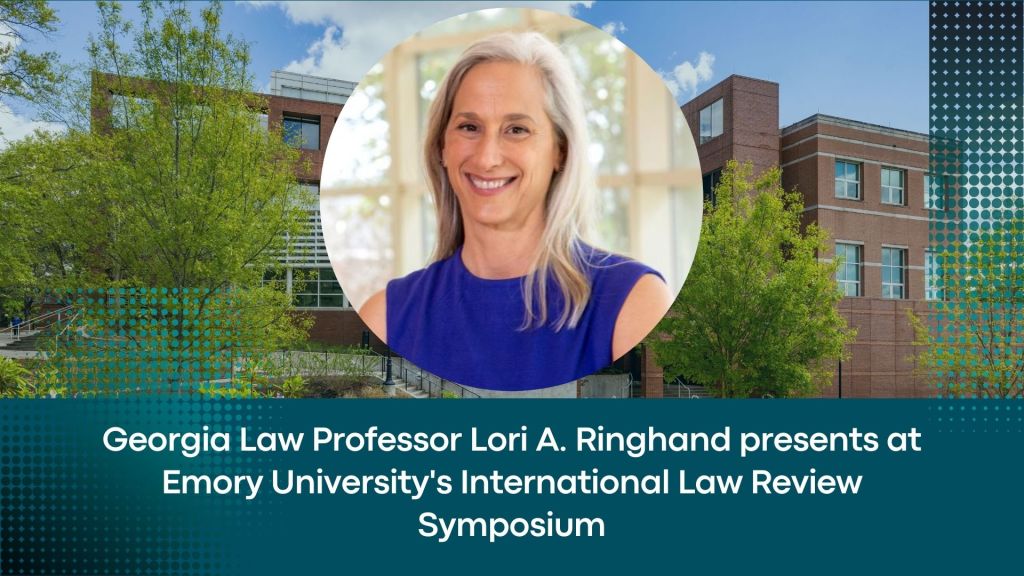
Georgia Law Professor Lori A. Ringhand presents at Emory University’s International Law Review Symposium

Earlier this month, University of Georgia School of Law Professor Lori A. Ringhand presented “First Amendment Restrictions on Non-citizens’ Engagement in Campaign Spending” at the Emory International Law Review symposium “Migration, Law, and Justice: The Evolving Role of International and U.S. Policies.” The event was held at the Emory University School of Law.

This year’s symposium focused on critical issues in immigration law and policy as they relate to international law. They explored the following three topics:

  • The Role of International Law in U.S. Immigration Decisions
  • Human Rights Obligations and the Treatment of Migrants
  • Legal Pathways to Citizenship: Challenges and Opportunities

Ringhand teaches courses on constitutional law and election law. She is a nationally known Supreme Court scholar and the author of two books about the Supreme Court confirmation process: Supreme Court Confirmation Hearings and Constitutional Change (with Paul M. Collins) published by Cambridge University Press; and Supreme Bias: Gender and Race in U.S. Supreme Court Confirmation Hearings, (with Christina L. Boyd and Paul M. Collins), forthcoming Fall 2023 with Stanford University Press. She also is the co-author of Constitutional Law: A Context and Practices Casebook, which is part of a series of casebooks dedicated to incorporating active teaching and learning methods into traditional law school casebooks. Ringhand also publishes extensively on election law related issues, and was awarded a Fulbright Distinguished Chair Award at the University of Aberdeen in Scotland to explore  the different approaches to campaign finance regulation taken by the United States and the United Kingdom.

Georgia Law’s Community HeLP Clinic wins asylum case for long-time client

The University of Georgia School of Law’s Community Health Law Partnership Clinic recently secured asylum for a long-time client.

Under the supervision of Director & Hosch Professor Jason A. Cade and Staff Attorney Kristen Shepherd, Elizabeth M. “Beth” Boland (J.D. ’26) and third-year student Lauren R. Harter (J.D. ’25) represented the client at her most recent hearing in Arlington, Virginia, marking the end of nine years of advocacy. Clinic Paralegal Sarah Ehlers served as interpreter.   

Other students who worked on the case, which included litigation before the 11th Circuit Court of Appeals, Board of Immigration Appeals, and the Federal District Court for the Northern District of Georgia, were Carolina Mares (J.D. ’25), Hope Skypek (J.D. ’24), Anna T. Ratterman (J.D. ’24), Ariane C. “Ari” Williams (J.D. ’22), Thomas A. Evans (J.D. ’22) and Frederick King (J.D. ’21). 

Georgia Law Professor Jason Cade cited by U.S. Court of Appeals for the Ninth Circuit 

University of Georgia School of Law Associate Dean & Hosch Professor Jason A. Cade’s article “Deporting the Pardoned” was recently cited by the U.S. Court of Appeals for the Ninth Circuit in the case Lopez v. Garland.

Below is an excerpt from the article:

Federal immigration laws make noncitizens deportable on the basis of state criminal convictions. Historically, Congress implemented this scheme in ways that respected the states’ sovereignty over their criminal laws. As more recent federal laws have been interpreted, however, a state’s decision to pardon, expunge, or otherwise set aside a conviction under state law will often have no effect on the federal government’s determination to use that conviction as a basis for deportation. While scholars have shown significant interest in state and local laws regulating immigrants, few have considered the federalism implications of federal rules that ignore a state’s authority to determine the continuing validity of its own convictions. This Article contends that limitations on the preclusive effect of pardons, expungements, appeals, and similar post-conviction processes undermine sovereign interests in maintaining the integrity of the criminal justice system, calibrating justice, fostering rehabilitation, and deciding where to allocate resources. In light of the interests at stake, Congress should be required to clearly express its intent to override pardons and related state post-conviction procedures. A federalism-based clear statement rule for statutory provisions that restrict generally applicable criminal processes would not constrain the federal government’s power to set immigration policy. Congress remains free to make its intent clear in the statute. But the rule would ensure that Congress, rather than an administrative agency, has made the deliberative choice to upset the usual constitutional balance of federal and state power.

Jason A. Cade is Associate Dean for Clinical Programs and Experiential Learning, J. Alton Hosch Professor of Law & Community Health Law Partnership Clinic Director. In addition to overseeing the law school’s 11 in-house clinics and 7 externship programs, Cade teaches immigration law courses and directs the school’s Community Health Law Partnership Clinic (Community HeLP), in which law students undertake an interdisciplinary approach to immigrants’ rights through individual client representation, litigation, and project-based advocacy before administrative agencies and federal courts.

Additional information about the Community HeLP Clinic can be found here.

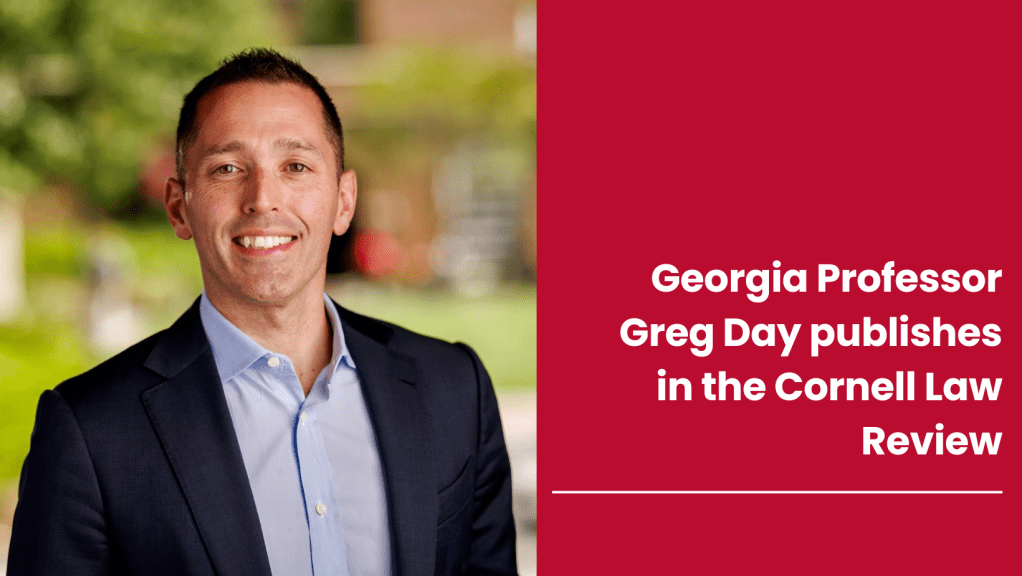
Georgia Professor Greg Day publishes in the Cornell Law Review

Greg Day, Associate Professor of Legal Studies at the Terry College of Business and professor (by courtesy) at the University of Georgia School of Law, published “Antitrust for Immigrants” in the Cornell Law Review.

Below is an abstract from the draft paper:

Immigrants and undocumented people have often encountered discrimination because they compete against “native” businesses and workers, resulting in protests, boycotts, and even violence intended to exclude immigrants from markets. Key to this story is government’s ability to discriminate as well: it is indeed common for state and federal actors to enact protectionist laws and regulations meant to prevent immigrants from braiding hair, manicuring nails, operating food trucks, or otherwise competing. But antitrust courts have seldom mentioned a person’s immigration status, much less offered a remedy.

This Article shows that antitrust’s “consumer welfare” standard has curiously ignored the plight of immigrants. Part of the reason is that antitrust law is characterized as a “colorblind” regime benefitting consumers collectively, meaning that it isn’t supposed to prioritize insular groups such as immigrants. Courts and scholars have also described matters of inequality and discrimination as “social harms” existing beyond antitrust’s scope. In fact, antitrust lawsuits have successfully sought to drive immigrants out of markets, alleging that competitors gained an “unfair” advantage from employing undocumented workers. Under this view of antitrust law, the exclusion of immigrants is an appropriate way of promoting competition.

This Article argues that anti-immigrant discrimination creates the exact types of harms that antitrust was meant to remedy. Since excluding immigrants can misallocate resources on citizenship or racial lines as opposed to their most productive usages, certain acts of discrimination should entail “conduct without a legitimate business purpose,” even when based solely on racial animus. A hidden type of market power is revealed in that foreign-born people are less able to employ self-help remedies to correct market failures. In addition to analyzing antitrust’s purpose and economic foundation, this Article delves into antitrust’s history to show that an original function of competition law was to protect foreigners. By demonstrating how incumbents can inflict greater levels of harm on immigrants while wielding less market power, this Article reimagines the consumer welfare standard and its colorblind approach as well as reveals how marginalized communities defy antitrust’s assumptions of self-help remedies.

Greg Day is an Associate Professor of Legal Studies at the Terry College of Business and holds a courtesy appointment in the School of Law. He is also an Affiliated Fellow at Yale Law School’s Information Society Project as well as the University of North Carolina’s Center for Information, Technology, and Public Life. His research has primarily focused on the intersection of competition, technology, innovation, and privacy as well as the disparate impact of anticompetitive conduct.

Georgia Law Professor Cade featured in The Atlanta Journal-Constitution

University of Georgia School of Law Associate Dean & Hosch Professor Jason A. Cade was recently featured in The Atlanta Journal-Constitution regarding the Southern Poverty Law Center’s Southeast Immigrant Freedom Initiative. The article titled “For migrants in Georgia, fighting deportation will become harder. Here’s why.” was written by Lautaro Grinspan and published 6/26/24. 

As stated in the article:

“Detained immigrants in Georgia tend to be held in remote areas, cut off from society, making it really difficult for them to access representation or have contact with family. [The Southern Poverty Law Center’s Southeast Immigrant Freedom Initiative] was essentially the only resource that existed to help them, and they did excellent work,” said Jason Cade, a professor at the University of Georgia School of Law, in a statement.

Jason A. Cade is Associate Dean for Clinical Programs and Experiential Learning, J. Alton Hosch Professor of Law & Community Health Law Partnership Clinic Director. In addition to overseeing the law school’s 11 in-house clinics and 7 externship programs, Cade teaches immigration law courses and directs the school’s Community Health Law Partnership Clinic (Community HeLP), in which law students undertake an interdisciplinary approach to immigrants’ rights through individual client representation, litigation, and project-based advocacy before administrative agencies and federal courts.

Read the full article here. Additional information about the Community HeLP Clinic can be found here.

Georgia Law Professors Cade and Norins present at AALS Conference on Clinical Legal Education

Professors Jason A. Cade and Clare R. Norins presented at the Association of American Law Schools’ 2024 Conference on Clinical Legal Education during May. Below are descriptions of their panel discussions:

Rapid-Response Legal Support for Movements: Seeking Immigration Protections for Organizing Workers

In the lead-up to and aftermath of DHS announcing new immigration protections for worker witnesses and amidst a rising tide of labor organizing across the country, immigrant workers and their organizations have turned to immigration lawyers—and especially law school clinics—as essential support for their campaigns. As law school clinics seek to respond to these requests, faculty and students are building a variety of rapid-response models to meet the movement moment, ranging from organizing-oriented individual representation to mass pro se legal clinics and everything in between. Along the way, legal teams must confront key values and ethics questions in movement lawyering as well as build best practices in this emerging area of legal expertise. These teams were integral to the advocacy push that resulted in the new guidance and are continuing to push for effective implementation that delivers for organizing workers and their organizations.

Presenters will share their varied approaches to key choices in organizing rapid response legal support for preparing deferred action for labor enforcement applications. These approaches will include reflection on the following questions:

  • What legal models have worked well to respond to the growing need for legal support?
  • How do we effectively involve students in building and implementing these legal models?
  • How do we as legal advocates integrate organizing objectives, such as group solidarity and worker leadership, into efforts to provide large-scale legal services?
  • How do we structure organizer, volunteer, and legal team information sharing to build trust and facilitate shared goals in representation and advocacy while also minimizing risk from disclosure of sensitive information?
  • How do we work in coalition to advocate on individual cases and broader policy issues throughout implementation so that these immigration protections deliver for organizing workers and their organizations?

Through guided discussion and breakout exercises, this concurrent session will pose questions about the value, and risk, of engaging in wide-ranging advocacy and litigation in a law school clinic. Ten years after the Ferguson uprising, we have taken many lessons from social movements and how we can challenge and dismantle systems of oppression and injustice. We also continue to ask critical questions about the role that we, as lawyers, play in structural and systemic change. We hope to use this session to surface both the benefits and challenges of this kind of collaborative lawyering and to get audience input on best practices for moving forward.

In addition to Cade, this panel included Katherine Evans, Duke University School of Law; Georgina Olazcon Mozo, University of Washington School of Law; Zaida C. Rivera, Seattle University School of Law; and Mary Yanik, Tulane University Law School.

Wide Ranging Litigation and Advocacy as Resistance and Resilience in a Law School Clinic?

In this concurrent session, presenters, all co-counsel in the Oldaker v. Giles litigation, will explore the challenges and benefits of wide-ranging litigation and advocacy as tools of resistance and resilience in a clinical setting. In Oldaker, the presenters and their co-counsel filed litigation on behalf of fourteen women who suffered medical abuse at the Irwin County Detention Center in Georgia.

In addition to Cade and Norins, this panel included Sabrineh Ardalan, Harvard Law School; and Sarah Sherman-Stokes, Boston University School of Law.  

Jason A. Cade is Associate Dean for Clinical Programs and Experiential Learning, J. Alton Hosch Professor of Law & Community Health Law Partnership Clinic Director. In addition to overseeing the law school’s 11 in-house clinics and 7 externship programs, Cade teaches immigration law courses and directs the school’s Community Health Law Partnership Clinic (Community HeLP), in which law students undertake an interdisciplinary approach to immigrants’ rights through individual client representation, litigation, and project-based advocacy before administrative agencies and federal courts.

Clare R. Norins, who also presented on the panel The Privacy Paradox: Balancing Transparency and Privacy in the Quest for Justice at this conference, is an assistant clinical professor and the inaugural director of the School of Law’s First Amendment Clinic, which represents clients in federal and state court on a range of First Amendment and media law issues. Representative matters include social media blocking by government officials, retaliatory arrest, the right to record, challenges to unconstitutional permit requirements, assertion of the journalist privilege under the Georgia Shield law, and defamation defense.

Georgia Law Professor Cade publishes article in the Wisconsin International Law Journal

Professor Jason A. Cade recently published “Challenging the Criminalization of Undocumented Drivers Through a Health Justice Framework” in 41 Wisconsin International Law Journal 325 (2024) (symposium issue).

From the abstract:

States increasingly use driver’s license laws to further policy objectives unrelated to road safety. This symposium contribution employs a health justice lens to focus on one manifestation of this trend—state schemes that prohibit noncitizen residents from accessing driver’s licenses and then impose criminal sanctions for driving without authorization. Status-based no-license laws not only facilitate legally questionable enforcement of local immigration priorities but also impose structural inequities with long-term health consequences for immigrants and their family members, including US citizen children. Safe, reliable transportation is a significant social determinant of health for individuals, families, and communities. Applying a health justice lens to the weaponization of no-license laws against noncitizens will both catalyze new legal challenges and create momentum for coalition building and policy reforms.

Jason A. Cade is Associate Dean for Clinical Programs and Experiential Learning, J. Alton Hosch Professor of Law & Community Health Law Partnership Clinic Director. In addition to overseeing the law school’s 11 in-house clinics and 7 externship programs, Cade teaches immigration law courses and directs the school’s Community Health Law Partnership Clinic (Community HeLP), in which law students undertake an interdisciplinary approach to immigrants’ rights through individual client representation, litigation, and project-based advocacy before administrative agencies and federal courts.

Georgia Law Professor Cade featured in The Atlanta Journal-Constitution

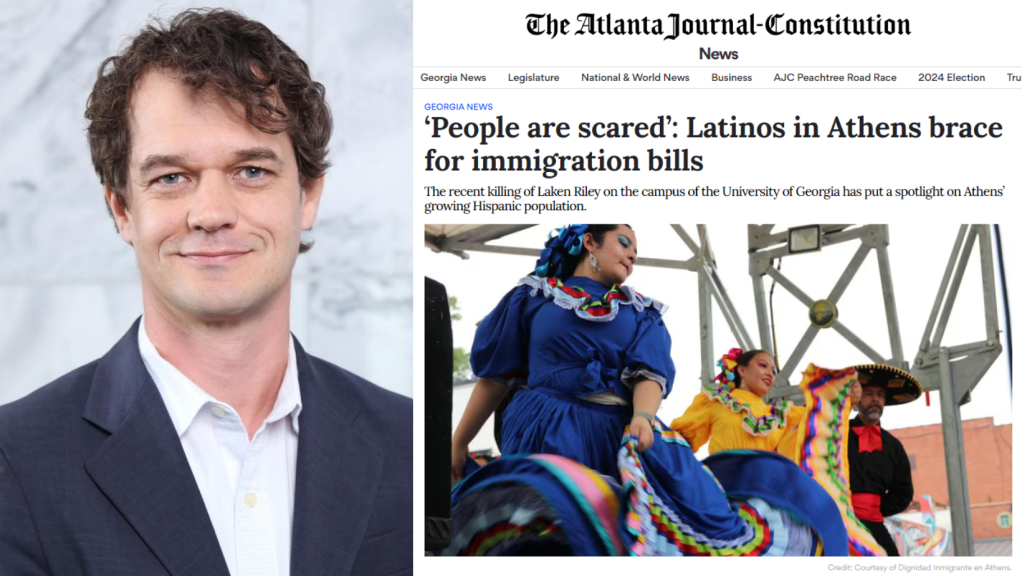
Professor Jason A. Cade was recently featured in The Atlanta Journal-Constitution regarding the University of Georgia School of Law’s Community Health Law Partnership Clinic, (“Community HeLP Clinic”). The article titled “‘People are scared’: Latinos in Athens brace for immigration bills” was written by Lautaro Grinspan and centered around the legislative consequences of the recent loss of Laken Riley on the University of Georgia campus, which put a spotlight on the growth of Athens’ Hispanic population. 

As stated in the article:

“The growth of the community has created significant demand for legal services to help with immigration cases. Those with limited means have only one pro-bono provider to turn to: a legal clinic at the University of Georgia School of Law, run by Professor Jason Cade.”

The Community HeLP Clinic focuses on interdisciplinary advocacy at the intersection of immigration status and health, including humanitarian and family-based immigration benefits, advocacy on behalf of noncitizen workers and detainees, and public education.

In reference to the Clinic within the article, Professor Cade said:

“We have the U.S. citizen children of the families that we serve very much in mind and are trying to do what we can to kind of reduce stress and stigma from their lives.”

Jason A. Cade is Associate Dean for Clinical Programs and Experiential Learning, J. Alton Hosch Professor of Law & Community Health Law Partnership Clinic Director. In addition to overseeing the law school’s 11 in-house clinics and 7 externship programs, Cade teaches immigration law courses and directs the school’s Community Health Law Partnership Clinic (Community HeLP), in which law students undertake an interdisciplinary approach to immigrants’ rights through individual client representation, litigation, and project-based advocacy before administrative agencies and federal courts.

To read the full article, please click here. To learn more about the Clinic, please click here.

UGA Professor Ramnath discusses book, “Boats in a Storm: Law, Migration, and Decolonization in South and Southeast Asia, 1942–1962” at law school

Kalyani Ramnath, Assistant Professor in the Department of History at the Franklin College of Arts & Sciences and Assistant Professor (by courtesy) at the University of Georgia School of Law, recently discussed her first book (detailed in previous post here) at an event organized by the Dean Rusk International Law Center. Joining Ramnath in conversation about Boats in a Storm: Law, Migration, and Decolonization in South and Southeast Asia, 1942–1962 (Stanford University Press, 2023) were Diane Marie Amann, Regents’ Professor, Emily & Ernest Woodruff Chair in International Law, and Co-Director of the Dean Rusk International Law Center, and Laura Phillips-Sawyer, Jane W. Wilson Associate Professor in Business Law.

Below is a description of Ramnath’s book:

Drawing on archival materials from India, Sri Lanka, Myanmar, London, and Singapore, Kalyani Ramnath narrates how former migrants battled legal requirements to revive prewar circulations of credit, capital, and labor, in a postwar context of rising ethno-nationalisms that accused migrants of stealing jobs and hoarding land. Ultimately, Ramnath shows how decolonization was marked not only by shipwrecked empires and nation-states assembled and ordered from the debris of imperial collapse, but also by these forgotten stories of wartime displacements, their unintended consequences, and long afterlives.

Ramnath received her Ph.D. in history from Princeton University in 2018, and was a Prize Fellow in Economics, History, and Politics at the Center for History and Economics at Harvard University from 2018 – 2021. She also holds a bachelor’s degree in arts and law (B.A., LL.B. (Hons.) (JD equivalent) from the National Law School of India University (NLSIU) and a master’s degree in law (LL.M.) from the Yale Law School.