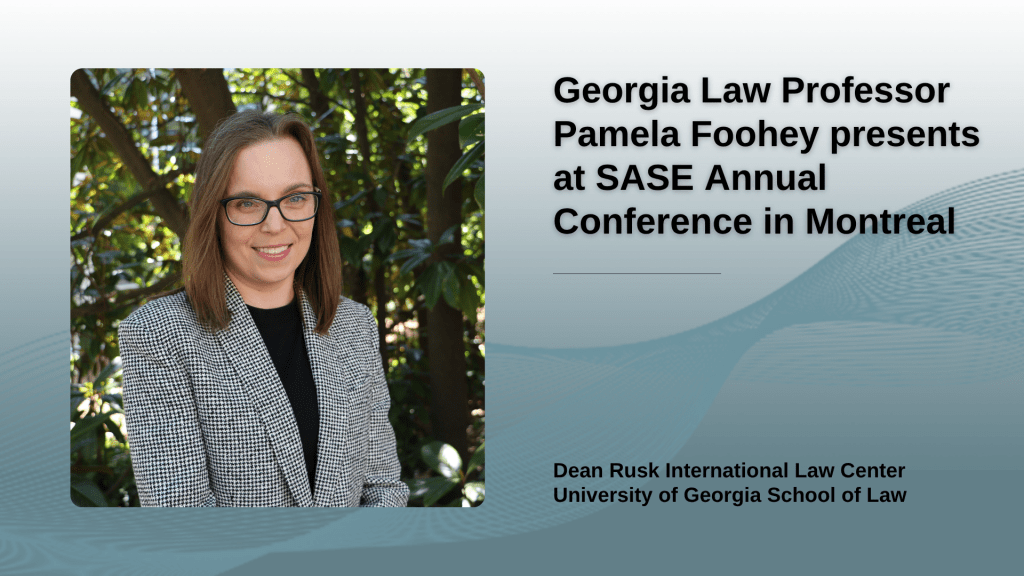
Foohey joined Georgia Law faculty as a full professor in 2024. She currently holds the Allen Post Professorship and teaches Bankruptcy, Secured Transactions and a Bankruptcy Practice Seminar. Specializing in bankruptcy, commercial law, consumer finance and business law, Foohey’s scholarship primarily involves empirical studies of bankruptcy and related parts of the legal system. She presently is a co-investigator on the Consumer Bankruptcy Project, a long-term research project studying persons who file bankruptcy. Data from this project serve as the basis of her co-authored book Debt’s Grip: Risk and Consumer Bankruptcy, University of California Press (Aug. 5, 2025). Her work in business bankruptcy focuses on nonprofit entities, with a particular emphasis on how religious organizations use bankruptcy. Data from this project are included in her in-progress book Forgive Us Our Debts: How Black Churches Use Bankruptcy to Survive, forthcoming with the University of Chicago Press.
Christopher M. Bruner is the Stembler Family Distinguished Professor in Business Law at the University of Georgia School of Law and serves as a faculty co-director of the Dean Rusk International Law Center.
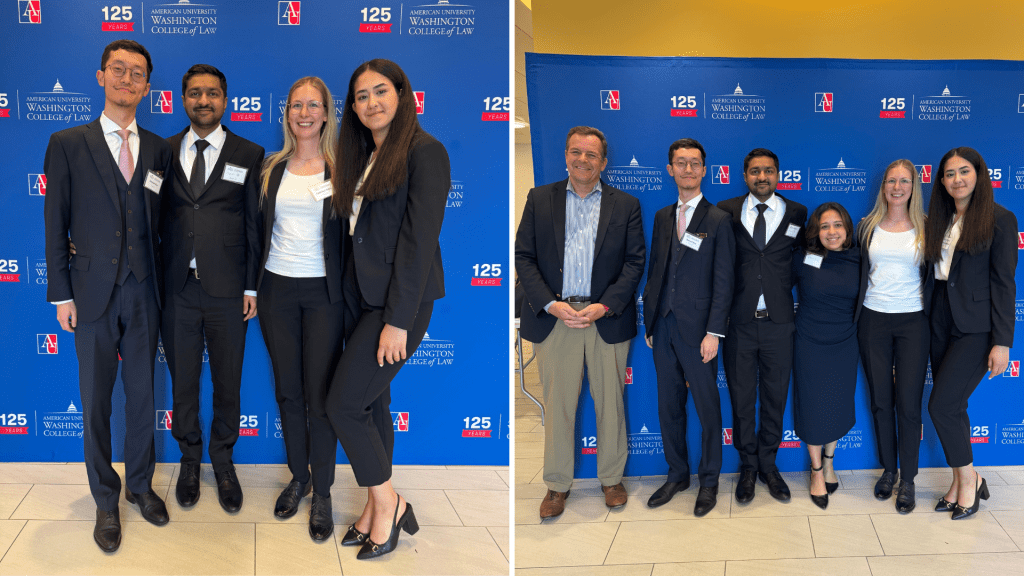
Members of the University of Georgia School of Law LL.M. Class of 2025 won the 12th International Commercial & Investment Arbitration Moot Competition hosted by American University Washington College of Law in Washington, D.C. earlier this month. This event was created specifically for LL.M. students to foster the study of international arbitration for the resolution of international business and investment disputes.
The University of Georgia School of Law’s spring 2025 International Law Colloquium recently welcomed Michigan Law’s Professor of Law Julian Arato, who presented his working paper, “The Institutions of Exceptions.” Timothy Meyer, Professor of International Business Law at Duke University School of Law, served as Arato’s faculty discussant.
Arato currently serves as the Faculty Director of the Center for International and Comparative Law at the University of Michigan School of Law. His research focuses on public international law, international investment law and arbitration, international trade, contracts, corporations, and private law theory. Arato is also a member of the board of editors of the American Journal of International Law.
Below is an abstract of Arato’s working paper:
International economic law binds states’ hands in the interest of liberalizing markets in various ways, including cross border trade in goods and services (trade) and capital (investment). The treaty regimes for both trade and investment do this by disciplining states through legal rules, while preserving a modicum of governmental power over policy. Though not always recognized as such, the preservation of policy space in these regimes typically involves exceptions-style reasoning by adjudicators – formally in the case of most trade and some investment treaties, and informally in the investment treaty regime more generally. This “exceptions paradigm” of justification has worked well in the trade regime, where it has been especially key to securing a workable balance between market disciplines and regulatory policy space in the WTO/GATT context. But it has been less successful at striking a reasonable balance in the investment regime – irrespective of whether the paradigm has been formally codified in an exceptions clause. This Article seeks to explain why, by focusing on the institutions within which this mode of justification is embedded. Certain institutional differences between these regimes help explain the varied success of exceptionalism in trade and investment, in particular: the right of action (public vs private); the degree of judicial centralization (ad hoc arbitration vs court system); and the available remedies (retrospective compensation vs prospective injunctive relief). I argue that it is trade law’s public-oriented institutions that have made the exceptions clause workable – not the other way around. By contrast, investment law’s private-oriented institutions make that system particularly inhospitable to exceptions-style justification.
This year, Professor Desirée LeClercq is overseeing the colloquium, which is designed to introduce students to features of international economic law through engagement with scholars in the international legal field. To view the full list of International Law Colloquium speakers, visit our website.
This program is made possible through the Kirbo Trust Endowed Faculty Enhancement Fund and the Talmadge Law Faculty Fund.
The University of Georgia School of Law’s spring 2025 International Law Colloquium welcomed Professor Christopher Bruner, who presented his working paper, “Sustainable Corporate Governance and Prospects for a US Value Chain Due Diligence Law.” Joshua Barkan, Associate Professor in the Department of Geography at the University of Georgia, served as Bruner’s faculty discussant.
Bruner is the Stembler Family Distinguished Professor in Business Law at the University of Georgia School of Law and serves as a faculty co-director of the Dean Rusk International Law Center. Bruner’s scholarship centers around corporate law, corporate governance, comparative law and sustainability.
Below is an abstract of Bruner’s working paper:
Laws requiring multinational companies to undertake due diligence to detect, prevent, and mitigate human rights and environmental abuses in their value chains have proliferated across Europe, and the European Union has adopted a directive to harmonise such national laws. This chapter assesses the prospects for enactment of such a value chain due diligence law in the United States.
Although such laws are often conceptualised as an extension of corporate law, they can just as readily be conceptualised as an extension of trade law – and the latter approach offers real potential to sidestep anti-ESG and anti-sustainability sentiment among the US political right. Packaged as a trade initiative, the prospects for bipartisanship improve because the political left and right can each embrace the effort by reference to policy preferences resonating with their respective bases. To the progressive left, such laws raise labour and environmental standards globally, while to the conservative right, such laws protect domestic industry from unfair foreign competition.
The chapter first examines corporate politics in the United States, discussing how fundamental corporate governance debates revolve around thorny ideological issues that strongly polarise the political left and right, diminishing the prospects for a value chain due diligence law conceptualised as an extension of corporate law. It then examines trade politics in the United States, discussing how framing by reference to trade improves the prospects for a US value chain due diligence law by sidestepping such ideological issues and giving both the political left and right plausible ways to view such a law as a victory for their respective bases. The chapter concludes with discussion of trade-offs raised by these differing modes of legal strategy and institutionalisation, observing that the corporate law approach offers broader reach with weaker enforcement while the trade law approach offers narrower reach with stronger enforcement.
This year, Professor Desirée LeClercq is overseeing the colloquium, which is designed to introduce students to features of international economic law through engagement with scholars in the international legal field. To view the full list of International Law Colloquium speakers, visit our website.
This program is made possible through the Kirbo Trust Endowed Faculty Enhancement Fund and the Talmadge Law Faculty Fund.
University of Georgia School of Law professor Christopher M. Bruner was featured in Insurance Day, published by London-based Lloyd’s List Intelligence. The article by Ben Margulies, titled “Can the UK Capture Captives?,” discusses the UK government’s effort to create a competitive captive insurance regime.
Bruner shared his thoughts on the factors that make a jurisdiction attractive for establishing captive domiciles, suggesting that smaller jurisdictions can offer fast and flexible policymaking processes. Their small size “makes co-ordination much easier among all the relevant public and private constituencies and it renders their commitment to attractive regulatory structures more credible. They’re highly dependent on these service offerings economically and the market knows it.” London, however, offers competitive advantages in its own right. “London’s main advantage is the extraordinary breadth and depth of corporate and financial services offerings in one place,” Bruner explains. “It’s the ultimate one-stop shop, including in risk management, which provides a strong foundation in the form of pre-existing professional and regulatory know-how.”
Christopher M. Bruner is the Stembler Family Distinguished Professor in Business Law at the University of Georgia School of Law and serves as a faculty co-director of the Dean Rusk International Law Center.
University of Georgia School of Law Professor Christopher M. Bruner was featured on Law360 regarding opportunities for international law firms amid shifting geopolitical landscapes. The article titled “What’s Next For The Global Legal Market In 2025?” was written by Cara Bayles and published December 5, 2024.
From the article:
Shrinking markets may even present opportunities for firms that “lean into the geopolitical conflict,” by representing Chinese companies in contentious regulatory matters with the U.S., according to Christopher Bruner, a professor of business law and international law at the University of Georgia School of Law.
“What for one firm might pose risks in terms of how they operate in China, for another might present opportunities if they are helping companies navigate those choppy geopolitical waters,” he said.
Christopher M. Bruner is the Stembler Family Distinguished Professor in Business Law at the University of Georgia School of Law and serves as a faculty co-director of the Dean Rusk International Law Center.
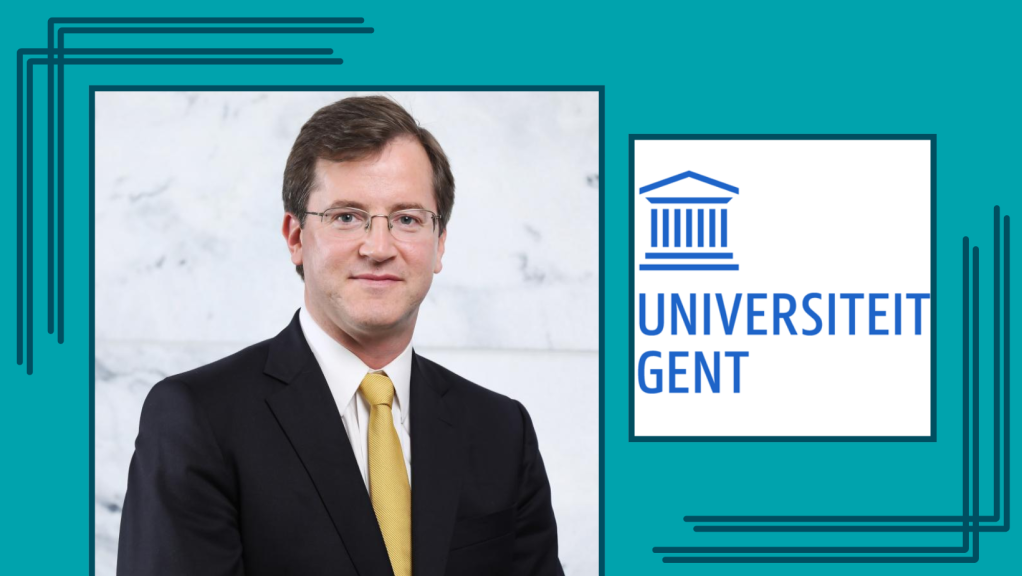
Christopher M. Bruner, Stembler Family Distinguished Professor in Business Law and Faculty Co-Director of the Dean Rusk International Law Center, gave the keynote address for a symposium on “Corporate Sustainability Due Diligence (CSDD), Sustainability, and Corporate Law” at Ghent University Law School in Belgium during May. Bruner’s keynote was titled “Developments and Debates on Corporate Sustainability in the US,” and the symposium was co-sponsored by the journal European Company Case Law (ECCL).
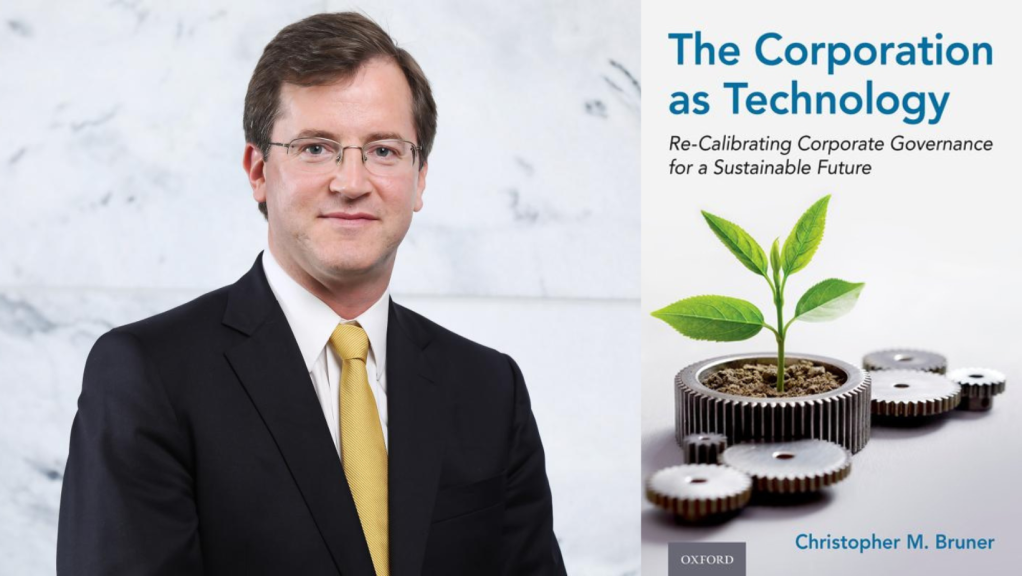
Recent decades have witnessed environmental, social, and economic upheaval, with major corporations contributing to a host of interconnected crises. The Corporation as Technology examines the dynamics of the corporate form and corporate law that incentivize harmful excesses and presents an alternative vision to render corporate activities more sustainable.
The corporate form is commonly described as a set of fixed characteristics that strongly prioritize shareholders’ interests. This book subverts this widely held belief, suggesting that such rigid depictions reinforce harmful corporate pathologies, including excessive risk-taking and lack of regard for environmental and social impacts. Instead, corporations are presented as a dynamic legal technology that policymakers can re-calibrate over time in response to changing landscapes.
This book explores the theoretical and practical ramifications of this alternative vision, focusing on how the corporate form can help secure an environmentally, socially, and economically sustainable future.
University of Georgia School of Law student Caden Pruitt, 2L, was selected as a recipient of the UGA Office of Global Engagement’s Asia-Georgia Internship Connection Scholarship to support his upcoming Global Externship Overseas (GEO) at KPMG Law in Ho Chi Minh City, Vietnam. Pruitt will be supervised at his externship by Georgia Law alumnus Binh Tran (J.D., ’11), Director at KPMG Law. In addition to the work he will complete as a legal extern, Pruitt will engage in a supervised research project with Professor Christopher M. Bruner, Stembler Family Distinguished Professor in Business Law & Faculty Co-Director of the Dean Rusk International Law Center.
Pruitt’s proposed research project will culminate in a note titled Vietnam: A guide to economic and legal developments,which will involve analyzing risks, opportunities, and the legal environment for foreign direct investors in Vietnam with consideration given to the interests of companies in Vietnam. The note will include three components: an analysis of the motivations for Foreign Direct Investments (“FDI”) in Vietnam, an analysis of the consumer market in Vietnam, and a proposal for contractual approaches to joint-value creation and mitigating risk. It will outline the legal framework for investments under Vietnamese law and will discuss contractual optimization for the resolution of disputes.
This scholarship funds student pursuing credit-bearing internships in southeast Asia for a duration of at least four weeks. Preference is given to students traveling to Cambodia, Indonesia, Japan, South Korea, Laos, Malaysia, Mongolia, the Philippines, Singapore, Taiwan, Thailand, and Vietnam.
This will be Pruitt’s second GEO; the summer of his first year at Georgia Law, he externed with Bodenheimer in Cologne, Germany, under the supervision of Georgia Law alumnus and Rusk Council member Dr. Christof Siefarth (LL.M., ’86).



 exchange of notes