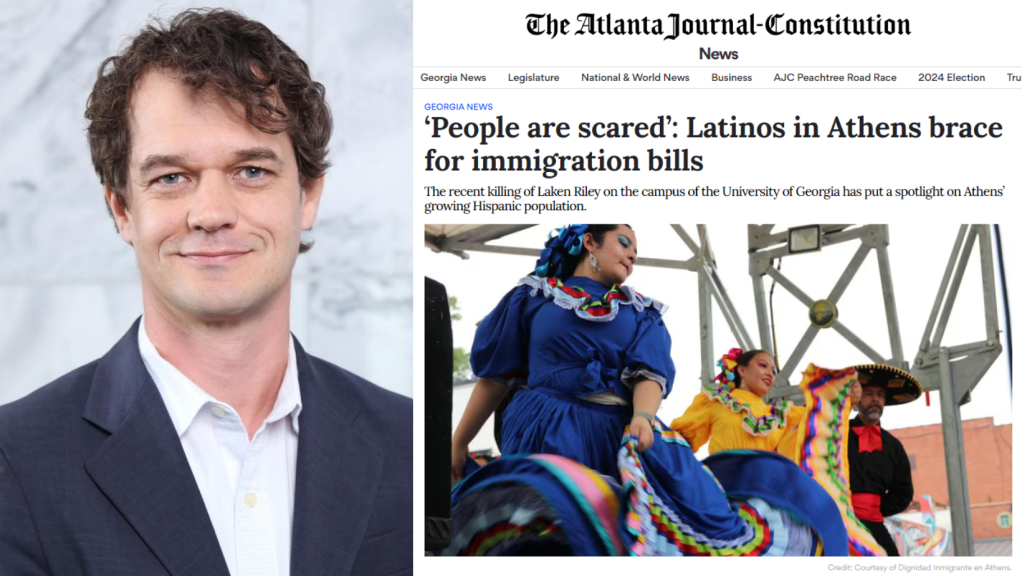
Professor Jason A. Cade was recently featured in The Atlanta Journal-Constitution regarding the University of Georgia School of Law’s Community Health Law Partnership Clinic, (“Community HeLP Clinic”). The article titled “‘People are scared’: Latinos in Athens brace for immigration bills” was written by Lautaro Grinspan and centered around the legislative consequences of the recent loss of Laken Riley on the University of Georgia campus, which put a spotlight on the growth of Athens’ Hispanic population.
As stated in the article:
“The growth of the community has created significant demand for legal services to help with immigration cases. Those with limited means have only one pro-bono provider to turn to: a legal clinic at the University of Georgia School of Law, run by Professor Jason Cade.”
The Community HeLP Clinic focuses on interdisciplinary advocacy at the intersection of immigration status and health, including humanitarian and family-based immigration benefits, advocacy on behalf of noncitizen workers and detainees, and public education.
In reference to the Clinic within the article, Professor Cade said:
“We have the U.S. citizen children of the families that we serve very much in mind and are trying to do what we can to kind of reduce stress and stigma from their lives.”
Jason A. Cade is Associate Dean for Clinical Programs and Experiential Learning, J. Alton Hosch Professor of Law & Community Health Law Partnership Clinic Director. In addition to overseeing the law school’s 11 in-house clinics and 7 externship programs, Cade teaches immigration law courses and directs the school’s Community Health Law Partnership Clinic (Community HeLP), in which law students undertake an interdisciplinary approach to immigrants’ rights through individual client representation, litigation, and project-based advocacy before administrative agencies and federal courts.
To read the full article, please click here. To learn more about the Clinic, please click here.
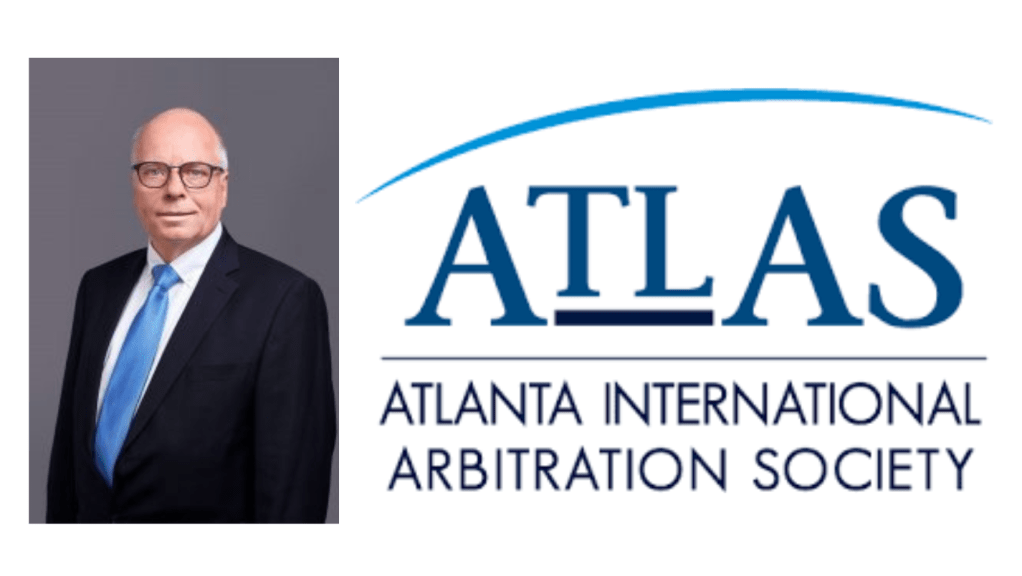
Siefarth is currently a partner at the German law firm Bodenheimer. He took office as President after AtlAS’s plenary meeting at Smith, Gambrell & Russell in March. Siefarth has been active in AtlAS throughout its 14-year history.
Siefarth has significant experience in arbitration throughout Europe, Asia, and the United States. He has participated on many AtlAS conference panels over the years, and he also has led discussions at AtlAS’s plenary meetings, including in December 2022, where the topic was “U.S. Experience with DIS Arbitration.” Siefarth is licensed to practice law in Germany and New York.
AtlAS’ mission is to promote and enhance Atlanta as a place to resolve the world’s business disputes using international arbitration and mediation. The University of Georgia School of Law is a founding organization and hosts its annual lecture every three years. Both Dean & Talmadge Chair of Law Peter B. “Bo” Rutledge and director of the Dean Rusk International Law Center Sarah Quinn serve on the organization’s Board of Directors.
For over a decade, our international law initiatives have ranked in the top 20 or so among U.S. law schools. In this year’s rankings, our international law curriculum tied with Northwestern University (Pritzker) Law, University of California (Davis) Law, and Vanderbilt University for the No. 20 spot. (The University of Georgia School of Law, as a whole, earned a No. 20 ranking this year for the second year in a row, as is posted here.)
► Superb members of the law faculty, including: Dean Peter B. “Bo” Rutledge, an international arbitration expert; the Center’s Faculty Co-Directors, Professors Diane Marie Amann, an expert in peace-and-security fields including the laws of war, child rights, and international criminal justice, and Christopher M. Bruner, a comparative corporate governance scholar. Among those supporting their efforts are many other Georgia Law faculty and courtesy faculty members, including: Thomas Burch, who leads the Appellate Clinic that has won clients relief under the Convention Against Torture; Anne Burnett, foreign and international law research librarian; Jason Cade and Clare Norins, who recently led a clinical team in securing federal redress for immigration detainees; Nathan S. Chapman, a scholar of due process and extraterritoriality; Jessica L. Heywood, Director of the Washington, D.C. Semester in Practice; Thomas E. Kadri, whose expertise includes cybercrime and global data privacy; Elizabeth Weeks, a health law specialist; Jonathan Peters, a journalism and law professor expert in international media and free speech; Laura Phillips-Sawyer, an expert in antitrust law and policy; Kalyani Ramnath, a global legal historian who focuses on South Asia; Lori A. Ringhand, a scholar of comparative constitutional law and elections law; Tim Samples, whose scholarship includes global digital platforms agreements; Kent Barnett, Sonja West, and Elizabeth Chamblee Burch, who have presented overseas on administrative law, media law, and civil procedure, respectively; Adam D. Orford, an environmental and energy law scholar; Kristen E. Shepherd, who developed and teaches the Legal Spanish curriculum; Walter Hellerstein, a world-renowned tax specialist; and Michael L. Wells, a European Union scholar.
► Visiting Scholars and Researchers, including, Mine Turhan, an assistant professor of administrative law in the Faculty of Law at the Izmir University of Economics in Türkiye, and Daesun Kim, an attorney practicing law in Vietnam who specializes in cross-border M&A, foreign investment, and public-private partnerships.
► Graduates who excel as partners in international commercial law firms, as heads of nongovernmental organizations and international organizations, as in-house counsel at leading multinational enterprises, and as diplomats and public servants – and who give back through participation in our Dean Rusk International Law Center Council, through mentoring, speaking with students (like Kannan Rajarathinam, Eduardo Conghos, Alexander White, Ellen Clarke, and Clete Johnson), and through other support.
With thanks to all, we look forward to continuing to strengthen our initiatives in international, comparative, transnational, and foreign relations law – not least, in the preparation of Georgia Law students to practice in our globalized legal profession.
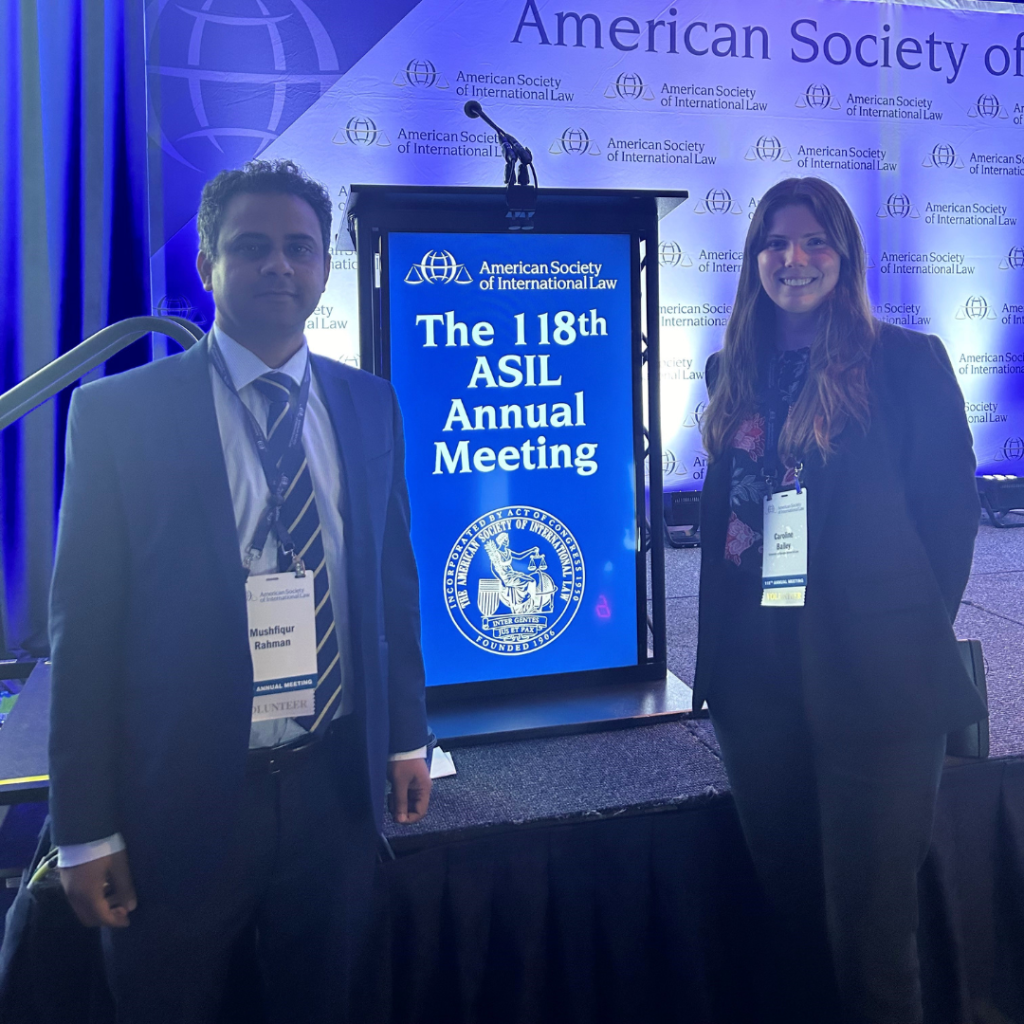
The Louis B. Sohn Professional Development Fellowship, awarded by the law school’s Dean Rusk International Law Center, supported the Bailey’s travel to the conference. Rahman was supported by a new scholarship, the Naresh Gehi Annual Award.
Reflecting on the most memorable panel discussions she attended during the conference, Bailey stated:
“I particularly enjoyed the panel titled ‘If Nature has Rights, Who Speaks on its Behalf?’ Tribal Attorney and Director of CDER’s Tribal Rights of Nature Program, Frank Bibeau, Senior Lecturer and ARC Research Fellow at the University of Melbourne Law School, Dr. Erin O’Donnell, and Director at the Max Planck Institute for Comparative Public Law and International Law in Heidelberg, Anne Peters provided valuable perspectives and insightful commentary on the role of international lawyers in the protection of and advocacy for the legal rights of the environment. It was interesting to hear about the balance between environmental rights and sustainable development, as well as the recent developments around the world in establishing rights for rivers.“
Rahman explained how meaningful these types of experiences can be for law students, especially LL.M.s:
“In building a legal career in the U.S. market, and especially with the difficulty of being an international student, one must not stop learning and developing his expertise in their chosen field. This is a long continuous process To that end, it is very necessary to take advantage of opportunities like the ASIL Annual Meeting. Attending the meeting is also helpful for students with ambitions who want not just to see themselves working in big law firms, but working on a bigger platform from a variety of viewpoints.“
To read prior posts about Georgia Law students volunteering at the ASIL Annual Meeting, please click here, here, and here.
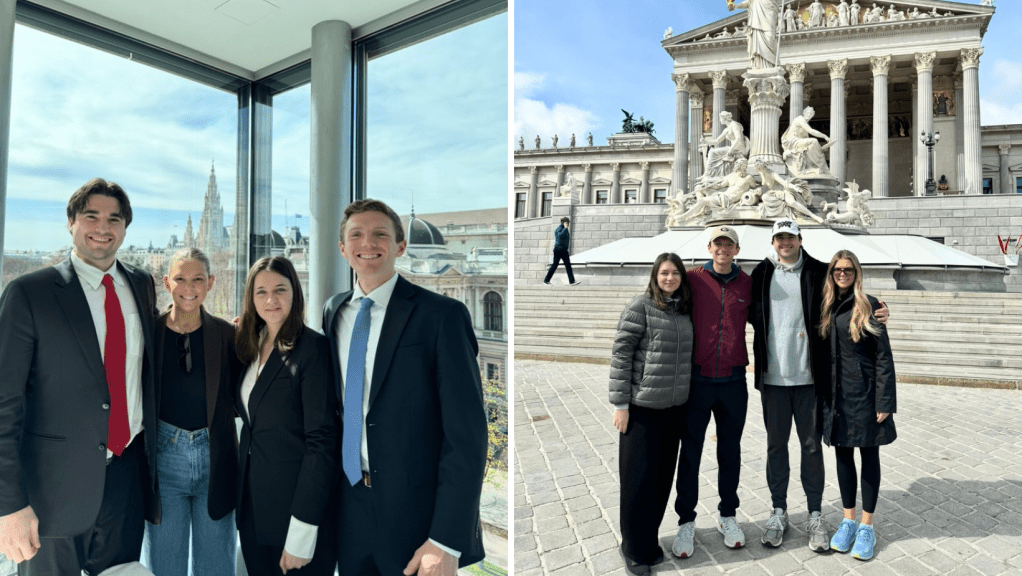
This year, 373 teams from 89 jurisdictions around the world competed in Austria. Alongside more than 2,500 students, the Georgia Law team competed for several days.
Reflecting on the last six months of Vis, Patrick shared,
“As a member of the Vis Moot team, I worked with my teammates to research, brief, and argue an international commercial arbitration case that reflected a real life issue. At the Vis competition in Vienna, we met and competed against teams from around the world who had all worked on the same case, which was such a unique experience. We were lucky to have the guidance, expertise, and support of Dean Rutledge. Overall, Vis exposed me to the global nature of commercial arbitration and gave me an increased appreciation of international law.“
To learn more about the Vis Moot team at Georgia Law, visit our website here.
Wilson-Wade and Vaughn attended the event with undergraduate and graduate students from across campus, including from the School of Public and International Affairs and from the Washington Semester program. Students were able to hear about Driehaus’ career and ask him questions about the relationship between domestic politics and international development.
Driehaus represented Ohio’s 1st Congressional District from 2008 to 2010. While in the House of Representatives, he focused on issues related to regional development, financial reform, and government accountability. Before serving in the U.S. House, Driehaus spent eight years in the Ohio Statehouse, including time as House Minority whip. He served for three years as Resident Senior Director in Iraq for the National Democratic Institute (NDI), a non-profit NGO that works around the world to safeguard democratic institutions. Driehaus is a founding member of the Good Government Group, a full-service public policy and public relations consulting firm. Additional work experience includes time as the Executive Director of Cincinnati Compass and Country Director for the United States Peace Corps in Morocco and Swaziland.
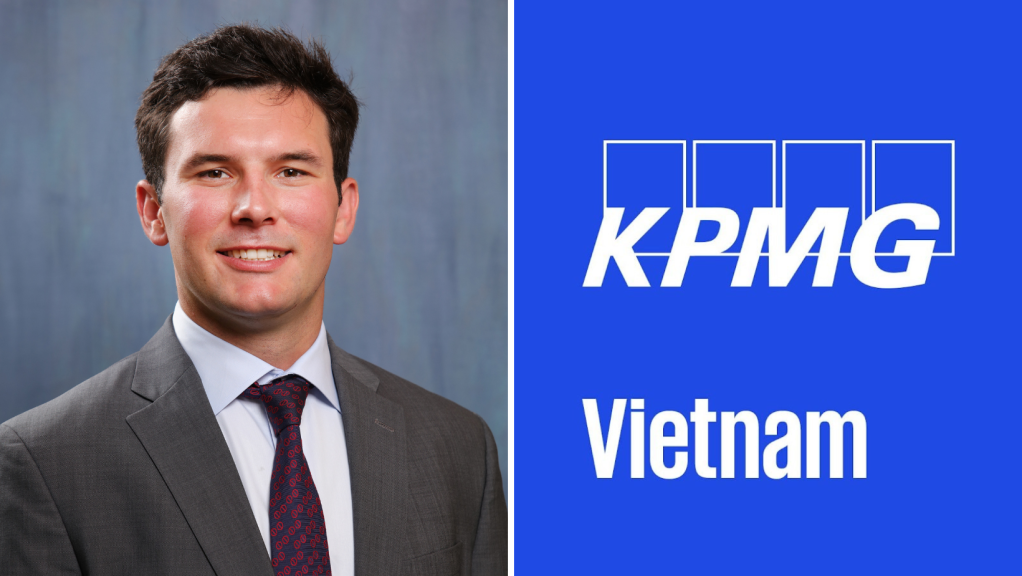
University of Georgia School of Law student Caden Pruitt, 2L, was selected as a recipient of the UGA Office of Global Engagement’s Asia-Georgia Internship Connection Scholarship to support his upcoming Global Externship Overseas (GEO) at KPMG Law in Ho Chi Minh City, Vietnam. Pruitt will be supervised at his externship by Georgia Law alumnus Binh Tran (J.D., ’11), Director at KPMG Law. In addition to the work he will complete as a legal extern, Pruitt will engage in a supervised research project with Professor Christopher M. Bruner, Stembler Family Distinguished Professor in Business Law & Faculty Co-Director of the Dean Rusk International Law Center.
Pruitt’s proposed research project will culminate in a note titled Vietnam: A guide to economic and legal developments,which will involve analyzing risks, opportunities, and the legal environment for foreign direct investors in Vietnam with consideration given to the interests of companies in Vietnam. The note will include three components: an analysis of the motivations for Foreign Direct Investments (“FDI”) in Vietnam, an analysis of the consumer market in Vietnam, and a proposal for contractual approaches to joint-value creation and mitigating risk. It will outline the legal framework for investments under Vietnamese law and will discuss contractual optimization for the resolution of disputes.
This scholarship funds student pursuing credit-bearing internships in southeast Asia for a duration of at least four weeks. Preference is given to students traveling to Cambodia, Indonesia, Japan, South Korea, Laos, Malaysia, Mongolia, the Philippines, Singapore, Taiwan, Thailand, and Vietnam.
This will be Pruitt’s second GEO; the summer of his first year at Georgia Law, he externed with Bodenheimer in Cologne, Germany, under the supervision of Georgia Law alumnus and Rusk Council member Dr. Christof Siefarth (LL.M., ’86).
In the article, Quinn discusses the Center’s focus on providing Georgia Law students with opportunities to globalize their legal education. She highlights the Center’s student-facing programming, including Global Governance Summer School, Global Externships Overseas, the NATO Externship, and semester-long exchanges with institutional partner O.P. Jindal Global University’s Jindal Global Law School. Explaining how the Center encourages all J.D. students to consider participating in these programs, Quinn states:
“We underscore to our students just how globalized the practice of law is— even [students] aspiring to work domestically can benefit from taking an international law course or gaining work experience abroad.”
Quinn provides information about the Center’s initiatives for foreign-educated law students and professionals, ranging from the 10-month Master of Laws (LL.M.) degree to the Visiting Researcher initiative. She notes that the Center’s events throughout the academic year, including the annual Georgia Journal of International and Comparative Law conference, offer opportunities for participation, particularly from alumni/ae and from interested professionals.
The article can be accessed in its entirety here. Global Atlanta is one of the Center’s institutional partners.
Quinn was named the permanent director of the Dean Rusk International Law Center after leading the unit for seven months on an interim basis. Quinn, who joined the School of Law in 2019, previously served as the associate director for global practice preparation. She was instrumental in developing the school’s partnership with India’s Jindal Global University, establishing the Graduate Certificate in International Law and transitioning the Global Governance Summer School into a credit-bearing program. Prior to joining the law school, Quinn worked with the UGA Office of Global Engagement and the U.S. Peace Corps in addition to serving as a director for the American School Language Institute in Morocco. She earned her B.A., B.F.A. and M.I.P. from UGA and her ED.M. from Harvard University.
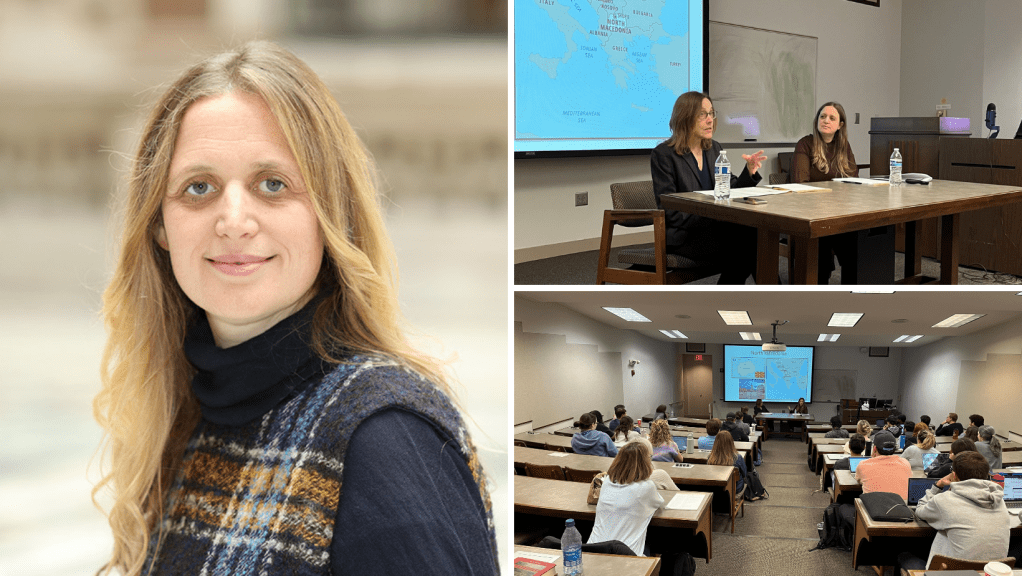
Galloway spoke with students about her diplomatic career, including her post as the United Kingdom’s Ambassador to North Macedonia. She was joined in conversation by Diane Marie Amann, Regents’ Professor of International Law, Emily & Ernest Woodruff Chair in International Law, Faculty Co-Director of the Dean Rusk International Law Center. Galloway’s talk was the most recent installment of the Dean Rusk International Law Center’s ongoing Consular Series, which presents students, staff, and faculty with global perspectives on international trade, cooperation, development, and policy.
Galloway assumed her current post as the British consul general in Atlanta in 2022, replacing former consul general Andrew Staunton. Staunton gave a presentation at Georgia Law in 2019 as part of the Center’s ongoing Consular Series. Galloway has more than 20 years of diplomatic experience; she started her career with the Foreign, Commonwealth and Development Office in 2000 and spent three years chairing the Maghreb working group at the European External Action Service. She has also held roles as the U.K. Permanent Representation to Brussels (2012-15), deputy head of the FCO’s International Organisations Department (2008-11) and head of the Darfur section of the Sudan unit in the FCO’s international development department (2007-08). Galloway spent a brief stint on a provincial reconstruction team in Helmand, Afghanistan, in 2006, that same year serving on the counter-terrorism review team in Her Majesty’s Treasury. Her only prior posting in the U.S. prior to her current role was a four-year assignment in Washington as second secretary in the political section at the British Embassy from 2002-06.
University of Georgia School of Law LL.M. student, N’guessan “Clément” Kouame, contributed to the most recent World Bank Report for Women, Business, and the Law (WBL) released on March 2. He served as a panelist contributor for Côte d’Ivoire, West Africa, reviewing the legal framework and landscape of the country regarding the improvement of women’s rights and women’s empowerment.
Women, Business and the Law (WBL) is a World Bank Group project collecting data on the laws and regulations that affect women’s economic opportunity. Since 2009, WBL has been enhancing the study of gender equality and informing discussions on improving women’s economic opportunities and empowerment. This is the second year in a row that Kouame will contribute to the WBL’s annual report. He provides sources, laws, and regulations to corroborate his answers and make recommendations and comments.
From the report’s overview:
Women, Business and the Law 2024 is the tenth in a series of annual studies measuring the enabling environment for women’s economic opportunity in 190 economies.
This edition of the report updates the Women, Business and the Law 1.0 index of eight indicators, structured around women’s interactions with the law as they begin, progress through, and end their careers: Mobility, Workplace, Pay, Marriage, Parenthood, Entrepreneurship, Assets, and Pension.
Women, Business and the Law 2.0 sets a new frontier for measuring the environment for women’s economic inclusion across three pillars: legal frameworks, measuring laws; supportive frameworks, measuring policy mechanisms to implement laws; expert opinions, shedding light on experts’ perception of women’s outcomes.
Women, Business and the Law 2.0 also introduces two new indicators: Safety, measuring frameworks addressing violence against women, and Childcare, measuring frameworks for the availability, affordability and quality of childcare.
Data in Women, Business and the Law 2024 are current as of October 1, 2023. By examining laws and policy mechanisms affecting the economic decisions women make as they go through different stages of their working lives, as well as the opinions of experts on the legal environment for women’s economic inclusion, Women, Business and the Law makes a contribution to policy discussions about the state of women’s economic opportunities.




 exchange of notes