Belgium portion of the Global Governance Summer School concludes with an array of international law topics

LEUVEN – Today marks the final day of classroom sessions of the Georgia Law – Leuven Global Governance School, and the final day students will be resident in Leuven. Students took part in three sessions, which focused on business and human rights, international security governance, and concluded with an overview of challenges to international law and global governance.

First, Dr. Axel Marx (left), Deputy Director of the Leuven Centre for Global Governance Studies, presented on business and human rights. After examining several case studies in which corporate activities adversely affected human rights, participants learned how supply chain and corporate governance structures can affect a business’ ability to manage human rights. Dr. Marx introduced key global governance instruments, such as the United Nations Guiding Principles on Business and Human Rights, that can be used to hold states and corporations accountable for human rights violations.
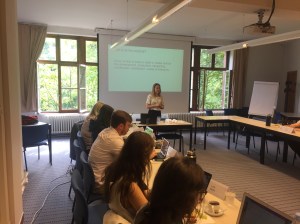
IMG_6489Second, Kathleen Doty (right), Director of the Dean Rusk International Law Center at University of Georgia School of Law, led an interactive session on global security governance. Professor Doty introduced students to global security governance, including international humanitarian law and arms control law. She explained the development of this body of law, focusing on arms control agreements, and introduced several major regimes and their common features. The students then participated in an exercise; faced with a global security crisis, students were tasked with addressing it via treaty negotiation, illustrating the difficulty of international cooperation.
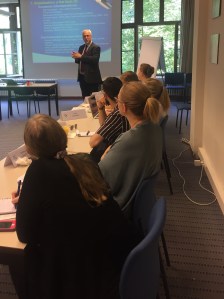
img_6512.jpgThe final session of the day provided an overview of international perspectives on and challenges to global governance, conducted by Professor Dr. Jan Wouters (left), Director of the Leuven Center for Global Governance Studies and the Co-Director of the Global Governance Summer School. Professor Wouters explained the history of globalization and the increase of economic, environmental, and human interdependence. He then explored challenges to the international system, such as anti-globalism, nationalism, and populism.
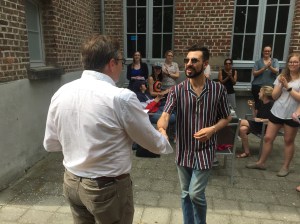
Student Ayman Tartir receives his diploma from Axel Marx.

Closing out a successful week of studies, students and faculty gathered at the Leuven Institute for Ireland in Europe for a concluding reception. Axel Marx and Kathleen Doty presented participants with attestations of completion.

Tomorrow, students from the University of Georgia School of Law will travel to The Hague, where they will visit international tribunals and organizations.
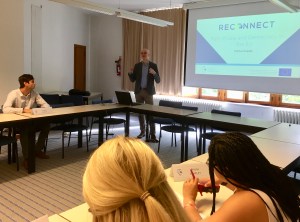
Global Governance Summer School students attend RECONNECT conference on democracy and the rule of law in the European Union

LEUVEN & BRUSSELS – The morning opened with an introduction to the European Union, presented by Michal Ovadek, a research fellow at the Leuven Centre for Global Governance Studies. An expert in the European Union legislative process, he provided an overview of the European Union architecture, and outlined the primary challenges to democracy in Europe. The session was designed to prepare students to participate fully in the rest of the day’s activities: a conference devoted to a research project aimed at reinvigorating core values of the European Union.

From left, Gamble Baffert, Charles Wells, Leila Knox, Emily Doumar, Maria Lagares Romay, Blanca Ruiz Llevot, Steven Miller, Alicia Millspaugh, and Briana Blakely.

The RECONNECT: Reconciling Europe with its Citizens through Democracy and the Rule of Law project, established by the Leuven Centre for Global Governance Studies, is supported by funds from the EU’s Horizon 2020 Research & Innovation programme. As part of the larger project, the Leven Centre convened the International Conference on Democracy and the Rule of Law in the EU. It gathered experts to discuss contemporary challenges to European Union integration, including judicial independence and rule of law, free press, and democratic institutions in countries like Poland and Hungary.

The conference took place in the Brussels’ beautiful Academy Palace, and opened with a welcome by Professor Jan Wouters (left), Co-Director of the Global Governance Summer School.

The conference featured keynote remarks by Daniel Keleman, Professor of Political Science and Law and Jean Monnet Chair in European Union Politics at Rutgers University, and Koen Lenaerts, President of the Court of Justice of the European Union (right). Two policy roundtables also featured perspectives from academics and advocates from around Europe on democracy and rule of law in the European Union, respectively.
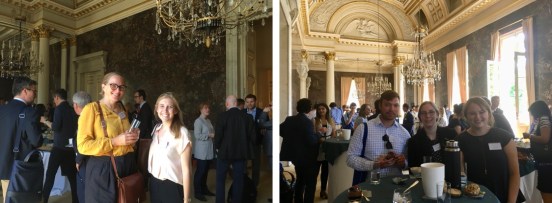
From left, Kathleen Garnett, Holly Stephens, Steven Miller, Alicia Millspaugh, Emily Snow.

Honored again to be honored for excellence in international law

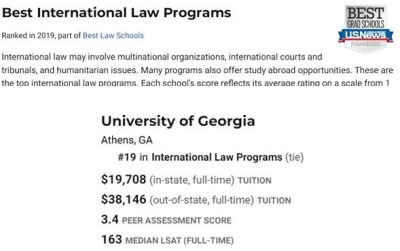
Delighted to share the news that the just-released 2020 US News rankings place our international law curriculum here at the University of Georgia School of Law at No. 19 in the United States.

By our count, this marks the 5th time in recent years we’ve been among the top 20 or so US law schools for international law.

The achievement is due in no small part to the enthusiastic support and hard work of everyone affiliated with Georgia Law’s 40-plus-year-old Dean Rusk International Law Center. As chronicled at this Exchange of Notes blog and our Center website, these include:

► Superb members of the law faculty, including: Dean Peter B. “Bo” Rutledge, an international arbitration expert; our Center’s Faculty Co-Directors and Director, respectively, Professors Diane Marie Amann, an expert in security governance fields including the laws of war and international criminal justice, Harlan G. Cohen, an expert in global governance and foreign relations law, and and Kathleen A. Doty, a specialist in arms control and the global Women, Peace & Security agenda; Professors Christopher M. Bruner, a comparative corporate governance scholar, Anne Burnett, foreign and international law librarian, Jason A. Cade, an immigration expert, Melissa J. Durkee, whose expertise includes international and transnational law, Lori A. Ringhand, a scholar of comparative constitutional law, current U.S.-U.K. Fulbright Scholar at the University of Aberdeen, and recent visitor to Israel’s Bar-Ilan University as part of our faculty exchange there, Kent Barnett, Sonja West, and Elizabeth Chamblee Burch, who have presented overseas on administrative law, media law, and civil procedure, respectively, Walter Hellerstein, a world-renowned tax specialist, Nathan S. Chapman, a scholar of due process and extraterritoriality Michael L. Wells, a European Union scholar;

► Talented students pursuing JD, MSL, and LLM degrees, including: the dozen or so who work with us as Dean Rusk International Law Center Student Ambassadors; the staffers and editors of the Georgia Journal of International and Comparative Law who produce one of the country’s oldest student journals, and who led our March 2018 conference, “The International Criminal Court & the Community of Nations”; the advocates on our Willem C. Vis International Commercial Arbitration Moot and Philip C. Jessup International Law Moot Court teams; participants in our full-semester NATO Externship in Belgium and in our Global Externships and Global Governance Summer School; and the student leaders of our International Law Society;

► Superb Center staff like Laura Tate Kagel, Amanda J. Shaw, Mandy Dixon, and Christian Lee;

► Visiting scholars like Professor Yanying Zhang of China’s Shandong University, Dr. SeongEun Kim of Korea’s Konkuk University, and Jiang Xi of China’s Jilin University of Finance and Economics;

► Academics, practitioners, and policymakers, from all over the world, who have contributed to our events – conferences and lectures, as well as our International Law Colloquium and Consular Series;

Graduates who excel as partners in international commercial law firms, as heads of public law entities like the United Nations Assistance Mission in Iraq, as in-house counsel at leading multinational enterprises, and as diplomats and public servants – and who give back through mentoring and other support;

► Our valued partnerships, with Georgia Law student organizations; with institutions like the Leuven Centre for Global Governance at Belgium’s University of Leuven; with organizations like the International Committee of the Red Cross, the American Society of International Law, the American Branch of the International Law Association, Global Atlanta, the World Affairs Council of Atlanta, the Atlanta International Arbitration Society, and the Planethood Foundation; with professional groups including the Georgia Asian and Pacific American Bar Association and the Vietnamese American Bar Association; with university units like the School of Public & International Affairs, the Department of Comparative Literature, the African Studies Institute, the Institute for Native American Studies, the Latin American & Caribbean Studies Institute, and the Willson Center for Humanities & Arts.

With thanks to all, we look forward to continue strengthening our initiatives in international, comparative, transnational, and foreign relations law – not least, in the preparation of Georgia Law students to practice in our 21st C. globalized legal profession.

Georgia Law Professor Harlan Cohen publishes chapter on “Fragmentation”

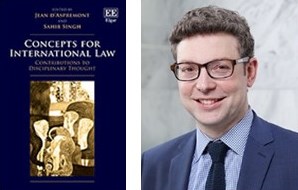
“Fragmentation” is the title of a just-published book chapter by Harlan Cohen, Gabriel M. Wilner/UGA Foundation Professor in International Law and Faculty Co-Director of the Dean Rusk International Law Center here at the University of Georgia School of Law.
The chapter appears in  Concepts for International Law: Contributions to Disciplinary Thought (Edward Elgar Publishing 2019), a 60-essay collection edited by scholars Jean d’Aspremont, of Sciences Po in Paris and the University of Manchester, and Sahib Singh, of the University of Helsinki.

Here’s the chapter abstract:

A danger, an opportunity, passé, a cliché, destabilizing, empowering, destructive, creative: depending on whom you ask, fragmentation has meant any and all of these for international law. The concept of fragmentation has been a mirror reflecting international lawyers’ perception of themselves, their field and its prospects for the future. This chapter chronicles fragmentation’s meanings over the past few decades. In particular, it focuses on the spreading fears of fragmentation around the turn of the millennium; how those fears were eventually repurposed; where, speculatively, those fears may have gone; and how and to what extent faith in international law was restored.

The book is available here; a version of Cohen’s contribution also is available at SSRN.

Georgia Law Professor Durkee presents space law paper at British Columbia

Georgia Law Professor Melissa J. Durkee recently presented her scholarship at the University of British Columbia Allard School of Law as part of the school’s faculty colloquium series.

Durkee, who is a J. Alton Hosch Associate Professor of Law, researches new forms of global governance, particularly interactions between government and business actors that affect the content and success of international legal rules. Her paper, “Interstitial Space Law,” explores these topics in the context of space. Here’s the abstract:

Private space companies have begun to stake massive investments on the prospect of deriving commercial value from objects in outer space. The multinational asteroid-mining company Planetary Resources recently explained to a U.S. Senate Subcommittee that it will “conduct a historic and unprecedented mission to. . . . prospect several near-Earth asteroids.” Amazon’s Blue Origin just launched a collaboration with German space companies to start a “permanent presence on the moon.” Elon Musk’s SpaceX intends to “focus all its engineering talent on building its Mars rocket.” Yet it is unclear whether these companies have a legal right to appropriate outer space materials for private commercial use. The controlling international law is a cluster of 1960s-era treaties, designed for the realities of cold war space exploration. The centerpiece of the early treaties, the 1967 Outer Space Treaty, clearly specifies that materials cannot be appropriated for national use, but the treaty is silent on private commercial use. Exploiting the opportunity this silence affords, private companies have begun to advance their own interpretation of the treaty in addresses to lawmakers, press releases, and corporate disclosures. They have also acted as though their interpretation were law, pressing forward with plans to commercialize space, and seemingly content to gamble on the possibility that international law will develop in their favor. The paper argues that this practice merits our attention as one of the diverse ways private companies take roles in international lawmaking. Here, private companies are working on two levels. First, they are shaping the development of international customary law by exploiting the failure of nation-states to shut down their activities. Second, they are creating a body of practice that would constitute the building blocks for customary international lawmaking, if the private companies were governmental actors, raising the possibility of a private common law for space.


Georgia Law’s 2019 Jessup International Law Moot team competes in New Orleans

72ED1EF0-BD4F-4F26-8A48-B3EC8ED506D1

The 2019 Georgia Law Jessup Team, from left: Hanna Karimipour, Sam Hatcher, Lyddy O’Brien, and Drew Hedin

Members of our University of Georgia School of Law team are competing this week in the New Orleans regional rounds of the Philip C. Jessup International Law Moot Court Competition. They’re part of a 60-year-old tradition, in which law students enact the presentation of arguments before the International Court of Justice, the Hague-based judicial organ of the United Nations.

Jessup2019_HiRes_PDF_300dpiIn New Orleans and in cities across the globe, teams from more than 680 law schools, representing 100 countries and jurisdictions, are arguing this year’s Jessup dispute, Case Concerning the Kayleff Yak (State of Aurok v. Republic of Rakkab).

We at Georgia Law’s Dean Rusk International Law Center have enjoyed working with this talented team of students throughout this academic year, and we wish them the best of luck in this year’s contest.

Georgia Law Professor Cohen presents on “Precedent” at University of Vienna

Earlier this month, Georgia Law Professor Harlan G. Cohen presented his scholarship at “Opening the Black Box of Precedent and Case-based Reasoning,” a 2-day workshop at Universität Wien/the University of Vienna in Austria.
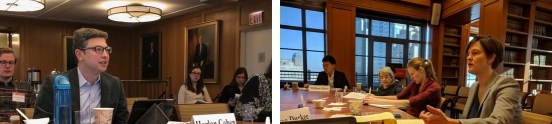
Cohen, who is the Gabriel M. Wilner/UGA Foundation Professor in International Law and serves as the Faculty Co-Director of the Dean Rusk International Law Center at the University of Georgia School of Law, presented a work in progress entitled “The Sociology of International Precedent.” He spoke as part of a panel on “Constructing Authority of Precedent,” along with scholars based in Austria and in Denmark. The workshop also included scholars from Canada, Croatia, Finland, France, and Italy.

Georgia Law Professors Cohen and Durkee present at 2018 International Business Law Scholars Roundtable

The University of Georgia School of Law was well represented at IBL 2018, this year’s International Business Law Scholars Roundtable.

The event, held last Friday and Saturday at Brooklyn Law School, opened with a panel on “Corporate and Private Law Governance Issues in the International Sphere.” Among the speakers was Georgia Law Professor Melissa J. Durkee (above right), who presented “The New Functional Sovereignty: Private Authority in Global Governance.”

The gathering concluded with a panel on “International Economic Law,” at which Harlan G. Cohen (above left), Wilner/UGA Foundation Professor in International Law and our Center’s Faculty Co-Director, presented “What is International Trade Law For?”

They joined dozens of scholars, from law faculties at Harvard, NYU, Peking University, Sweden’s Orebo University, and elsewhere.

On Belgium World Cup day, 2018 Georgia Law-Leuven Centre Global Governance Summer School begins

LEUVEN – Our 2018 Global Governance School has just begun in this centuries-old university city, where sidewalks cafes are awash in outdoor plasma screens and bedecked with Belgian flags, all in anticipation of the Red Devils’ knockout World Cup match this evening against Japan.

This is the 2d year that our University of Georgia School of Law Dean Rusk International Law Center has presented this summer school in partnership with the Leuven Centre for Global Governance Studies at KU Leuven, one of Europe’s premier research institutions. It continues a 4-decades-old Georgia Law tradition of summer international education in Belgium.

Today, students from Georgia Law and a range of European universities came together for three lectures designed to introduce them to the concept and practice of global governance:

1st, yours truly, Georgia Law Professor Diane Marie Amann (left), Emily & Ernest Woodruff Chair in International Law and one of our Center’s Faculty Co-Directors, presented a classical account of international law. Using the example of the ongoing controversy over the Chagos Islands, I then raised questions of the challenges posed by the state-centric system at the core of that account.

2d, Dr. Leonie Reins (below), an Assistant Professor in Law at Tilburg University in the Netherlands, focused on issues related to climate change as a way to explore challenges of international environment law governance.

3d, Georgia Law Professor Harlan G. Cohen (top), Gabriel M. Wilner/UGA Foundation Professor in International Law and one of our Center’s Faculty Co-Directors, answered the question “Why Global Governance?” Concepts like the tragedy of the commons and game theory informed his presentation.

The week’s coursework resumes tomorrow, when a quartet of American and European experts will deliver lectures on trade and sustainable development.

Visiting Scholar Piotr Uhma Delivers Lecture on International Law and Democracy

IMG_2095Last week, Georgia law faculty, students, and friends from other departments were treated to a lecture by Dr. Piotr Uhma, Visiting Research Scholar at the Dean Rusk International Law Center. Uhma presented his new paper, completed while in residence at the Center, What democracy is the value of international law? In it, he focuses on the linkages between democracy and international law, explores the shape of democracy in the context of a changing international order, and the issue of non-liberal democracy. In particular, he discussed Poland’s recent political changes and what they mean for democracy and the rule of law.

Uhma serves as a lecturer in international law and postdoctoral researcher at the Andrzej Frycz Modrzewski Kraków University, located in Kraków, Poland. He formerly held multiple posts with the Organization for Security and Co-operation in Europe, and worked as Director of the Legal and Corporate Communications Office of the Polish Electric Power Grid company, PSE Operator S.A. He has been visiting at the Center during the spring 2018 semester.