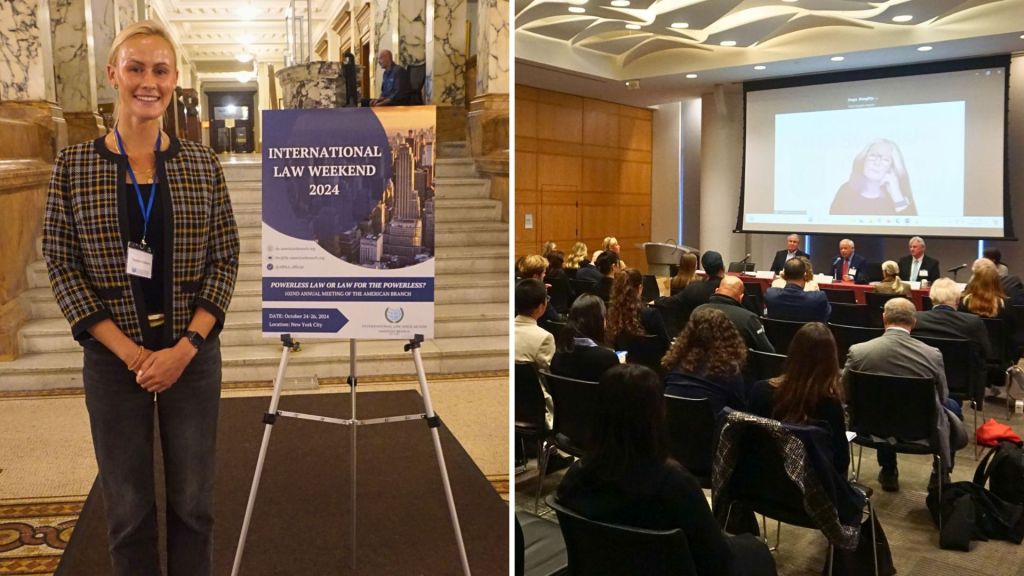
Jack Beard, Professor and Director of the Space, Cyber & National Security Law Program at the University of Nebraska College of Law, and member of Committee on the Use of Force for the American Branch of the International Law Association (“ABILA”), served as the panel’s moderator. Panelists included Laura Grego, Senior Scientist and Research Director for the Global Security Program of the Union of Concerned Scientists; Heather Harrison Dinniss, Senior Lecturer for the Department of International and Operational Law at the Swedish Defence University; David A. Koplow, Scott K. Ginsburg Professor of Law for the Georgetown University Law Center; and Dale Stephens, Professor and Director of the Research Unit on Military Law and Ethics at the University of Adelaide, Australia.
Graham was one of five ambassadors selected nationwide to assist with the work of ABILA in the preparation of the International Law Weekend 2024 conference. She attended ABILA’s ILW along with 7 other Georgia Law students through the support of Louis B. Sohn Professional Development stipends, detailed in a prior post (here). Graham’s full blog post can be accessed here.
Groups like ABILA have been an integral part of my academic growth, and I am thrilled to have the opportunity to contribute as a student ambassador. I hope to use this position to meet other professionals across the field and give back in helping other students better understand the academic and professional opportunities available to them in studying international law
Graham is the second Georgia Law student in the last two years to be selected as an ABILA student ambassador. Last year, LL.M. student Bohdan Krivuts served in this role, detailed in a prior post (here).
University of Georgia School of Law 2L Madison Graham recently completed an externship in Norfolk, Virginia, in the legal department of HQ SACT, a leading unit of the North Atlantic Treaty Organization. This externship forms part of Georgia Law’s D.C. Semester in Practice initiative, in partnership with NATO Allied Command Transformation. Graham arrived at Georgia Law after working as a Staff Assistant and Legislative Correspondent in the U.S. Senate. As an undergraduate at the University of Tennessee, Knoxville, Graham interned for the USDA in Washington, D.C. Her law school experiences have included service as an Editorial Board Member of the Georgia Journal of International & Comparative Law, a summer internship at Brussels-based law firm Van Bael & Bellis through the Global Externships Overseas initiative, and President of the International Law Society. Below, Graham reflects on her experiences as an extern with NATO HQ SACT this semester.
I first heard about the opportunity to intern with NATO through the University of Georgia School of Law and the Dean Rusk International Law Center nearly three years ago. At the time, I was only beginning to think about law school and where I might apply. Eventually, however, opportunities like this one are the reason I came to Georgia Law. Getting to spend the spring semester in the Office of the Legal Advisor at NATO’s Headquarters Supreme Allied Command Transformation (HQ SACT) was nothing short of a dream come true.
Fortunately, the mere fact of doing the externship is not where the dream ended. Not only was I working in the midst of an international organization, I was also physically working on a section of the biggest naval base in the world. Because of these two features, I received uniquely multifaceted exposure to both the complexities of working in an international organization, as well as the realities of working in a military environment. As a law student interested in pursuing a career in the national security realm of federal public service, this exposure could not have been more valuable.
The substance of the work was also incredibly rewarding. The Office of the Legal Advisor performs an wide variety of legal roles to support HQ SACT’s mission, and I was fortunate to experience parts of each.
First, the office provides legal assistance to the international military staff of HQ SACT. This is usually in the form of helping them obtain local driver licenses, helping their spouses obtain work permits, assisting with traffic tickets, ensuring their visas are up to date, and preparing powers of attorney for outgoing military personnel. Personally, I found this facet of my work to be an incredibly eye-opening and important reminder of how hard it is to legally transition to life in America. But even further, this work involved communicating with NATO staff from each of the 32+ NATO member countries. This was a test of my ability to communicate clearly, anticipate needs and expectations based on certain peoples’ backgrounds, and generally remind myself of how much peoples’ own cultural perceptions affect their approach to life. As an undergraduate anthropology major, I thought I was prepared for this, but could not have expected how much this work experience even further tested and honed these skills for me.
Second, the Office of the Legal Advisor supports HQ SACT through a variety of more general counsel duties. This might include anything from advising on intellectual property rights, contracting, employment law, operational law, and international law. However, the office prides itself on supporting the endeavors of other sections of HQ SACT – ensuring that their plans and processes are within legal possibility. Because of this, the work of the office is largely dependent on the needs and processes of other offices. In my case, this meant I got to help with contracting guidance for contracting officers in the procurement branch, as well as helping to draft another HQ SACT-wide directive for the permissible use of funding for staff morale and welfare activities. This was a great way to hone the knowledge and skills from previous semesters’ contracting and drafting classes, while also having to adapt to the unique requirements NATO has for such documents.
The highlight of my time, however, may have been the multiple educational and coursework opportunities I was able to participate in. These ranged from online, subject-specific courses – on topics like counterterrorism and gender perspectives in armed conflict – to a week-long Strategic Writing Course, to sitting in on meetings with representatives from the International Committee on the Red Cross. Lastly, the Office of the Legal Advisor hosted a week-long Legal Gathering, with legal advisors from several NATO commands around the world invited to talk about each other’s ongoing work and areas in need of assistance. This as a great opportunity to meet other European lawyers with their own unique backgrounds, as well as learn more about NATO’s structure and the roles of each command. Most importantly, however, my supervisors were incredibly supportive of my participation in all these learning opportunities. It is well-understood that just being in the room, taking in as much information as you can, is so valuable to a young student.
Lastly, I was lucky enough to work with incredible colleagues in HQ SACT during my externship. For example, interns from all over Europe, working in other offices at HQ SACT, welcomed me with open arms and have become close friends. I would, however, like to specifically thank my supervisors and colleagues in the Office of the Legal Advisor: Monte DeBoer, Theresa Donahue, Renata Vaisviliene, Cyrille Pison, Kathy Hansen-Nord, Mette Hartov, Agathe Tregarot, and Galateia Gialitaki. Their kindness, patience, and overall support made an already incredible experience even more special. From bi-weekly staff meetings to monthly staff lunches, to staff birthday celebrations, I felt welcomed as a full member of the team from my first day to my last.
I could not be more thankful for my time at NATO HQ SACT, and was reminded of that each time I was asked: “so how do you get to be here?” Over the course of the semester, I must have watched at least a dozen people marvel at the fact that Georgia Law has this externship opportunity available to students. Its uniqueness cannot be understated; I firmly believe it is an something every student at Georgia Law – regardless of your current interests may be – should at least take a moment to appreciate, if not consider doing themselves.
University of Georgia School of Law 2L Madison L. Graham was featured in National Juristregarding her experience studying abroad. During her 1L summer in 2023, Graham participated in both the Global Governance Summer School and the Global Externships Overseas initiative, administered by the Dean Rusk International Law Center. She reflects on her experiences in the National Jurist article titled “Studying Abroad Can Be Life Changing” written by Trevor Mason and published in the magazine’s Winter 2024 edition.
Graham discusses the impact of participating in international opportunities as a law student. Graham began her summer with the Global Governance Summer School, a 10-day study abroad presented through a partnership between Georgia Law and KU Leuven’s Centre for Global Governance Studies through which students study in Belgium and the Netherlands:
“As someone already interested in international law, it was really special to see other people who didn’t think that they were interested in it start to challenge their own perspectives, start to realize how ‘international’ law pervades domestic practice, and the scope of international opportunities that exist in the American legal context.
Also, I think it is really important for American law students to recognize and remember that there is an entire world out there handling the same legal challenges we are, and often in a different way.
To have the opportunity to learn from specialists in the field, and step into the courts and government offices of the legal systems we spend semesters learning about, was an incredible opportunity. Getting to do all of that and make new friends along the way was an experience I could not be more thankful for.
The opportunities it provides from an educational and professional perspective are unlike ones I have seen at any other law school, and something every student should consider doing.”
Upon completion of Global Governance Summer School, Graham started a legal externship placement at Van Bael & Bellis through the Global Externships Overseas initiative. Georgia Law alumni David Hull (J.D., ’83) and Porter Elliott (J.D., ’96) facilitate placements and supervise law students at this Brussels-based firm. Van Bael & Bellis specializes in domestic Belgian law matters, mergers and acquisitions, and focuses heavily on EU competition law, EU data privacy, and international trade law. Graham’s summer work focused on the latter three categories, assisting senior associates and partners prepare client memos, regulatory updates, research new EU and US legislation, and proofreading legal documents as a native-English speaker.
“Being challenged to understand a new law-making process helped me not only adapt my research skills to be able to learn what I need to about a ‘foreign’ legal framework, but also better understand effects on US legislative process and domestic policy, generally. Further, I was fortunate to be in a firm with lawyers from 20 different countries, so I was constantly being exposed to different ideas, cultural norms, problem-solving approaches, and even legal backgrounds (given those people that were coming from Civil Law-based countries).
My GEO helped me solidify and reaffirm my aspirations about possibly working abroad if I get the opportunity, and hopefully working in a public sector position. Further, though, it helped me improve my skills researching laws and regulations from other countries and legislative systems, which will benefit me no matter what international-law-focused position I could possibly end up in.
This experience also built my confidence in being able to move to a new place, make new friends, and succeed in a new professional environment. That is a big step for a lot of people post-grad, so having a trial period in an exceptionally new environment is a great trial experience and confidence booster. I also think that anytime you can work around people with that many different personal, cultural, and educational experiences will humble you in the very best way, by forcing you to challenge your preconceived notions about the world. I have always appreciated that challenge, but it’s so easy to forget. This summer was a great reminder and time of reflection for me, and one I think every law student needs.”
***
To learn more about international opportunities at the University of Georgia School of Law, visit our website here.
Gabriel M. Wilner/UGA Foundation Professor in International Law & Faculty Co-Director of the Dean Rusk International Law Center Harlan Grant Cohen spoke to International Law Society (ILS) members in late September as part of an ongoing brown bag lunch series with international law faculty at UGA Law.
Cohen provided the students in attendance with an introduction to his current research. He then outlined his path into academia and offered students insight into the spectrum of professional opportunities within the field of international law, noting fast-growing sectors like export controls, CFIUS issues, and space law. He also offered some reflections on the changing nature of the field, including the recent trend of withdrawal from international organizations and treaties; the emergence of new centers of power that challenge norms in international law; and increasing economic competition influencing international law through mechanisms such as trade rules and sanctions. Cohen encouraged student questions to drive the majority of the conversation, providing career and networking advice throughout the discussion. He recommended that students interested in international law enroll in the spring Public International Law course, attend conferences and get involved in international law organizations, and try to learn a second language if possible.
ILS President, 2L Madison Graham, spearheaded this series with the intention of orienting new law students towards the international law faculty. She hopes to expand the student body’s definition of what international law means and to bring their attention to the academic achievements of the international law faculty here at UGA Law.
ILS is the student chapter of the International Law Students Association, a Washington, D.C.-based organization that for decades has provided students with opportunities to study, research, and network in the international law arena through conferences, publications, and administration of the Philip C. Jessup International Law Moot Court Competition. At UGA Law, ILS hosts events and projects designed to stimulate and advance understand of international, comparative, foreign, and transnational law and institutions. ILS’ faculty advisor is Diane Marie Amann, Regents’ Professor of International Law, Emily & Ernest Woodruff Chair in International Law, Faculty Co-Director of the Dean Rusk International Law Center.


 exchange of notes