Georgia Law 2L Madison Graham on her D.C. Semester externship at NATO HQ SACT: “a dream come true”

University of Georgia School of Law 2L Madison Graham recently completed an externship in Norfolk, Virginia, in the legal department of HQ SACT, a leading unit of the North Atlantic Treaty Organization. This externship forms part of Georgia Law’s D.C. Semester in Practice initiative, in partnership with NATO Allied Command Transformation. Graham arrived at Georgia Law after working as a Staff Assistant and Legislative Correspondent in the U.S. Senate. As an undergraduate at the University of Tennessee, Knoxville, Graham interned for the USDA in Washington, D.C. Her law school experiences have included service as an Editorial Board Member of the Georgia Journal of International & Comparative Law, a summer internship at Brussels-based law firm Van Bael & Bellis through the Global Externships Overseas initiative, and President of the International Law Society. Below, Graham reflects on her experiences as an extern with NATO HQ SACT this semester.

I first heard about the opportunity to intern with NATO through the University of Georgia School of Law and the Dean Rusk International Law Center nearly three years ago. At the time, I was only beginning to think about law school and where I might apply. Eventually, however, opportunities like this one are the reason I came to Georgia Law. Getting to spend the spring semester in the Office of the Legal Advisor at NATO’s Headquarters Supreme Allied Command Transformation (HQ SACT) was nothing short of a dream come true.

Fortunately, the mere fact of doing the externship is not where the dream ended. Not only was I working in the midst of an international organization, I was also physically working on a section of the biggest naval base in the world. Because of these two features, I received uniquely multifaceted exposure to both the complexities of working in an international organization, as well as the realities of working in a military environment. As a law student interested in pursuing a career in the national security realm of federal public service, this exposure could not have been more valuable.

The substance of the work was also incredibly rewarding. The Office of the Legal Advisor performs an wide variety of legal roles to support HQ SACT’s mission, and I was fortunate to experience parts of each.

First, the office provides legal assistance to the international military staff of HQ SACT. This is usually in the form of helping them obtain local driver licenses, helping their spouses obtain work permits, assisting with traffic tickets, ensuring their visas are up to date, and preparing powers of attorney for outgoing military personnel. Personally, I found this facet of my work to be an incredibly eye-opening and important reminder of how hard it is to legally transition to life in America. But even further, this work involved communicating with NATO staff from each of the 32+ NATO member countries. This was a test of my ability to communicate clearly, anticipate needs and expectations based on certain peoples’ backgrounds, and generally remind myself of how much peoples’ own cultural perceptions affect their approach to life. As an undergraduate anthropology major, I thought I was prepared for this, but could not have expected how much this work experience even further tested and honed these skills for me.

Second, the Office of the Legal Advisor supports HQ SACT through a variety of more general counsel duties. This might include anything from advising on intellectual property rights, contracting, employment law, operational law, and international law. However, the office prides itself on supporting the endeavors of other sections of HQ SACT – ensuring that their plans and processes are within legal possibility. Because of this, the work of the office is largely dependent on the needs and processes of other offices. In my case, this meant I got to help with contracting guidance for contracting officers in the procurement branch, as well as helping to draft another HQ SACT-wide directive for the permissible use of funding for staff morale and welfare activities. This was a great way to hone the knowledge and skills from previous semesters’ contracting and drafting classes, while also having to adapt to the unique requirements NATO has for such documents.

The highlight of my time, however, may have been the multiple educational and coursework opportunities I was able to participate in. These ranged from online, subject-specific courses – on topics like counterterrorism and gender perspectives in armed conflict – to a week-long Strategic Writing Course, to sitting in on meetings with representatives from the International Committee on the Red Cross. Lastly, the Office of the Legal Advisor hosted a week-long Legal Gathering, with legal advisors from several NATO commands around the world invited to talk about each other’s ongoing work and areas in need of assistance. This as a great opportunity to meet other European lawyers with their own unique backgrounds, as well as learn more about NATO’s structure and the roles of each command. Most importantly, however, my supervisors were incredibly supportive of my participation in all these learning opportunities. It is well-understood that just being in the room, taking in as much information as you can, is so valuable to a young student.

Lastly, I was lucky enough to work with incredible colleagues in HQ SACT during my externship. For example, interns from all over Europe, working in other offices at HQ SACT, welcomed me with open arms and have become close friends. I would, however, like to specifically thank my supervisors and colleagues in the Office of the Legal Advisor: Monte DeBoer, Theresa Donahue, Renata Vaisviliene, Cyrille Pison, Kathy Hansen-Nord, Mette Hartov, Agathe Tregarot, and Galateia Gialitaki. Their kindness, patience, and overall support made an already incredible experience even more special. From bi-weekly staff meetings to monthly staff lunches, to staff birthday celebrations, I felt welcomed as a full member of the team from my first day to my last.

I could not be more thankful for my time at NATO HQ SACT, and was reminded of that each time I was asked: “so how do you get to be here?” Over the course of the semester, I must have watched at least a dozen people marvel at the fact that Georgia Law has this externship opportunity available to students. Its uniqueness cannot be understated; I firmly believe it is an something every student at Georgia Law – regardless of your current interests may be – should at least take a moment to appreciate, if not consider doing themselves.

***

For more information and to apply for the NATO Externship, please visit our website.

Center director Quinn featured in Global Atlanta article

Dean Rusk International Law Center director Sarah Quinn was recently featured in Global Atlanta regarding her new leadership position at the University of Georgia School of Law. The article titled “New Dean Rusk Center Director: How UGA Prepares Georgia’s Future International Lawyers” was written by Leigh Villegas.

In the article, Quinn discusses the Center’s focus on providing Georgia Law students with opportunities to globalize their legal education. She highlights the Center’s student-facing programming, including Global Governance Summer School, Global Externships Overseas, the NATO Externship, and semester-long exchanges with institutional partner O.P. Jindal Global University’s Jindal Global Law School. Explaining how the Center encourages all J.D. students to consider participating in these programs, Quinn states:

“We underscore to our students just how globalized the practice of law is— even [students] aspiring to work domestically can benefit from taking an international law course or gaining work experience abroad.”

Quinn provides information about the Center’s initiatives for foreign-educated law students and professionals, ranging from the 10-month Master of Laws (LL.M.) degree to the Visiting Researcher initiative. She notes that the Center’s events throughout the academic year, including the annual Georgia Journal of International and Comparative Law conference, offer opportunities for participation, particularly from alumni/ae and from interested professionals.

The article can be accessed in its entirety here. Global Atlanta is one of the Center’s institutional partners.

Quinn was named the permanent director of the Dean Rusk International Law Center after leading the unit for seven months on an interim basis. Quinn, who joined the School of Law in 2019, previously served as the associate director for global practice preparation. She was instrumental in developing the school’s partnership with India’s Jindal Global University, establishing the Graduate Certificate in International Law and transitioning the Global Governance Summer School into a credit-bearing program. Prior to joining the law school, Quinn worked with the UGA Office of Global Engagement and the U.S. Peace Corps in addition to serving as a director for the American School Language Institute in Morocco. She earned her B.A., B.F.A. and M.I.P. from UGA and her ED.M. from Harvard University.

Rachel Galloway, British consul general in Atlanta, speaks at Georgia Law

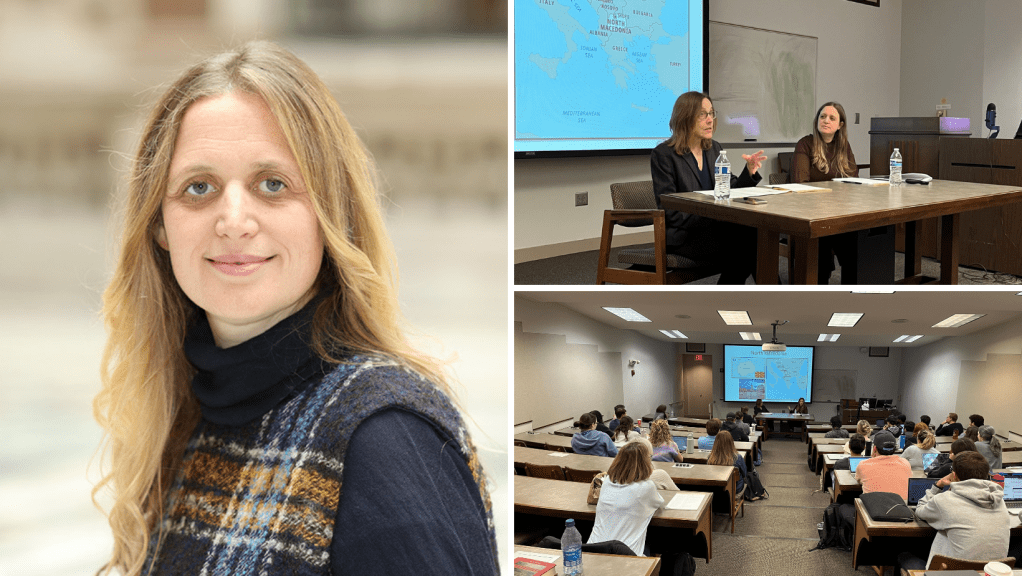
In March, the British consul general in Atlanta, Rachel Galloway, delivered a lecture at the University of Georgia School of Law, “From Alexander the Great to NATO, reflections on four years as the UK’s Ambassador to North Macedonia.”

Galloway spoke with students about her diplomatic career, including her post as the United Kingdom’s Ambassador to North Macedonia. She was joined in conversation by Diane Marie Amann, Regents’ Professor of International Law, Emily & Ernest Woodruff Chair in International Law, Faculty Co-Director of the Dean Rusk International Law Center. Galloway’s talk was the most recent installment of the Dean Rusk International Law Center’s ongoing Consular Series, which presents students, staff, and faculty with global perspectives on international trade, cooperation, development, and policy.

Galloway assumed her current post as the British consul general in Atlanta in 2022, replacing former consul general Andrew Staunton. Staunton gave a presentation at Georgia Law in 2019 as part of the Center’s ongoing Consular Series. Galloway has more than 20 years of diplomatic experience; she started her career with the Foreign, Commonwealth and Development Office in 2000 and spent three years chairing the Maghreb working group at the European External Action Service. She has also held roles as the U.K. Permanent Representation to Brussels (2012-15), deputy head of the FCO’s International Organisations Department (2008-11) and head of the Darfur section of the Sudan unit in the FCO’s international development department (2007-08). Galloway spent a brief stint on a provincial reconstruction team in Helmand, Afghanistan, in 2006, that same year serving on the counter-terrorism review team in Her Majesty’s Treasury. Her only prior posting in the U.S. prior to her current role was a four-year assignment in Washington as second secretary in the political section at the British Embassy from 2002-06.

Georgia Law 3L Collin Douglas on his D.C. Semester externship at NATO HQ SACT: “unique law school experience”

Pleased today to welcome this post by University of Georgia School of Law student Collin Douglas, who described his recently completed Fall 2022 externship in Norfolk, Virginia, in the legal department of HQ SACT, a leading unit of the North Atlantic Treaty Organization. This externship forms part of Georgia Law’s D.C. Semester in Practice initiative, in partnership with NATO Allied Command Transformation. Collin arrived at Georgia Law with a background in international affairs, having earned master’s and bachelor’s degrees in that field from the University of Oklahoma. His law school experiences have included service as Executive Articles Editor of the Georgia Journal of International & Comparative Law, internships at USAID and the Documentation Center of Cambodia, and work as a research assistant for a climate and security institute. Collin is due to receive his J.D. degree this May.

My time at the NATO Supreme Allied Command Transformation Office of the Legal Advisor was an incredibly rewarding and valuable experience. It was a completely unique law school experience, and allowed me to do work I could not do elsewhere.

In the wake of the February 2022 Russian invasion of Ukraine, the mission of NATO has felt that much more vital. The invasion of Ukraine gave NATO a renewed focus and drive, and that fact was clear from the ever-quickening pace of work around NATO SACT. The Legal Advisor performs a wide variety of legal roles within NATO SACT to support the mission, and I was able to interact with all of those roles.

As soon as I began working, I was treated as an equal member of the team and trusted with important work. One of the responsibilities of the Office of the Legal Advisor is to provide legal aid support to the international military staff of NATO SACT. This support ranges from advising on how to handle speeding tickets to coordinating with the State Department on visa issues. Within a few weeks of starting work, I was the first person who greeted any legal assistance client who walked in the door, of which there were 10-20 every day. Talking with NATO personnel from 32+ different countries exposed me to 32+ different legal perspectives and cultures. This fact gave the legal assistance portion of the work its own international perspective, as we often had to anticipate things like the Norwegian perspective on landlord-tenant issues, the German perspective on automobile sales, Albanian frustration with the visa process, or simply whether someone fully grasped the legal aspects of something they were involved with.

The Office of the Legal Advisor also performs the more typical general counsel duties of any other large organization, but with the added (and interesting) layer of being an international organization. This work covers contracting, employment intellectual property issues, and much more. This work does not differ significantly from that of a general counsel’s office in a large corporation. Where it does differ is the immunity that NATO receives under the treaties that make up the NATO system. I was able to support this work by researching and helping to articulate NATO’s view on its own immunity. Doing work of this kind for an international organization is such a rare opportunity, and I jumped on the chance to contribute to it.

My externship at NATO was part of the UGA Law Semester in D.C. program, led by Professor Jessica Heywood, so I took part in two classes that greatly contributed to my time at NATO. As part of this program we heard each week from a different lawyer working in Washington, D.C. This provided an excellent opportunity to learn about the many career paths available to attorneys who want to work in the nation’s capital. I also had a weekly class session with other students doing similar externship experiences; this allowed me to better understand my strengths and weaknesses in the workplace and to grow as an individual.

I am extremely grateful for my time at NATO SACT. There is no other law school experience that compares to it. I want to thank my amazing colleagues Monte DeBoer, Mette Hartov, Theresa Donahue, Kathy Hansen-Nord, Vincent Grassin, Butch Bracknell, Madeleine Goddrie, and Galateia Gialitaki.

Scholarly achievements, vibrant initiatives highlighted in newsletter of Dean Rusk International Law Center, University of Georgia School of Law

For a recap of the year’s research and global practice accomplishments, have a look at the newly published newsletter of the Dean Rusk International Law Center at the University of Georgia School of Law. Features include:

Scholarly achievements of our Center Director, Melissa J. Durkee, and our many other globally minded faculty, including Diane Marie Amann and Harlan G. Cohen, our Center’s Faculty Co-Directors, as well as Zohra Ahmed, Christopher Bruner, Jason Cade, Nathan Chapman, Walter Hellerstein, Thomas Kadri, Jonathan Peters, Peter B. “Bo” Rutledge, Tim Samples, and Laura Phillips-Sawyer.

► The exceptional performance of the Georgia Law students who competed in the 2022 Philip C. Jessup International Law Moot Court Competition, placing second in the United States, competing through octofinals internationally, and tying for best overall oralist through the International Advanced Rounds.

► Our International Law Colloquium in Spring 2022, a course featuring works-in-progress conversations with international law scholars based in Latin America and Europe as well as the United States.

► Recent events, including our day-long conference on “The Law of Global Economic Statecraft” cosponsored with the Georgia Journal of International & Comparative Law and other University of Georgia entities, our Consular Series of talks with diplomats, presentations by distinguished lawyers on issues including the Ukraine-Russia war, and participation in panels at meetings of the American Branch of the International Law Association, the American Society of International Law, and other global entities.

► Initiatives aimed at preparing our J.D. and LL.M. students for global legal practice, including our NATO Externship, our Global Externships, and the Global Governance Summer School we host in partnership with the Leuven Centre for Global Governance at Belgium’s University of Leuven (plus additional partnerships with O.P. Jindal University in India and Bar Ilan University in Israel).

The full newsletter is here.

Georgia Law at top in international law, Center-administered NATO externship featured in national preLaw magazine

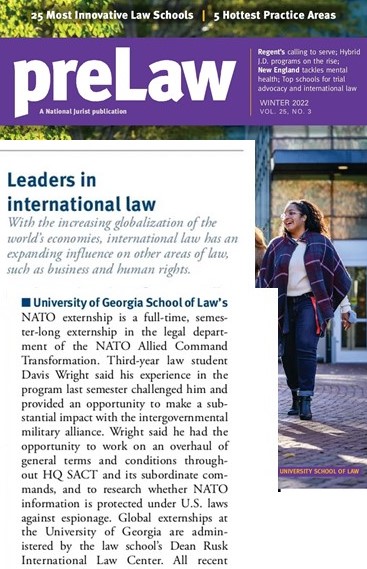
The just-released issue of preLaw magazine places the University of Georgia School of Law among the United States’ top international law curriculums; in so doing, it features an initiative of our Dean Rusk International Law Center.

In an article entitled “25 Most Innovative Law Schools,” author Michelle Weyenberg reports (page 42) on a valued partnership which Georgia Law entered several years ago with the North Atlantic Treaty Organization. Georgia Law’s “NATO externship,” she writes, “is a full-time, semester-long externship in the legal department of the NATO Allied Command Transformation.” She then describes experiences by our most recent extern, 3L Davis Wright, who worked in-person in Norfolk, Virginia, throughout the Fall 2021 semester (prior post):

“Third-year law student Davis Wright said his experience in the program last semester challenged him and provided an opportunity to make a substantial impact with the intergovernmental military alliance. Wright said he had the opportunity to work on an overhaul of general term and conditions throughout HQ SACT and in its subordinate commands, and to research whether NATO information is protected under U.S. laws against espionage.”

The NATO externship is one of many with international components in Georgia Law’s D.C. Semester in Practice initiative, directed by Georgia Law Professor Jessica Heywood, and also one of our Center’s many Global Externships Overseas and At-Home (GEO/GEA), administered by Sarah Quinn, our Center’s Associate Director for Global Practice Preparation.

Georgia Law 3L Davis Wright on his externship in Virginia: “My time at NATO helped me grow as an aspiring lawyer, law student, and person.”

Pleased today to welcome this post by University of Georgia School of Law student Davis Wright, who describes his just-completed his Fall 2021 externship in Norfolk, Virginia, in the legal department of HQ SACT, a leading unit of the North Atlantic Treaty Organization. This externship is administered by our law school’s Dean Rusk International Law Center in partnership with NATO Allied Command Transformation. Davis arrived at Georgia Law with a background in international relations and politics, having competed in Model United Nations and worked for a member of the Dáil Éireann. His experiences at Georgia Law have included service as a Dean Rusk International Law Center Student Ambassador and J.D.-to-LL.M. liaison. He is due to receive his J.D. degree this May, and then to begin practice as an Associate at the Atlanta office of Jones Day.

Working in the Office of the Legal Advisor at the North Atlantic Treaty Organization (NATO) Headquarters Supreme Allied Commander Transformation (HQ SACT) in Norfolk, Virginia, was an exciting and rewarding experience. In the time I was at HQ SACT I grew substantially, in personal, academic, and professional aspects.

Personal growth

During the time I spent at HQ SACT, I was exposed to a diverse range of ideas and people. While the Chief Legal Advisor at HQ SACT is American, there is a French Legal Advisor, a Dutch Legal Advisor, and a Turkish intern. All of these interactions were valuable to me as I was exposed to cultural and legal perspectives from their home nations. 

My interactions at the office likewise gave me exposure to a diverse set of views on a variety of topics, ranging from the insignificant, such as musical preferences, to the significant, such as views on the war in Afghanistan and NATO’s involvement in it. These new friendships, and sometimes deep discussions, helped me grow as a person and challenged my views and perspective of the world.

Academic growth

As one part of my externship at HQ SACT, I participated in a once-a-week seminar course with Georgia Law Professor Diane Marie Amann, who is a Faculty Co-Director of the Dean Rusk International Law Center. We discussed a variety of topics through weekly readings on different areas of international law. Highlights included the role of the legal advisor in armed conflict, rules of engagement, and immunities of international organizations in domestic courts. Most of these subjects were new to me, and the weekly seminar helped build my knowledge and challenge my perspective on different international legal issues.

I am especially pleased that I was encouraged to lead the discussions in this seminar and to select readings for subjects that I find of interest. This encouragement to be curious and take a leading role also helped me grow academically.

Professional growth

The experience at HQ SACT was completely new for me as I had never before worked in the national security sector or for an international organization. My time in the legal office was largely split into two categories, as follows:

  • Legal assistance: During the mornings I was assigned to legal assistance work. This is essentially all the support elements that the office provides to both civilian and military personnel at HQ SACT. This work varies depending on who walks through the door, but includes a large amount of immigration work.  These experiences provided me an appreciation of the multitude of legal issues that foreign personnel face during their time in the United States. Additionally, these experiences provided me valuable client interaction that will assist my future career.
  • Legal projects: In the afternoons I worked on projects for the legal advisors. These projects varied considerably. For example, I had the opportunity to work on an overhaul to the general terms and conditions throughout HQ SACT and its subordinate commands, and to research whether NATO information is protected under U.S. laws against espionage. These projects all challenged me and provided an opportunity to make a substantial impact during my time at HQ SACT.  

In short, my time at NATO helped me grow as an aspiring lawyer, law student, and person. I am sure I will use the experiences I have gained so far at NATO in my future career.

I am extremely grateful that the Dean Rusk International Law Center and the University of Georgia School of Law allowed me to partake in this unique experience. Specifically, I would like to thank the Center’s Associate Director for Global Practice Preparation, Sarah Quinn, and Professor Amann, for their valuable guidance. I would also like to thank everyone at HQ SACT, especially Theresa Donahue, Kathy Hansen-Nord, Monte DeBoer, Butch Bracknell, Mette Hartov, Vincent Grassin, and Muge Karatas.

Scholarly achievements, vibrant initiatives highlighted in newsletter of Dean Rusk International Law Center, University of Georgia School of Law

For a recap of the year’s research and global practice accomplishments, have a look at the just-published newsletter of the Dean Rusk International Law Center at the University of Georgia School of Law. Features include:

► Welcome to our new professor, Zohra Ahmed, as well as scholarly achievements of our Center Director, Melissa J. Durkee, and our many other globally minded faculty, including Diane Marie Amann, Christopher Bruner, Jason Cade, Harlan G. Cohen, Walter Hellerstein, Thomas Kadri, Jonathan Peters, Peter B. “Bo” Rutledge, and Laura Phillips Sawyer.

► The return of our International Law Colloquium in Spring 2022, a course featuring works-in-progress conversations with authors; this year’s edition will include international law scholars based in Latin America and Europe as well as the United States.

► Recent events, including our day-long conferences on international environmental law and on global healthcare governance cosponsored with the Georgia Journal of International & Comparative Law, our Consular Series of talks with diplomats, presentations by Visiting Scholars and other distinguished lawyers, our cohosting of International Law Weekend South with the American Branch of the International Law Association, and participation in panels at the American Society of International Law and other global meetings, as well as academic and civil-society roundtables.

Initiatives aimed at preparing our J.D. and LL.M. students for global legal practice, including our NATO Externship, our Global Externships, and the Global Governance Summer School we host in partnership with the Leuven Centre for Global Governance at Belgium’s University of Leuven, plus support for internationally minded students’ organizations, journal, and advocacy teams.

The full newsletter is here.

Georgia Law alumna Lauren Brown publishes on “Legal Answer to the China Question” in NATO Legal Gazette

“Partnership, Not Pivot: NATO’s Legal Answer to the China Question” is the title of an article by Georgia Law alumna Lauren Brown, just published at 41 NATO Legal Gazette 27-45 (2020). The essay appears in an issue devoted to the subject of “Legal Aspects of Innovation.”

Brown wrote the article while serving in Spring 2019 as a full-semester NATO Legal Extern in Mons, Belgium, an experience she described in a prior post.

With reference to NATO, the North Atlantic Treaty Organization (NATO), Brown’s Legal Gazette essay asserts:

“[T]he Organization is falling behind in addressing the multipolar reality that has defined the geopolitical landscape since the early twenty-first century. This multipolar world features as primary influencers the United States, the Russian Federation, and the People’s Republic of China. And it requires NATO to undertake innovation in its strategy; in particular, to broaden its partnership initiatives formally to include China.”

The essay proceeds to outline multiple ways by which such a partnership might be forged, and concludes that “NATO’s future relevance is contingent upon its ability to directly and formally engage China in a meaningful cooperative partnership.”

Brown earned her Georgia Law J.D. degree magna cum laude in 2019. Since then, she has practiced as an Associate in the International Trade Practice at the Washington, D.C., office of the global law firm Squire Patton Boggs.

She also holds a master’s degree in International Relations from the University of Edinburgh in Scotland and B.A. in International Studies, with highest distinction, from the University of North Carolina-Chapel Hill. Before beginning her legal studies, she had worked as a news analyst in the Washington area. Her activities at law school included: Articles Editor of the Georgia Journal of International and Comparative Law; Research Assistant to Professor Harlan G. Cohen, our Center’s Faculty Co-Director; and Summer 2017 Global Extern at War Child Holland in Amsterdam.

Brown was Georgia Law’s inaugural NATO Legal Extern, thanks to a partnership between our Center and NATO Allied Command Transformation. That initiative is ongoing, as indicated by 3L Miles Porter’s recent post on his experience at NATO HQ SACT in Norfolk, Virginia.

Brutal Peace: Lieber Code, NATO mission, and personal journey, by Georgia Law 3L Miles S. Porter


In this item, Miles S. Porter, a J.D. candidate in the University of Georgia School of Law Class of 2021, reflects on his Spring 2020 full-semester externship at NATO HQ SACT in Norfolk, Virginia. Miles’ background includes: B.A. degree in international relations and German, University of South Carolina 2011; U.S. Army active duty 2013-2018, including tour in Afghanistan; and U.S. Army reservist since 2018.

Peace can be brutal. I am reminded of this axiom as an unwelcome silence invades my office space from the street below. The COVID-19 pandemic has brought life to what some have called a “peaceful” and “virtual” standstill. But with an unprecedented 30-plus million Americans claiming unemployment in the last month, “brutal” seems a more appropriate descriptor.

Like many of my peers, I finished my spring semester externship from home, a mere 800 socially distanced miles from my worksite, the NATO headquarters in Norfolk. Early on, I had looked forward to watching the 30th flag raised at Norfolk in honor of North Macedonia’s recent membership, to enjoying the parade of nations at the NATO Festival, and to hearing former NATO Supreme Allied Commander Transformation General James Mattis speak at the Norfolk Forum. Instead I am at home, reflecting.

While America finds itself embroiled in yet another metaphorical war, against COVID,  perhaps it is appropriate then that my thoughts have ultimately turned to war itself. Specifically, they have turned to a theory of war that decries the paradox of a “humane war.” This paradox is explored in the 2012 book I read as part of my externship tutorial: Lincoln’s Code: The Laws of War in American History, by Yale Law Professor John Fabian Witt. A compelling narrative about one of the first codifications of the laws of war and perhaps one of the earliest uses of lawfare, Lincoln’s Code is more page-turning adventure story than legal treatise.

The book’s conclusions, far from uncontroversial, initially resonated with me. But they also raised important questions about the role of NATO, the rule of law, and the future of warfare. This post will examine those questions, then end with some thoughts on my NATO experience.

Now to “Old Hundred.”

“Old Hundred”

The U.S. War Department issued General Order No. 100, also known as the Lieber Code, in May 1863, at the height of America’s bloodiest war. Commissioned by President Abraham Lincoln’s Secretary of War, Edwin Stanton, and endorsed by the General-in-Chief of all Union Armies, Henry Halleck—an attorney himself—the “Old Hundred” was a necessary contribution to the Union’s war efforts. First, it helped frame the conflict in legal terms, extending law of war protections to prisoners and proving to foreign states that the Union’s actions were in fact legitimate. Second, it enabled Lincoln to achieve his goal of emancipation.

Lincoln had won the 1860 election on a platform that denounced the expansion of slavery into new states. This precipitated the secession of South Carolina even while James Buchanan was still President, and set the nation on the path to civil war.

The story of The Code is told in tandem with the story of its author, and the maxims within are better read as a story of lessons learned. While Francis Lieber was an academic, a professor first at the University of South Carolina and later at what is now Columbia University, he was also a soldier. He was someone who had his family and his life torn apart by war. His sons fought on opposite sides during the conflict he helped to end. Rather than devote himself to pacifism, however, Lieber thought the call to arms was “the most honorable calling of mankind” and that “when carried on by civilized peoples, just wars were the way civilization spread. … Justice, not peace, [was] the highest ideal.”  (Witt 178). Not only did he believe in the importance of just wars, Lieber had kept slaves himself for a time and had seen firsthand the effects of slavery while living in South Carolina. It is in this context that “Old Hundred” should be read.

A notable characteristic of Lieber’s work was that it ran counter to then-conventional doctrine on the laws of war. Lieber openly spoke out against the end of war advocated by the leading contemporary European thinkers (182), preferring the writings of older theorists like Clausewitz. Humanizing wars, in Lieber’s opinion, had the paradoxical effect of prolonging human suffering.  He urged short and sharp wars because “the more earnestly and keenly wars are carried on, the better for humanity, for peace and civilization.” (184) This became the basis for the last sentence in Article 29 of his Code:

“Sharp wars are brief.”

The principle at the essence of the Code is military necessity. As Witt shows, military necessity became an almost absolute power, remarkable for what it forbade and more remarkable for what it allowed. Torture was expressly forbidden but the starvation of villages, emancipation of slaves as enemy property, and martial law were permitted, even expected. And yet the principle persisted, so that in the present day military necessity is one of the five accepted principles of the laws of armed conflict, or LOAC.

“Old Hundred” quickly gained traction abroad. European lawyers and politicians had been searching to codify their own “enlightened” laws of war after over a century of bloody conflicts. To this end, they concluded the very first Geneva Convention in 1864. Yet delegates at that Geneva Conference, influenced by some of the more pacifistic thinkers of the day, had gone in a somewhat different direction than Lieber. Their Convention outlawed some of the barbarities of war, reforming war in the hopes of one day ending it altogether. This approach foretold advancements in the laws of war that would occur in the wake of the World Wars of the 20th century.

Choosing an Approach

The Charter of the United Nations was signed and entered into force in 1945.  A short five years later, the North Atlantic Treaty, NATO’s founding document, likewise was signed and entered into force. Today, in 2020, Kabul, Afghanistan, has been the site of armed conflict and a nearly two-decades-long military presence by America and its NATO allies. The fact provokes questions:

  • Is the “forever war” a byproduct of the humanization of warfare?
  • Is that result what Francis Lieber had fought so vehemently against? Or is it merely indicative of the progress made towards the abolishment of warfare as an institution, which the United Nations and its progeny were designed to facilitate?
  • By sheathing the short war, have we lost a valuable weapon in our proverbial arsenal, holding ourselves to morals that our less scrupulous foes may not?

These were the questions that I faced after reading Lincoln’s Code.

Initially, I embraced the short, sharp wars advocated by Lieber, Tolstoy, and Clausewitz. Frustrated by a perceived lack of progress in recent war efforts and the absence of defining victories (ignoring a certain shipboard declaration of victory), my inclination was towards a strategy of power, shock, and awe. I thought that .

After further consideration, I think maybe this initial reaction was a bit rash: While I agree with many of the principles and ideals set forth by Lieber and his short-war sympathizers, I believe that he made some key mistakes. Like many who romanticize, he failed to account for the realities of the world.

If we do the same, we do so at our own peril.

Short wars reached their pinnacle with the Cold War. That is ironic since the Cold War was long – nearly a half-century prompted by the threat of the ultimate short war, nuclear war.  The international community has since demonstrated a strong aversion to this inhumane form of short war, to the point that in a near-peer conflict it may be more than ill-advised, it may be a nearly impossible strategy to pursue.  The changing instrumentalities of war, towards weapons of mass destruction, have altered the calculus of war.  As America’s near-peer adversaries retain an interest in a balanced geo-political environment, even short wars with non-nuclear equipped opponents seems unlikely.  The new realities of warfare include nuclear weapons, and as long as this remains true, the possibility of short wars will remain distant.

Post-Cold War NATO, or NATO 2.0, represents the other side of this equation. The military alliance, initially established as a After the USSR fell, NATO endured. It participated in some of the largest humanitarian efforts of the 20th and 21st centuries, in places like Kosovo, Haiti, and Afghanistan.

In truth, globalization, the threat of nuclear warfare, and a determined international effort to outlaw war have changed the face of warfare completely. Warfare today is about competition, about living in the gray areas of the law. It resembles humanitarian aid more than it does Gettysburg or Antietam.

Democracy, liberty, and the rule of law are the conquering tools of warfare in the 21st century. They have enabled the alliance to grow to 30 full-fledged members, to conclude official partnerships with 20 Partnership for Peace nations, as well as to develop relationships with numerous other nations from disparate corners of the earth, from Australia to Colombia to Pakistan. The great deterrents in today’s conflicts are not so much weapons as they are the financial costs of waging expeditionary wars and the potential damaging of financial systems. In this environment, communities of peace built on a common foundation are capable of outlasting more powerful foes.

NATO is also capable of holding its own during armed conflicts when they arise. (Another discussion could be had about member nations’ willingness to uphold their article 5 commitment of mutual defense, but that is a separate issue.) NATO retains flexibility in the deployment of its rules of engagement, which allow member nations to pursue their individual national interests while retaining a unity of effort. Effective management of NATO forces requires mastery of this concept by commanders across echelons. Once achieved, it leaves the alliance with plenty of capabilities to accomplish the mission.

Irish poet Robert Lynd once said:

“The belief in the possibility of a short, decisive war appears to be one of the most ancient and dangerous of human delusions.”

The short wars envisioned by Lieber require justice to be the prevailing value in the pursuit of national objectives, and that in turn requires the actors pursuing these objectives to act justly.  The limited set of circumstances where this is achievable make his theory complicated enough to make unwise policy.  The abuses of the Code’s ideas that took place in subsequent conflicts, like the one in the Philippines at the turn of the 20th century, make this clear.  As Witt demonstrated in Lincoln’s Code, the principle of military necessity acted as a cloak that attempted to legitimize abhorrent acts.

Whether organizations like NATO go too far in their pursuit of peace, whether they are influenced too much by groups trying to humanize an inherently inhumane act, strike me as unnecessary questions in today’s environment. Competition will indeed manifest itself as “forever wars.” I find this outcome preferable to the alternative of a persistent nuclear threat. 

Final Thoughts

I have found that even dream jobs can begin to show their faults after a few weeks. While NATO certainly suffers from its shortcomings, this job never lost its appeal. In fact, most of what I initially saw as shortcomings eventually appeared to have been deliberate components of NATO’s grand design. The endless hours needed to exhaust every opinion on a topic until consensus is reached certainly can be challenging. The fact that every nation gets a voice at all, however, is truly amazing.

One of my mentors at NATO once told me,

“The beauty of NATO is that it is.”

I hope that despite its challenges in the future, it will always continue to be.