As part of Cambridge project, Georgia Law Professor Amann publishes options for including children in eventual Ukraine-Russia peace process and agreement

Georgia Law Professor Diane Marie Amann has contributed an analysis of international child law to the Ukraine Peace Settlement Project of the Lauterpacht Centre for International Law at the University of Cambridge in the United Kingdom.

The paper itself, entitled “Ukraine Settlement Options Paper: Children,” relies on syntheses of international legal frameworks involving children and armed conflict; in particular, the 2016 Policy on Children of the International Criminal Court Office of the Prosecutor and the United Nations’ agenda that monitors and publicizes data on what the UN Security Council has identified as the Six Grave Violations against Children During Armed Conflict. The paper looks as well to two peace agreements – the 1999 Lomé Agreement on Sierra Leone and the 2016 Colombia peace agreement – to propose ways by which any ppeace negotiations and eventual settlement of the ongoing Ukraine-Russia conflict could pay due regard to children’s experiences, rights, needs, and capacities.

A summary of the paper appeared Friday, under the title “Options for a Peace Settlement in Ukraine: Options Paper IX – Children,” at Opinio Juris blog.

The paper’s Appendix comprises tables that map the adherence – or not – of Ukraine and Russia to the international law treaty regimes and soft law instruments discussed in the body of the paper.

Amann, who is Regents’ Professor of International Law, Emily & Ernest Woodruff Chair in International Law, and Faculty Co-Director of the Dean Rusk International Law Center here at the University of Georgia School of Law, is a Visiting Academic this summer at University College London. She served from 2012 to 2021 as the Special Adviser to the International Criminal Court Prosecutor on Children in & affected by Armed Conflict.

In addition to SSRN, Amann’s 34-page paper is available here at the Lauterpacht Centre site, which serves as a depository for dozens papers by an array of international law and international relations experts, on topics ranging from use of force and weapons of mass destruction to land claims, asset sanctions, and detainee release and exchange.

Georgia Law Professors Christopher Bruner and MJ Durkee present during plenary sessions at annual National Business Law Scholars Conference

The University of Georgia School of Law was well represented at the 13th annual National Business Law Scholars Conference, with both Professor Christopher M. Bruner and Professor Melissa J. “MJ” Durkee presenting at plenary sessions:

  • Durkee (above left), who is Georgia Law’s Associate Dean for International Programs, Director of the Dean Rusk International Law Center, and Allen Post Professor, presented at a session entitled “International Law, National Security, and Corporate Law.” Joining her on the panel were Kish Parella of Washington and Lee University School of Law, Tom C.W. Lin of Temple University Beasley School of Law, Evan Criddle of William & Mary Law School, and moderator Megan W. Shaner of University of Oklahoma College of Law.

Held at the University of Oklahoma College of Law, the conference brought together more than four dozen scholars from around the United States for two days of discussions on an array of business law topics including, in addition to international law and corporate governance, securities regulation, technology, corporate criminal law, and bankruptcy law.

While Visiting Academic at University College London, Georgia Law Professor Amann presents “No Exit at Nuremberg”

Georgia Law Professor Diane Marie Amann gave a presentation yesterday at University College London Faculty of Laws, where she is a Visiting Academic for all of Summer 2022.

Her talk, entitled “No Exit at Nuremberg: The Postwar Order As Stage for 21st-Century Global Insecurity” (video here) drew upon her research on participants at the post-World War II International Military Tribunal, as well as an existentialist play written toward the end of that long war. The talk investigated the relationship of international criminal justice to security with particular reference to the ongoing Ukraine-Russia conflict.

Amann is Regents’ Professor of International Law, Emily & Ernest Woodruff Chair in International Law, and Faculty Co-Director of the Dean Rusk International Law Center here at the University of Georgia School of Law (she is pictured above at the right of the table). Chairing her talk in London yesterday, and moderating questions from in-person and online attendees was Dr. Martins Paparinskis (above left), a Reader in Public International Law at UCL who recently was elected to an upcoming term on the United Nations’ International Law Commission.

Georgia Law Professor Hellerstein gives presentation on e-commerce and taxation at UNCTAD meeting

Walter Hellerstein, Distinguished Research Professor & Shackelford Distinguished Professor in Taxation Law Emeritus here at the University of Georgia School of Law, presented last week at an online meeting organized by the United Nations Conference on Trade and Development.

Hellerstein spoke on “Main Issues on E-Commerce and Taxation” as part of a 2-day the online Ad Hoc Expert Group Meeting on Electronic Commerce and Taxation. This principal presentation helped to set the stage by providing an overview of the issues relevant for e-commerce taxation.

Georgia Law Professor Nathan Chapman gives scholarly presentations at Oxford and Heidelberg universities

Nathan Chapman, Pope F. Brock Associate Professor of Professional Responsibility here at the University of Georgia School of Law, is just back after giving scholarly presentations at Oxford University in the United Kingdom and the University of Heidelberg in Germany.

The Oxford Programme for the Foundations of Law and Constitutional Governance hosted Professor Chapman’s visit last month to the Oxford University Faculty of Law, where he gave two presentations:

  • “Judicial Review in the US As a Tradition of Moral Reasoning.” Commenting were Professor Richard Ekins (St. John’s, Oxford) and Professor Fernando Simon Yarza (Oxford/Navarre).
  • “The Doctrine of Qualified Immunity,” which summarized his argument in “The Fair Notice Rationale for Qualified Immunity,” forthcoming in the Florida Law Review. Professor Timothy Endicott (All Soul’s, Oxford) commented.

In Germany, Chapman presented as part of the Internationales Wissenschaftsforum, or International Academic Forum, at the University of Heidelberg. Entitled “Government Conditions on Religious School Funding,” the chapter will appear in an interdisciplinary book on The Impact of Political Economy on Character Formation. Workshop participants were the other authors and editors of the book. They included scholars in social theory, theology, philosophy, economics, and law from the Universities of Chicago, Heidelberg, Bonn, Queensland, and Stellenbosch, located, respectively, in the United States, Germany, Australia, and South Africa.

Georgia Law Professor Amann joins panel on paths to accountability in conference cosponsored by law schools at Notre Dame and Ukrainian Catholic universities

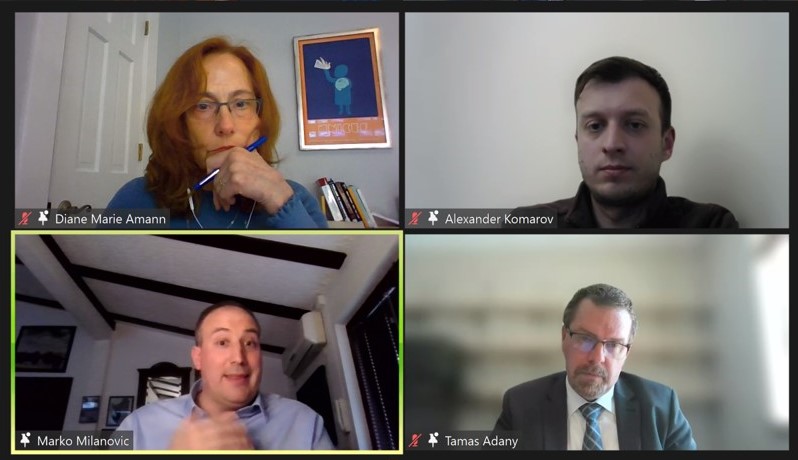
Diane Marie Amann, who is Regents’ Professor of International Law, Emily & Ernest Woodruff Chair in International Law, and Faculty Co-Director of the Dean Rusk International Law Center here at the University of Georgia School of Law, spoke yesterday at “Legal Challenges Posed by the Large-Scale Russian Invasion of Ukraine,” a conference cosponsored by the University of Notre Dame Law School and the Ukrainian Catholic University Law School.

The latter university is located in Lviv, Ukraine – also the birthplace of the late Louis B. Sohn, who was the inaugural holder of Georgia Law’s Woodruff Chair in International Law.

Professor Amann took part in a panel entitled “Prosecution,” along with Marko Milanovic, Professor of Public International Law at the University of Nottingham School of Law in the United Kingdom and Oleksandr Komarov of the Ukrainian Catholic University Law School. Moderating was Tamás Ádány, Fulbright Visiting Professor at Notre Dame Law this semester, and also Head of the Department of International Law at Pázmány Péter Catholic University in Budapest, Hungary.

Discussed in their panel were legal frameworks and forums that hold potential for providing measures of accountability for violations of international law reported since Russia’s February 24, 2022, invasion of Ukraine. These include the illegal resort to armed force – that is, the crime of aggression – as well as atrocity crimes committed once the armed conflict had begun. (Related prior posts here, here, here, and here.)

Participants in the online conference’s two other panels examined additional aspects of the Ukraine-Russia conflict; namely, challenges to the collective security structure, and the use of economic sanctions by states and international organizations.

MJ Durkee, Georgia Law Associate Dean and our Center’s Director, presents forthcoming article at William & Mary Law School International Law Workshop

Melissa J. “MJ” Durkee, who is Associate Dean for International Programs, Director of the Dean Rusk International Law Center, and Allen Post Professor here at Georgia Law, took part as both a presenter and a commentator at the daylong International Law Workshop sponsored online Saturday by William & Mary Law School.

Durkee presented “The Pledging World Order,” an article forthcoming in the Yale Journal of International Law.

She also commented on a paper entitled “The Powers of Judgment: Hannah Arendt’s Moral and Legal Thought,” by David Luban, University Professor and Professor of Law and Philosophy at Georgetown Law.

Commenting on Durkee’s paper was William & Mary Law Professor Evan Criddle. Along with another William & Mary Law Professor, Nancy Combs, Criddle hosted the workshop, which featured scholars from several law faculties in the United States and in The Netherlands.

Oxford University Press publishes book on corporate governance, sustainability by Georgia Law Prof Christopher Bruner

A new book entitled The Corporation as Technology: Re-Calibrating Corporate Governance for a Sustainable Future and written by Christopher M. Bruner, the Stembler Family Distinguished Professor in Business Law here at the University of Georgia School of Law, has been released today by Oxford University Press.

Here’s OUP’s description:

“Recent decades have witnessed environmental, social, and economic upheaval, with major corporations contributing to a host of interconnected crises. The Corporation as Technology examines the dynamics of the corporate form and corporate law that incentivize harmful excesses and presents an alternative vision to render corporate activities more sustainable.

“The corporate form is commonly described as a set of fixed characteristics that strongly prioritize shareholders’ interests. This book subverts this widely held belief, suggesting that such rigid depictions reinforce harmful corporate pathologies, including excessive risk-taking and lack of regard for environmental and social impacts. Instead, corporations are presented as a dynamic legal technology that policymakers can re-calibrate over time in response to changing landscapes.

“This book explores the theoretical and practical ramifications of this alternative vision, focusing on how the corporate form can help secure an environmentally, socially, and economically sustainable future.”

Drawing upon corporate governance structures and reform efforts from around the world, Professor Bruner studies these issues in three parts, entitled, respectively, “The Dynamism of the Corporation,” “Re-Conceptualizing the Corporation,” and “Harnessing the Corporation.” Further details here.

In D.C. during ASIL Annual Meeting this week, Georgia Law scholars on panels at ASIL and at Brookings Institution

Scholars at the University of Georgia School of Law are taking part on panels during this week’s 116th Annual Meeting of the American Society of International Law, the theme of which is “Privatizing International Governance.”

The annual meeting opened yesterday and runs through Saturday – in person, in Washington, D.C., for the first time in a couple years. Indeed, the meeting is hybrid, with registration available for online viewers – including, at ASIL Academic Partners like Georgia Law, free registration for students.

Georgia Law representation includes these panels:

10:30-11:30 a.m., Friday, April 8: Privatizing International Governance

Melissa J. “MJ” Durkee, who is Associate Dean for International Programs, Director of the Dean Rusk International Law Center, and Allen Post Professor (pictured above left), will serve as moderator for a panel entitled “Privatizing International Governance,” part of the meeting’s International Law Beyond the State track.

Here’s the panel description:

“The 2030 Agenda for Sustainable Development and the UN Guiding Principles on Business and Human Rights both encourage engaging business groups as partners in developing global governance agendas. Such multi-stakeholder and public-private partnerships are increasingly common and seen as essential to the future of international business regulation. The participation of affected groups brings expertise, promotes engagement and buy-in, and secures funding. At the same time, critics have raised alarms about industry capture of the UN climate change bodies, global financial governance institutions, and international public health standard-setting efforts. In response, institutions like the World Health Organization and the Food and Agriculture Organization are implementing reforms to prevent mission-distortion by business groups. At a time when multilateral cooperation is at an ebb, public-private partnerships are indispensable, and yet the danger of undue influence is real. The time is therefore ripe to consider how to productively engage business groups in global governance. This roundtable of experts will discuss cutting-edge efforts by international organizations to capture the benefits of business participation while reducing the harms. The roundtable will consider access rules, existing and proposed reforms, and how past experience may offer lessons for future challenges.”

Panelists will be: Patricia Kameri-Mbote, United Nations Environment Programme; Nora Mardirossian, Columbia Center on Sustainable Investment; Suzy Nikièma, Lead, Sustainable Investment, International Institute for Sustainable Development; and Nancy Thevenin, United States Council for International Business.

3-4:30 p.m., Friday, April 8: Fourth Annual International Law Review Editors-in-Chief Roundtable

Harlan G. Cohen, who is Gabriel M. Wilner/UGA Foundation Professor in International Law and Faculty Co-Director of the Dean Rusk International Law Center at Georgia Law (above right), will serve as a panelist in the “Fourth Annual International Law Review Editors-in-Chief Roundtable,” an online session that is part of the meeting’s Professional and Academic Development track.

Here’s the panel description:

“In recognition of the important role that student-edited international law journals play in the dissemination of international legal scholarship, the Society hosts an annual International Law Review Editor Roundtable. This Roundtable will discuss key issues around legal scholarship, including: selecting great topics that might be more relevant to the various audiences of law journals, including scholars and practitioners; how international law journals can be more effective at soliciting and/or selecting relevant pieces of international legal scholarship; and how to work with authors (who may have different cultural perspectives) to successfully publish their pieces. The Roundtable will be facilitated by international law experts as well as sitting editors-in-chief of law student-run international law journals. The Society invites current students and recent graduates interested in the process of scholarship and publication in international law to connect with their peers and distinguished scholars and practitioners.”

Joining Professor Cohen on the panel will be Colorado Law Professor James Anaya and Vanderbilt Law Professor Ingrid Wuerth.

Additionally:

11 a.m.-1 p.m. Friday, April 8: Eighth Annual Justice Stephen Breyer Lecture on International Law, Brookings Institution

Diane Marie Amann, who is Regents’ Professor of International Law, Emily & Ernest Woodruff Chair in International Law, and Faculty Co-Director of our Center (above second from left), will serve on a panel to be held after Philippe Sands, a barrister and University College London law professor now visiting at Harvard Law, delivers a lecture entitled “Crimes Against Humanity, Genocide, and Ecocide: of Rights, Responsibilities, and International Order.” Other panelists will be Georgetown Law Professor Jane Stromseth and George Washington University Law Professor Sean D. Murphy. Online registration is still available here for this event.

Georgia Law professors also are taking part in ASIL leadership meetings during the annual conference, which is supported by four volunteer Georgia Law students: 1Ls John Carter and Jack Schlafly and LLMs Veronika Grubenko and Agustina Figueroa Imfeld.
Georgia Law Professor Diane Marie Amann keynotes 2022 ESIL Research Forum in Glasgow, Scotland

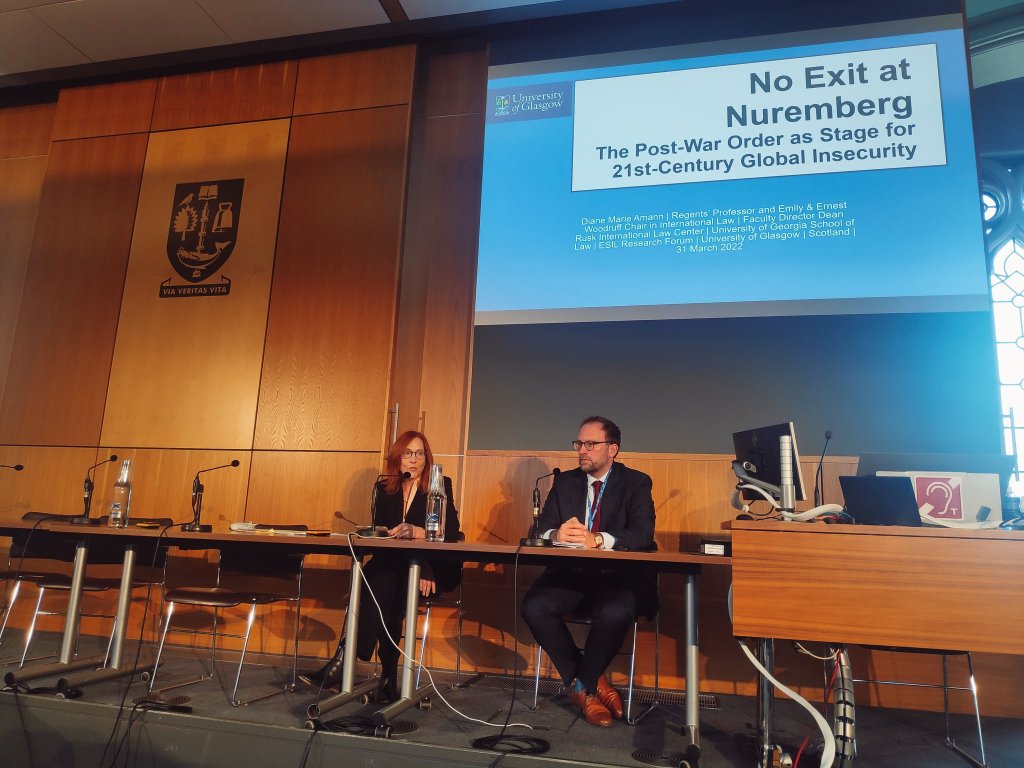
No Exit at Nuremberg: The Postwar Order as Stage for 21st-Century Global Insecurity” is the title of the keynote address that University of Georgia School of Law Professor Diane Marie Amann delivered Thursday at the University of Glasgow, Scotland, thus opening the 2022 Research Forum of the European Society of International Law. Her topic dovetailed with the forum’s overall theme, “International Law an Global Security: Regulating an Illusion?”

Introducing Amann – who is Regents’ Professor of International Law, Emily & Ernest Woodruff Chair in International Law, and Faculty Co-Director of the Dean Rusk International Law Center – was Glasgow Law Professor Christian J. Tams, Director of the Glasgow Centre for International Law & Security.

Amann framed her talk around two artefacts of the period immediately after World War II, when the 1945-46 Trial of Major War Criminals was unfolding before the International Military Tribunal at Nuremberg, Germany: the play that Jean-Paul Sartre entitled Huis Clos but that is known in English as Vicious Circle or No Exit; and the front page of a French newspaper that referred not only to that play, but also to food shortages, the East-West threat spurred by the advent of nuclear weapons, and the IMT trial. She then linked the military, economic, political, and human security threads these artefacts raised to current events including conflicts in Ukraine and elsewhere.