“London had fallen”: Brexit reflections from a Georgia Law Global Extern

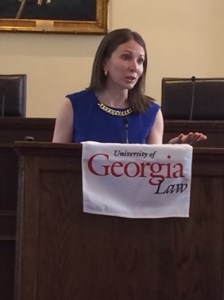
It’s our pleasure today to publish this post by Shirley Kathryn Griffis (below right), a member of the Georgia Law Class of 2017. Katie, as she’s known, spent Spring 2016 as  in our study abroad at Oxford University, and then began her second summer as a Global Externship Overseas in the London law firm Maples Teesdale. Reflecting on last week’s “Brexit” vote, Katie writes:

KatieThe first thing I thought on Friday morning was, “this can’t have happened.” It was a sentiment shared by almost all of my colleagues at Maples Teesdale’s London office, where I am spending my summer Global Externship Overseas. Together, we spent Friday morning pulling up articles, dusting off our United Kingdom constitutional law practice guides, and sharing legal theories on how the Brexit vote might be undone. It seemed that through the 51.9% to 48.1% vote to leave the European Union, London had fallen.

And we were in denial:

“The referendum is not legally binding.”

“Parliament can override.”

“Scotland won’t accept this. They can block it.”

“Cameron didn’t invoke Article 50, there’s still a chance.”

“Did you see the petition for the second referendum? Three million signatures! This won’t stand.”

The mood in London quickly turned from denial to anger when Prime Minister David Cameron announced that the results of the referendum must be respected, and the members of Parliament largely agreed. I chimed in with other voices from London on social media, asking how this could have happened. The feeling in London is that there is so much to be angry about that it is hard to know where to start, and whom to blame. Londoners started circulating a secessionist petition, there was a rally in Trafalgar Square to show solidarity with Europe, and everyone is talking about immigrating to Ireland.

London has a long way to go before accepting the reality of Brexit. The financial markets are reeling. The pound has plummeted, hitting a 31-year low in just four hours, and four major companies—Prudential Insurance, HSBC, BT and Royal Bank of Scotland—announced they were considering major staffing changes to include relocation or mass downsizing. As the financial capital of the United Kingdom, most major businesses in London have structured themselves to operate in accordance with European Union law and procedure. It is for this reason that London’s “stay” vote was 70% in favor—the European Union is vital to the survival of London’s economy.

FlagsThis is my second summer working for Maples Teesdale in London. I have always envisioned myself returning to London to practice after I graduate from the University of Georgia School of Law, but I worry now about whether that will be a possibility. It’s still uncertain what jobs, even industries, are safe, and how long the current financial crash will continue. I stand by my colleagues here in London, hoping that no matter how far London falls, it won’t take long at all to get back up and carry on.

Review: Human rights’ importance clear in Amazon “rubber barons” film

embrace

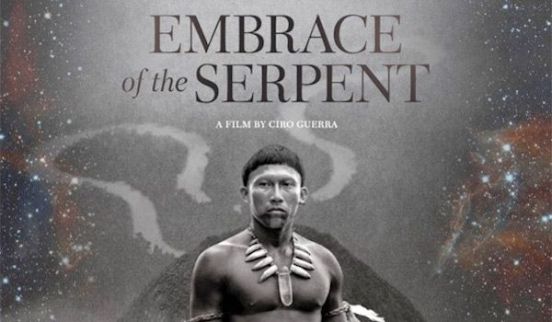
It’s our pleasure today to publish this post, which Hannah Coleman (below right), a member of the Georgia Law Class of 2017, wrote during her spring semester course on International Human Rights Law. Reviewing the feature-length, black-and-white drama Embrace of the Serpent (2015), by Colombia filmmaker Ciro Guerra, Hannah writes:

colemanEmbrace of the Serpent opens with the image of an Amazonian shaman, Karamakate, dressed in the authentic dress of his people. The man peers out over the river and quickly stands up as if he senses something. Then, a long boat pulls in between the trees with two men on board. Karamakate urges the two men to turn around and leave, but the boat continues to move closer and closer. Then, Karamakate pulls out a weapon and threatens the strangers to leave this place immediately. The audience can sense Karamakate’s tension and distrust of these travellers. Regardless of his warnings, the men do not stop, and the boat pulls ashore.

One man, Manduca, appears to be a native of the Amazon, but he is dressed in what Karamakate describes as “white man clothes.” Manduca refers to the second man, a white scientist from Germany named Theo, as his travel partner, and describes Theo’s rapidly weakening state. Karamakate is resistant to the new men, but his interest is peaked when Theo tells him there are still members of his tribe alive in another part of the jungle. The three men eventually set out on a journey, to find a sacred healing plant that they believe will rid Theo of his illness, and to find Karamakate’s people.

The audience is unaware of exactly what time period the film is set in, but the director provides clues in the form of discussions about white rubber barons coming into the forest and forcing the indigenous people into slavery in order to capitalize on the forest’s rubber trees.

The director skillfully focuses the audience’s attention on the impact the colonization is having on the indigenous people by concentrating on the journey of the men. Each time the men pull onto a riverbank to collect supplies, take a break, or camp for the evening, they meet someone different. With each interaction, the audience gains more insight into the horrors the indigenous people are facing due to the rubber barons, and we learn more about why Karamakate distrusts everyone. At one point, the three men arrive at a mission. This part was particularly interesting and disturbing because these people were stripped of their culture and forced into European practices. The mission consists only of young boys who are wearing white robes and not allowed to speak their native language. It was extremely sad to see all of these boys, taken from their parents at a young age, and forced to forget about their past.

After a while, a second story is skillfully woven into the movie’s plot. This story takes place several years later and involves Karamakate and another white man named Evan. Evan is following the diaries of Theo in order to find the same sacred plant Theo needed to cure his sickness. This second story is even more gut wrenchingly sad than the first, because Evan finds Karamakate in the same place that Theo and Manduca found him, only many years have passed, and Karamakate is still alone. It is clear that Karamakate’s memory is fading as he cannot tell Evan any details about his first trip with Theo and Manduca. But he agrees to help Evan find his way to the sacred plant.

boatAs these two follow the same pathway that Karamakate took many years before with Theo and Manduca, the audience is horrified to discover the lasting impact that the colonization has had on the Amazonian cultures. The most disturbing part of this story occurred when the two men arrived at the mission. They discover that this tribe of people has gone mad from engaging in cannibalism and likely inbreeding given their segregation from others. There are no Europeans left at the mission, so the tribe has taken some of the traditional Christian practices and interpreted them. This includes one man claiming to be Jesus Christ and tribe members forced to commit suicide. This portion of the film left a very powerful image of the horrors that entail when a group of people come into a community, strip them of their history, provide new practices, and then leave them confused and alone.

Until this movie, I had no knowledge about the European invasions of the Amazon to collect rubber, and the impact that this colonization had on the numerous cultures in that part of the world. The film demonstrates the impact on the indigenous people through Karamakate. He is the last remaining member of his tribe. Now, Karamakate has resolved himself to live in solitude where he is engrossed in loneliness. The impact of his solitude is really felt when the movie enters into the second story where Karamakate is the only man, living in the same place, alone, struggling to remember his past, and believing he is merely a shadow of his former self that walks the earth detached from his body. I can imagine many tribes in this region felt a very similar impact on their cultures during this invasion of their land. As their people are killed off, their traditions begin fading with their memories.

In my opinion, the most impactful statement of the whole movie was the dedication at the very end. While these images of death, destruction, and the loss of entire cultures, the director chose to end the film by dedicating the work to the song of those cultures and the songs we will never know. Those words have resonated with my since I saw the film. I am struck with such sadness that entire tribes have been forgotten; it is almost as if they never existed.

I am left thinking about how many times this phenomenon has occurred. Where the world calls for an item, such as rubber, so people invade, kill, and destroy everything in their wake in order to satisfy a desire. This being my first human rights class and my first international law class, this film demonstrated to me, once again, the importance of human rights and the uniting of nations to assure that people are not being stripped of their rights. I always knew that issues like this existed, but I never fully grasped the gravity of some of these events. It is interesting, sometimes it takes a movie based on true events to cause people, like me, to realize how history has a way of repeating itself. If we do not take care and protect people, we will continue to witness travesties such as the ones described in Embrace of the Serpent.

Our newest Masters of Laws

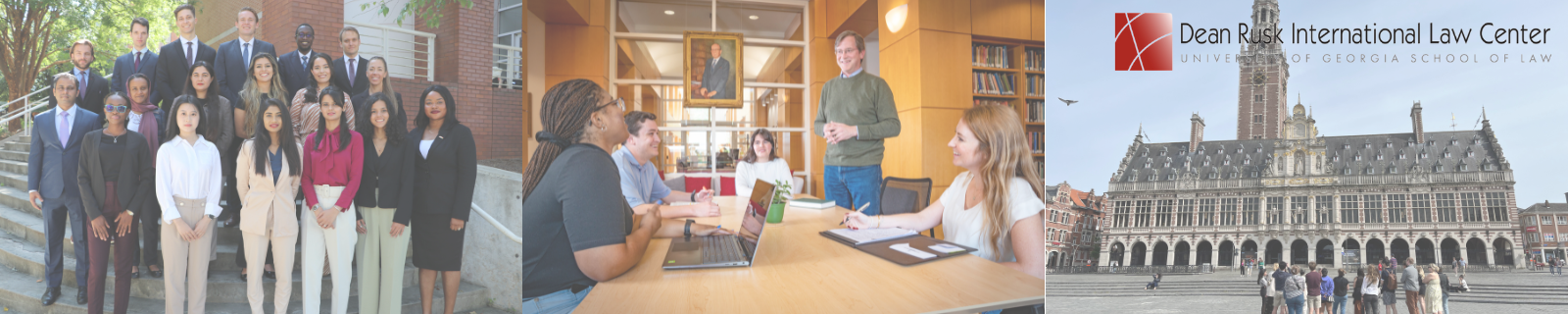
Saturday was the University of Georgia School of Law commencement, and we were very pleased to welcome to our community of nearly 500 LLM graduates the 15 talented lawyers pictured below. Congratulations to our newest Masters of Laws!

IMG_7955

Our LLM Class of 2016 posed on Graduation Day for a photo with Laura Tate Kagel, our Center’s Director of International Professional Education (bottom right). From left, the new alums are: top, Elisha Atulomah, Miguel David Medina Cordoba, Mahemud Tekuya, and Fazle Rabbi Chisty; middle, Huajin Tang, Kun Wang, Simon Wolffram, Xiao Zhang, and Deborah Nogueira-Yates; bottom, Ekaterina Knapik, Gladys Ashiru, Nastasja Spee, Socorro Moctezuma Flores, Tingting Tang , and Oluwakemi Kusemiju.

Summer 2016 GEOs: Georgia Law students ready to take on the world

GEO blog post photoThis summer, ten law students will benefit from international placements through the Global Externship Overseas, or GEO, administered by Georgia Law’s Dean Rusk International Law Center.

These students have been awarded funding to enable them to earn legal training in law firms, in-house legal departments, government agencies, and nongovernmental organizations around the world. Practice areas span a range, including refugee law, property law, criminal law, corporate law, and cultural heritage law.

2016 GEO participants include several rising 3Ls, who are headed to Europe and Asia:

► Bradley Dumbacher – GÖRG, Cologne, Germany
► Shirley Kathryn Griffis – Maples Teesdale, London, United Kingdom
► Brenny B. Nguyen – Boat People SOS, Bangkok, Thailand
► Jianan Zhang – Lenovo & Han Kun Law, Beijing, China

Numerous rising 2Ls also will be working ’round the world:

► Megan Alpert – GÖRG, Cologne, Germany
► Victoria Barker – DLA Piper, St. Petersburg, Russia
► Decker McMorris – Tosetto, Weigmann e Associati, Milan, Italy
► Claire Provano – Studio Legale Associato Rossini, Turin, Italy
► Carson Stepanek – Tosetto, Weigmann e Associati, Milan, Italy
► Hannah Mojdeh Williams – Department of Intangible Cultural Heritage, Ministry of Culture and Fine Arts, Phnom Penh, Cambodia

We congratulate them all on their GEO acceptance, and wish them an enriching summer. Can’t wait to hear travel notes!

Former Nigeria prosecutor’s LLM year features US practice experience

IMG_0526.Gladys ASHIRU_2_fb

Among the many talented foreign-trained lawyers set to earn Georgia Law’s Master of Laws (LLM) degree this month is Gladys Ashiru, who arrived with considerable experience as a prosecutor in Nigeria. She’s enriched this experience this year: in addition to her academic studies and a professional development trip, Gladys has worked as a volunteer prosecutor here in Athens.

Having immigrated to the United States, Gladys chose to put her career back on track by pursuing an LLM at Georgia Law. She says she was impressed by the collegiality she encountered during a visit to campus, and swayed by LLM graduates who spoke glowingly of their experience here.

Gladys’ strong interest in criminal law prompted Laura Tate Kagel, our Center’s Director of International Professional Education, to connect her with the Athens-based Office of the District Attorney for the Western Judicial Circuit, whose staff includes a number of Georgia Law alums. Assistant District Attorney Paige Otwell (JD 88) became Gladys’ mentor and introduced her to District Attorney Ken Mauldin (JD 80). After Gladys enrolled in Mauldin’s Spring 2016 Trial Practice course, he offered her the opportunity to observe and help out in the D.A.’s office. With the semester now at an end, Gladys recounts:

“It was an amazing experience for me. The internship broadened my horizons and exposed me to perspectives different from mine, especially in areas relating to jury selection and trials.”

After commencement on May 21, Ashiru plans to take the Georgia and New York bar exams, and also hopes to contribute to legal reform in Nigeria. Although she says that Georgia Law was challenging, she also found it rewarding, and calls it

“the best choice I made!”

A world of issues addressed in new edition of Georgia Journal of International & Comparative Law

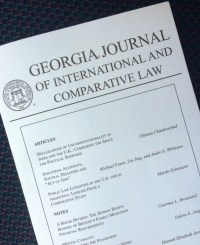
IMG_1031Four more than 4 decades, important articles on international, transnational, and comparative law and policy have found a publication home at Georgia law’s Georgia Journal of International and Comparative Law. Volume 43 Issue 2, the latest edition of GJICL, has just been released and is available online.

The volume begins with three articles, by five scholars from Asia, Europe, and South America:

31th_chintan

Declarations of Unconstitutionality in India and the U.K.: Comparing the Space for Political Response, by Chintan Chandrachud (left), candidate for Ph.D. in Law, University of Cambridge, England

faureIndustrial Accidents, Natural Disasters and “Act of God”, by: Professor Michael Faure (right), Professor of Comparative & International Environmental Law at Maastricht University’s Maastricht European Institute for Transnational Legal Research and Professor of Comparative Private Law & Economics at the Rotterdam Institute of Law and Economics, Erasmus liuSchool of Law, both in the Netherlands; Dr. Liu Jing (left), postdoctoral researcher in Research Institute of Environmental Law, School of Law, Center of Cooperative Innovation for Judicial Civilization, Wuhan University, China, and Behavioral Approach of Contract & Tort at Erasmus andriUniversity Rotterdam; and Dr. Andri Wibisana (right), Lecturer at the Faculty of Law Universitas Indonesia in Jakarta

oynPublic Law Litigation in the U.S. and in Argentina: Lessons From A Comparative Study, by Professor Martín Oyhanarte (left), Professor of Law at Universidad Austral and Universidad del Salvador  in Buenos Aires, Argentina

Three Notes, by alums who received their Georgia Law J.D.s in 2015, also appear in the volume:

broussardA House Divided: The Human Rights Burden of Britain’s Family Migration Financial Requirements, by Courtney L. Broussard (right), Staff Attorney, U.S. Court of Appeals for the Eleventh Circuit

jangMental Capacity: Reevaluating the Standards, by Eulen E. Jang (left), PSJD Fellow, National Association for Law Placement, Washington, D.C.

jarrellsHistory, TRIPS, and Common Sense: Curbing the Counterfeit Drug Market in Sub-Saharan Africa, by Hannah Elizabeth Jarrells (right), Associate Attorney at the Atlanta law firm of Ferrer Poirot Wansbrough Feller Daniel & Abney

Antiquities trafficking said to fuel transnational mayhem by Daesh et al.

davisetal

Alumna Tess Davis, 2d from left, met with Georgia Law 1Ls after her lecture; from left, Hannah Williams, Ava Goble & Karen Hays. Hannah will work on cultural heritage issues this summer through a Global Externship Overseas (GEO) at the Cambodia Ministry of Culture & Fine Arts, Department of Intangible Cultural Heritage.

“As long as there have been tombs, there have been tomb raiders.”

So began the terrific talk on trafficking that Tess Davis, Executive Director of the D.C.-based Antiquities Coalition, delivered to a rapt University of Georgia audience this week.

Having conceded the point quoted at top, Davis stressed that today the problem is much different and much greater. On the list of lucrative transnational organized crime, she asserted, antiquities trafficking places 3d, right behind arms trafficking and drug trafficking.

The threat is not simply one of criminal behavior, she continued. Rather, Davis stressed that profits from antiquities trafficking – profits believed to be in the millions of dollars – provide revenue vital for the nonstate actor waging armed conflict in Syria and Iraq. That entity calls itself “Islamic State” and is often labeled “ISIS” or “ISIL” in the media; taking a lead from diplomats in France and, recently, the United States, Davis preferred “Daesh,” the group’s Arabic acronym, for the simple reason that “they hate to be called that.”

Initially trained as an archeologist, Davis began to focus on legal means to combat antiquities trafficking while still a student at Georgia Law. Since earning her J.D. in 2009, she’s been a leader at the Lawyers’ Committee for Cultural Heritage and in the American Society of International Law Cultural Heritage & the Arts Interest Group, a researcher at Scotland’s University of Glasgow, a member of Georgia Law’s Dean Rusk International Law Center Council, and, as the photo above demonstrates, a mentor to Georgia Law students and other young lawyers interested in working in the field. Her efforts to help repatriate antiquities stolen from Cambodia earned multiple mentions in The New York Times.

Her talk drew links between the looting of cultural heritage during and after the 1970s Khmer Rouge reign of terror and current looting in the Middle East today. In both instances, she said, “cultural cleansing” – in the contemporary case, the destruction and thievery of monuments sacred to moderate Muslims and others – precedes and parallels efforts to erase and subjugate the humans who venerate those monuments. It’s a state of affairs documented in her Coalition’s new report, “Culture Under Threat.”

“The world failed Cambodia,”

Davis said, then expressed optimism at growing political will to do something about the Middle East. She advocated enactment of S. 1887, the Protect and Preserve International Cultural Property Act now working its way through Congress. The legislation, whose cosponsors include a Georgia U.S. Senator, David Perdue, is urgent: Davis estimated that U.S. buyers represent 43% of the current demand for looted Syrian antiquities.

Women’s voices cast in leading role at 33d annual Edith House Lecture

evansLeading Georgia Law’s annual celebration of its 1st woman law graduate this year was an extra special, and especially inspiring, alumna.
Delivering the 33d annual Edith House Lecture, Stacey Godfrey Evans (left) treated students, faculty, staff, and others in the law school community to a talk entitled “The Voice of a Woman Lawyer: Why it Matters and How to Use It.”

It’s a subject for which she’s well qualified, as 3L Hannah Byars (below right), leader of the Women Law Students Association, made clear. Byars related that after Evans earned her J.D. in 2003, she practiced as an associate at BigLaw firm, then opened a small firm with a handful of colleagues. Evans established her own firm, S.G. Evans Law LLC, in 2014. And since 2011, she’s represented District 42, in Smyrna, as a Democrat in the Georgia State Assembly.hannah

Evans opened her talk by reciting the still-low percentages of women at high levels of the legal profession and politics, then urged the women in her audience to let their voices be heard.

“When you change who is in the room, you change the conversation,”

Evans said at one point, and added that women should not fear to be controversial when the situation merits. She concluded by encouraging women to run for office.

houseIt was a fitting tribute to the namesake of this lecture series, depicted at left: Edith House (1903-1987), whose portrait hangs in the law school rotunda. She and another student in the Class of 1925 were Georgia Law’s 1st women graduates. House was co-valedictorian, and went on to a distinguished career, including a stint as the 1st woman U.S. Attorney in Florida. Thanks to a Women Law Students Association initiative (see this great online scrapbook at p. 53), lectures have been given each year in her honor since 1983.

D.C. week: Sohn Fellow Pentagon tour

pentagon1apr16This week in D.C.: In their first days volunteering at the Annual Meeting of the American Society of International Law, our Louis B. Sohn Professional Development Fellows have witnessed both a panoramic (and pan-American) Grotius Lecture by Chilean President Michelle Bachelet and a witty talk by Supreme Court Justice Stephen Breyer on his new book, The Court and the World: American Law and the New Global Realities.

Today, they’re on a behind-scenes tour of the Pentagon. Depicted at center is Kathleen A. Doty, Associate Director for Global Practice Preparation at our Dean Rusk International Law Center– a former Department of Navy lawyer, she arranged the visit. The Georgia Law students surrounding her are, from left, Hannah Mojdeh Williams, Victoria Aynne Barker, Katherine Nicole Richardson, and  Deborah Nogueira Yates.

D.C. bound, for ASIL Annual Meeting

SONY DSC

Students, faculty, and staff at Georgia Law are heading this week to Washington, D.C. – members and Academic Partner of the American Society of International Law, bound for ASIL’s 110th Annual Meeting.

It’s always a special time of year for us at the Dean Rusk International Law Center, given our long tradition with the Society – not least because Louis B. Sohn, our inaugural Emily & Ernest Woodruff Chair in International Law, served as an ASIL President. In his honor, the Center has awarded Louis B. Sohn Professional Development Fellows to our 1 LLM, 1 MSL, and 3 JD students who will volunteer at the meeting. They’re pictured above, standing tall with the portrait of Professor Sohn which overlooks our Center’s Louis B. Sohn Library on International Relations.  The Sohn Fellows are, from left, Hannah Mojdeh Williams, Victoria Aynne Barker, Katherine Nicole Richardson, Deborah Nogueira Yates, and Bradley C. Bowlin.

Also ASIL bound are:

copydianeDiane Marie Amann, Georgia Law’s Associate Dean for International Programs & Strategic Initiatives, current holder of the Emily & Ernest Woodruff Chair in International Law, and a former Vice President of the Society. Amann, who leads our Center, will take part in a panel discussion of the new International Committee of the Red Cross Commentary on the First Geneva Convention at 2 p.m. Wednesday, March 30. Her talk is a forerunner to a planned Georgia Journal of International & Comparative Law conference on the Commentary, to be held on Friday, September 23, 2016.

????????????????????????????????????

► Georgia Law Professor Harlan Cohen, who serves on ASIL’s Executive Council and as Managing Editor of its AJIL Unbound.

SONY DSC

Kathleen A. Doty, our Center’s Associate Director for Global Practice Preparation, and a past Attorney-Editor at ASIL. Formerly an attorney in the Office of the General Counsel, U.S. Department of the Navy, Doty also serves as Chair of ASIL’s Nonproliferation, Arms Control, and Disarmament Interest Group, also known as NACDIG. In that capacity, she’ll be moderating a panel entitled The Emergence of Cyber Deterrence: Implications for International Law, from 11 a.m. to 12:30 p.m. on Thursday, March 31. Speakers will be Gary Brown, Professor of Cyber Security at the Marine Corps University; Jonathan E. Davis, Attorney-Adviser, Office of the Legal Adviser, U.S. Department of State; and Tara McGraw Swaminatha, Of Counsel at the Washington office of DLA Piper LLP. Here’s the panel description, as set out at page 37 of the Annual Meeting Program:

“Military and civilian policymakers increasingly stress the importance of deterring other nations from engaging in computer network exploitation and attacks against the United States. Resulting from the behavior of China, Iran, and North Korea respecting offensive cyber capabilities, deterrence features prominently in the new Department of Defense cyber strategy, the response of the Obama administration to high profile attacks, and the Congressional debate around cyber issues. This panel will explore the emergence of cyber deterrence, and new trends in cyber security generally, as they relate to international law. Some important areas of concern include: how the emphasis on deterrence might affect the law on State responsibility, non-intervention, counter-measures, and the use of force; whether moving to strengthen cyber deterrence requires changing the permissive nature of international law on espionage; what new norms might be needed to support and stabilize cyber deterrence, such as confidence-building measures, arms control rules, and norms on escalation control; and how the emergence of cyber deterrence might affect other cyber issues important in international law, including Internet governance, digital commerce, and human rights. The session will also analyze what international legal lessons might be learned from nuclear and non-nuclear contexts where States have adopted deterrence strategies.”

See you there!