UGA Law students attend American Branch of the International Law Association’s International Law Weekend through Louis B. Sohn Professional Development Fellowships

Top row, from left to right: Aashka Vyas, Bohdan Krivuts, N’guessan Clément Kouame, Savelii Elizarov Bottom row, from left to right: Anna Carolina Mares, Eman Abdella Ali, Shivani Ravi Prakash, Victoria Agbakwuru, and Sarah Quinn

Each fall, the American Branch of the International Law Association hosts its annual International Law Weekend (ILW) conference in New York City. This event features over 30 panels, and many of the world’s leading international lawyers and diplomats participate. Audiences recently have included more than a thousand practitioners, academics, U.N. diplomats, business leaders, federal and state government officials, NGO leaders, journalists, students, and interested citizens. 

This year, the University of Georgia School of Law was a sponsor of the event, and eight students attended through the support of Louis B. Sohn Professional Development Scholarships awarded by the Dean Rusk International Law Center. This builds on a tradition of supporting students seeking professional development opportunities (Prior posts here, here, and here). Recipients of the scholarships this year included:

Krivuts was selected by ABILA to serve as one of six Student Ambassadors for the event.

ILW keynote speakers included Ambassador Sheikha Alya Ahmed Saif Al Thani, Permanent Representative of the State of Qatar to the United Nations, and Judge Gatti Santana, President, International Residual Mechanism for Criminal Tribunals. The students enjoyed hearing a range of perspectives on the current international law scheme and how its shortcomings and challenges may be met. For example, one of the panels that Vyas attended was “Investment Law and Energy in times of Armed Conflict.” She appreciated the legal framing of the recent events in Ukraine, and noted that these discussions illuminate the “…considerable gaps…in the current legal regime” and how they could potentially be addressed by “…adopting new measures to maintain cross-border investments during armed conflict.” Kouame, meanwhile, enjoyed the panel entitled “Trade, Labor Rights and Forced Labor.” He said that the panelists provided insight concerning the enforcement of labor and human rights provisions of the USMCA directly related to a research project he is conducting under Professor Christopher M. Bruner.

In addition to the ILW programming, students met with LL.M. alumni working in New York. These included Julie Guo (LL.M., ’09), who hosted students in her firm’s New York City office; along with Parham Zahedi (LL.M., ’18) and Tatyana Popovkina (LL.M., ’23), who met with students before the conference on Saturday. In both meetings, students were able to learn about the experiences of Guo, Zahedi, and Popvkina at UGA Law, how they prepared for the New York bar exam, and their advice for conducting domestic job searches. Students appreciated their insights; Mares, for example, commented that her conversations with alumni reminded her of the strength of the UGA Law community. “Alumni spoke about their gratitude for time spent at UGA and mentioned wanting to do as much as possible to help UGA grads entering the legal field,” she reflected. “Though New York is a competitive market to enter, with hard work and support from fellow UGA grads, it appears to be in reach as a dynamic place to establish a legal career.”

Each of the eight UGA Law students who attended the ABILA ILW agreed that being able to attend this type of professional conference is valuable as they learn about the field of international law and consider their professional futures. Ravi Prakash noted the event’s “transformative impact” on her professional aspirations. “This experience introduced me to a network of highly accomplished individuals in the realm of international law, many of whom are prolific writers, professors, ambassadors and successful attorneys in the field,” she commented. “Interacting with these experts not only expanded my knowledge but also provided valuable insights and connections that will be invaluable in my journey. On a personal level, it instilled in me a deeper passion for international law and a sense of belonging within this community of experts. This event has undoubtedly set me on a path to a more promising and fulfilling future in international law.”

UGA Law Professor Cohen Speaks with International Law Society

Gabriel M. Wilner/UGA Foundation Professor in International Law & Faculty Co-Director of the Dean Rusk International Law Center Harlan Grant Cohen spoke to International Law Society (ILS) members in late September as part of an ongoing brown bag lunch series with international law faculty at UGA Law.

Cohen provided the students in attendance with an introduction to his current research. He then outlined his path into academia and offered students insight into the spectrum of professional opportunities within the field of international law, noting fast-growing sectors like export controls, CFIUS issues, and space law. He also offered some reflections on the changing nature of the field, including the recent trend of withdrawal from international organizations and treaties; the emergence of new centers of power that challenge norms in international law; and increasing economic competition influencing international law through mechanisms such as trade rules and sanctions. Cohen encouraged student questions to drive the majority of the conversation, providing career and networking advice throughout the discussion. He recommended that students interested in international law enroll in the spring Public International Law course, attend conferences and get involved in international law organizations, and try to learn a second language if possible.

ILS President, 2L Madison Graham, spearheaded this series with the intention of orienting new law students towards the international law faculty. She hopes to expand the student body’s definition of what international law means and to bring their attention to the academic achievements of the international law faculty here at UGA Law.

ILS is the student chapter of the International Law Students Association, a Washington, D.C.-based organization that for decades has provided students with opportunities to study, research, and network in the international law arena through conferences, publications, and administration of the Philip C. Jessup International Law Moot Court Competition. At UGA Law, ILS hosts events and projects designed to stimulate and advance understand of international, comparative, foreign, and transnational law and institutions. ILS’ faculty advisor is Diane Marie Amann, Regents’ Professor of International Law, Emily & Ernest Woodruff Chair in International Law, Faculty Co-Director of the Dean Rusk International Law Center.

UGA Law 3L Meredith Williams reflects on participation in the Bavarian International Trademark Association (“BITMA”) convention in Munich, Germany

Today we welcome a guest post by Meredith Williams, a member of the University of Georgia School of Law Class of 2024. Meredith is one of several UGA Law students to participate in a semester-long international externship, a pilot extension of our existing Global Externships Overseas initiative. This pilot is a joint initiative between the Dean Rusk International Law Center and the law school’s Clinical and Experiential Program. Meredith’s post describes her experience attending an international convention as part of her externship.

I am spending the fall semester of my 3L year working as a legal extern with Weickmann, an intellectual property law firm located in Munich, Germany. I work under Dr. Udo W. Herberth (LL.M., ’96), who heads the firm’s brands and designs group.

A highlight of my global externship thus far has been attending the second annual Bavarian International Trademark Association (“BITMA”) convention, which Dr. Herberth founded. The conference took place over two days, during which I met trademark and patent attorneys from fourteen different countries. On the first day, attorneys from each country presented on the topics of 1) use and 2) jurisdiction.

My externship and this conference in particular have crystalized for me how intellectual property is an increasingly international area of law. Many clients and companies wish to register, maintain, and prevent infringement of their trademarks in more than one country; yet, there are nuanced and important distinctions between different jurisdictions’ requirements and timelines. In a field of law where adding value to a brand is crucial, it is important to be aware of these differences and stay on top of deadlines.

I enjoyed learning from the diverse group of individuals at the BITMA conference. For example, a topic I found compelling was the question of translation of trademark languages. In Canada, the Quebec charter regarding French language has been amended. Attorneys at the conference suggested this will have an impact on trademarks because the French portion of the mark must be twice the size, yet the entire trademark need not be translated. For example, in Quebec, an Apple store could display a large “Le Magasin” before “Apple,” and not have to translate “Apple” into “Pomme.” Further, in Japan, there are four different scripts, which create even more nuance to registering a word mark. These evaluations go into much more detail than we had time to cover during the conference, but it has piqued my interest as something I had never thought about living in the English-dominant US.

Another aspect of the BITMA conference that I enjoyed was the balance between personal and professional. The group of 25 of us shared many meals, watched the traditional Bavarian parade for the opening weekend of Oktoberfest, and eventually made our way to the festivities. While the substantive knowledge I acquired from this group is important, I also learned a lot from interacting with everyone on a personal level. Dr. Herberth fostered a warm and supportive atmosphere throughout the convention. This type of collegial experience served as a reminder that there is value in getting to know colleagues as people outside of work. The BITMA group treated me as an equal and were interested in my path and life. It reminded me that I want to lend a helping hand to law students and those in the early stages of their careers as I progress through mine.

I look forward to the second half of my semester working at Weickmann. I thank UGA Law for leaving such a lasting, positive impression on Dr. Herberth; it is for this reason that he was incentivized to provide educational experiences for UGA Law students like myself, and it is also why I know that I, too, want to provide this type of experience to a UGA Law student one day.

Alexander Campbell King Law Library hosts annual gathering for international students

Last Friday, international students at UGA Law gathered for an annual reception hosted by the Alexander Campbell King Law Library. International students in the J.D. program, Master of Laws (LL.M.) students, and exchange students from O.P. Jindal Global University Law School (JGLS) were invited to this social gathering to meet with each other and Law Library staff. This year, several LL.M. alumni/ae were in attendance, in addition to staff from the Dean Rusk International Law Center, the Center’s two Visiting Research Scholars, members of the Center’s Faculty Committee, and law faculty who teach classes for LL.M. students.

This event began in 2018 when Access Services Manager Marie Mize and Access Services Associate Szilvia Somodi proposed that the Law Library host a reception for the LL.M. students in order to introduce them to the law library staff and to talk about the library’s services. They and Foreign & International Law Librarian Anne Burnett planned the reception, which was first held September 11, 2018.

Over the years, this event has evolved in response to both students’ needs external circumstances. The event date was adjusted to accommodate the acculturative stress patterns of international students, who, Law Library staff learned, tend to experience homesickness around this time of the year. During the 2020-21 academic year, the Law Library held two virtual receptions in the fall and spring semesters to build community despite not being able to gather in person. In lieu of catered refreshments, Somodi and Mize assembled goodie bags that were made available for pickup in the Law Library for the week surrounding the virtual events.

Beginning in 2022, the Law Library expanded the event to include all international students in the J.D. program and Visiting Research Scholars. This year, the first two exchange students from UGA Law’s partnership with JGLS joined, in addition to several LL.M. alumni/ae. Somodi and Mize continue to be crucial to the planning and execution of the event, with the broader support of the library’s Student Engagement Team.

This event shines a spotlight on the relationship between the Law Library and UGA Law’s community of international students, emphasizing that they are welcome and encouraged to use the library’s facilities and services— and that the Law Library staff is glad they are here.

UGA Law clinics continue efforts on behalf of immigrant women alleging abuse, retaliation while in ICE detention

The University of Georgia School of Law clinics’ faculty and students, including Jason A. Cade, Associate Dean for Clinical Programs and Experiential Learning, and Kristen Shepherd, Community Health Law Partnership Clinic Staff Attorney of the Community HeLP Clinic, have continued their advocacy on behalf of women clients who are challenging the abuses they endured while in U.S. immigration detention.

As previously posted UGA Law’s Community HeLP Clinic and First Amendment Clinic have pursued administrative, judicial, and advocacy paths in support of women who had been in the custody of U.S. Immigration and Customs Enforcement (ICE) at the Irwin Detention Center, a privately run facility in south Georgia. While there, the women were subjected to nonconsensual medical procedures. Those who spoke out were met with retaliatory acts, including attempted or actual removal from the United States. For more than two years, the UGA Law clinics have represented these women in judicial and administrative proceedings.

The Community HeLP Clinic made significant progress in recent months on behalf of several women who experienced nonconsensual medical procedures while detained by ICE. These efforts included ongoing advocacy before a State Clemency Office, representation before immigration court on behalf of a woman who was unjustly deported, and successful advocacy before the Board of Immigration Appeals to reopen a third woman’s removal proceedings. The Clinic continues to represent these women and others in a putative class action lawsuit relevant to their allegations of medical abuse and retaliation. More information on these successes and engagements can be found here.

The Community HeLP Clinic is centered around interdisciplinary advocacy that focuses on immigration status and health, noncitizen workers and detainees, and public education. Along with overseeing the law school’s 11 in-house clinics and 7 externship programs, Cade directs the Clinic and aids law students in undertaking an interdisciplinary approach to immigrants’ rights through individual client representation, litigation, and project-based advocacy before administrative agencies and federal courts. Shepherd supervises students as they engage in a variety of services including interviewing and advising clients, conducting research and drafting legal documents, advocating in court proceedings and administrative hearings, and collaborating with legal and medical professionals in the community.

From classmates to colleagues: LL.M. alumna Rawdha Hidri (LL.M. ’23) and 2L Carolina Mares reflect on summer work experience together

Through the Global Externships Overseas (GEO) initiative administered by the Dean Rusk International Law Center, 2L Carolina Mares spent her summer working in international arbitration at the Houerbi Law Firm in Tunis, Tunisia. In this placement, Ms. Mares worked under the supervision of Rawdha Hidri, a Fulbright recipient who completed her Master of Laws (LL.M.) at UGA Law in May 2023.

While it is not uncommon for our J.D. students to work under our LL.M. alumni/ae in GEO placements, this is the first experience in recent memory when they had the opportunity to meet on-campus and learn together as classmates prior to their experience abroad. Below, Mares and Hidri describe their experiences participating in the GEO from the perspectives of student and supervisor, respectively. Responses have been edited for length and clarity.   

* * * *

Carolina Mares, 2L

What initially interested you about the Global Externships Overseas (GEO) initiative?

With the desire to practice international law in my career moving forward, I knew that the GEO initiative was an incredible opportunity designed to encourage me to explore one potential avenue for my future. I was torn between pursuing summer work in public international law or looking for a firm that would give me some experience in international arbitration. However, when I heard about the possibility of focusing exclusively on international arbitration at Houerbi Law Firm, my mind was set.

What was your GEO experience like?

This summer, I worked at Houerbi Law Firm in Tunis, the capital of Tunisia. The firm specializes in commercial international arbitration and operates between Tunis and Paris with a focus on disputes in Europe, the Middle East, and Africa. My work consisted of reading case dockets, synthesizing parties’ positions, analyzing factual and legal exhibits, drafting an answer to a request for document production, and writing appropriate parts of an award. What I enjoyed most was the novelty of each case I got to work on. The parties in the disputes ranged from state to private parties in the UAE, Italy, Jordan, Iran, Malaysia, Tunisia, Turkey, and Morocco. I also had the chance to learn about all sorts of industries, including oil and gas, gold and fine jewelry manufacturing, and government procurement.

In addition to Rawdha, Mr. Houerbi was a phenomenal mentor to me during my time in Tunisia. With sixteen years of experience as the Arbitration and ADR Director of the ICC for the Mediterranean, the Middle East, and Africa, his positive and direct feedback played an important role in shaping my work and experience at the firm. He often invited me to sit in on team meetings that did not pertain to my particular cases so that I could gain exposure to as many disputes as possible, and he encouraged me to observe all of the virtual hearings that took place this summer.

How do you envision your GEO contributing to your academic and professional goals?

Taking part in the GEO has already impacted my professional trajectory. First, I now know that I enjoy the work involved in international arbitration, and I can picture myself pursuing a career in this practice area. Second, I’m convinced that my participation in a GEO is the reason I landed a 2L summer job fairly quickly, as it was the hot topic in all of my interviews. But more importantly, the GEO gave me a chance to take a deep dive into a niche area of law that is difficult to get into as a novice, especially in the Atlanta area. In addition to delving into international arbitration, the GEO program allowed me to develop my confidence navigating across cultures all while improving my French skills in a captivating work environment.

What was the best part of participating in a GEO?

The highlight of my GEO experience was making deep connections with my colleagues and experiencing day-to-day life in an incredibly rich culture that was brand new to me. Besides taking on the role of mentor, Rawdha was also my cultural guide. She introduced me to the coastal neighborhoods of Tunis, invited me to join her family and friends on the weekend for a shopping expedition in the Medina, pointed out the flocks of flamingos flying by in V-formation as we lounged on the beach, and took me sightseeing in Hammamet where we attended an amateur Opera concert at the Dar Sebastian villa overlooking the Mediterranean. In short, the best part of doing a GEO was getting a feel for the flow of life in Tunis and growing in my cultural competency, all of which I owe in big part to Rawdha’s support as my mentor and host.

* * * *

Rawdha Hidri (LL.M., ’23)

What interested you in serving as a placement supervisor for a GEO?

My time at UGA Law was so formative, I was eager to reciprocate and provide inquisitive American J.D. students with an experience as enriching as the one that I had in Athens. I strongly believe that immersing oneself in new experiences and can be influential on both personal and professional levels. Throughout my journey at UGA Law, I embraced the role of an informal cultural ambassador for my country Tunisia. The GEO initiative emerged as an ideal opportunity for both providing American J.D. students with professional experiences in a distinct legal framework and within a specific geopolitical context and with rich cultural immersion in my home country.

How did hosting a UGA Law student contribute to your firm’s work?

Carolina’s ability to methodically structure and articulate her thoughts has been a valuable addition to our team dynamics. Her innate attention to detail was evident from the outset, as she engaged diligently with the tasks assigned to her. Encouraging her to delve further and uncover nuances within cases became a rewarding challenge, showcasing her dedication to thorough exploration.

How did you approach integrating a UGA Law student into the local community and culture?

In the spirit of fostering a sense of belonging, I took it upon myself to introduce Carolina to the richness of Tunisian culture, ensuring she tried traditional Tunisian cuisine and experienced the crystal-clear waters of the Mediterranean. The entire team enthusiastically engaged in this process, sharing suggestions of places to visit, offering language lessons, and collectively enjoying lunches together outside the office on a weekly basis. This collaborative approach not only enhanced Carolina’s integration but also fostered a supportive and inclusive environment, benefitting both her and the entire team.

What did you enjoy about serving as a supervisor for a GEO?

Serving as a supervisor for a GEO was incredibly rewarding on a personal level. It expanded upon my own Fulbright journey that I started at UGA Law, allowing me to share my perspective and insights with someone eager to learn. The most fulfilling aspect was knowing that the student I hosted would carry their experiences in Tunisia with them, and that perspective would continue to guide them in their professional pursuits. This connection ensures a lasting impact, creating a sense of continuity and mutual understanding that extended beyond the program itself.

* * * *

Global Externships Overseas (GEOs) are four-to-twelve week summer placements in diverse areas of legal practice around the world. Students return to Athens with new colleagues and mentors, legal practice skills, and a deeper appreciation of the global legal profession. Over the last fifteen years, more than 200 UGA Law students have completed a GEO. Students secure placements tailored to their career goals with the aid of the Dean Rusk International Law Center.

For more information about GEOs, visit our website.

Nomsa Ndongwe, Research Fellow at the James Martin Center for Nonproliferation Studies, speaks at UGA Law

James Martin Center for Nonproliferation Studies (CNS) Research Fellow Nomsa Ndongwe spoke to students about careers in international law and contemporary security challenges Wednesday here at the University of Georgia School of Law.

Joined by UGA alumna and CNS Research Associate Tricia White, Ndongwe discussed her own career trajectory and current work in nonproliferation at CNS. Both Ndongwe and White identified several skills aspiring international lawyers can work towards in law school, including learning languages and developing subject matter expertise. Ndongwe championed the importance of professional networking, building relationships with peers, and making use of the resources available to students at UGA Law, like the Career Development Office and the Dean Rusk International Law Center. She also answered student questions about the Russian war in Ukraine, space law, maritime law, and global nuclear security challenges.

Ndongwe is a Co-founder of the WCAPS West Coast Chapter, and an N-Square Innovators Network Fellow 2020 – 2021. As of January 2022, she co-leads the CNS Young Women in Nonproliferation Initiative, is a School of International Futures Mentor 2023, and served as a Girl Security mentor. She is also a part of the P5 –Young Professionals Network (YPN) 2022-2023 cohort. She has a Master of Arts in Nonproliferation, Terrorism Studies, and Financial Crime Management from the Middlebury Institute of International Studies. She obtained her first degree, an LLB Single (Hons) degree at Brunel University, and her Postgraduate Diploma in Legal Practice (LPC) from the University of Law in Guildford, UK.

Previously, she served as diplomat for the Zimbabwe Permanent Mission to the United Nations Office at Geneva, focusing mainly on the Disarmament portfolio and International Telecommunication Union (ITU). Nomsa is a featured non-proliferation panelist/moderator for the Ploughshares Foundation, Harvard Belfer Center, Trinity College DC, United Nations Office for Disarmament Affairs (UNODA) New York, Naval Postgraduate School, United Nations Institute for Disarmament Research (UNIDIR), N Square Innovators Network and Royal United Services Institute (RUSI).

This event was cosponsored by the International Law Society and the UGA Law Career Development Office.

Welcoming the newest class of Master of Laws (LL.M.) students to UGA Law

With the Fall 2023 semester in full swing, we at the Dean Rusk International Law Center are proud to welcome another class of talented lawyers, now studying for our University of Georgia School of Law Master of Laws (LL.M.) degree.

The group of 18 hails from 14 different countries in Africa, Asia, Europe, and the Americas, including Nigeria, Ethiopia, India, Germany, Argentina, Romania, Brazil, Russia, Côte d’Ivoire, Ukraine, Ghana, China, Bangladesh, and Afghanistan. Among them are lawyers and other professionals specializing in a wide range of fields including corporate law, alternative commercial dispute resolution, immigration law, bankruptcy law, family law, corporate sports law, international trade, business law, cybersecurity and digital fraud, refugee and asylum law, technology law, tax law, and criminal law.

They are pictured above, standing on the steps of Dean Rusk Hall. From the left to right – top row: Daniel Danca, Bohdan Krivuts, Savelii Elizarov, Cornelius Bulanov, N’guessan Clément Kouame, Jonas Römer; middle row: Md Mushfiqur Rahman, Eman Abdella Ali, Quraisha Sherzad, Raissa dos Santos Bastos Rolim, Gracia Varinia Rojas Mina Bogliotti, Agostina Calamari; bottom row: Victoria Agbakwuru, Xinyi Nie, Shivani Ravi Prakash, Naina Bishnoi, Amanda Pinto, and Lydia Lartey.

This Class of 2024 joins a tradition that began at the University of Georgia School of Law in the early 1970s, when a Belgian lawyer became the first foreign-trained practitioner to earn a UGA Law LL.M. degree. In the ensuing four decades, the law school and its Dean Rusk International Law Center have produced nearly 600 LL.M. graduates, with ties to nearly 100 countries and every continent in the world.

Side by side with J.D. candidates, LL.M.s follow a flexible curriculum tailored to their own career goals – goals that may include preparation to sit for a U.S. bar examination, or pursuit of a concentration affording advancement in their home country’s legal profession or academic institutions.

The application for the LL.M. Class of 2025 is now open; for information or to apply for LL.M. studies, see here.

First Legal Spanish Course Offered at UGA Law This Fall

This fall, UGA Law students have the opportunity to enroll in a new Legal Spanish course taught by Professor Kristen Shepherd, Community Health Law Partnership Clinic Staff Attorney & Adjunct Instructor.

Professor Shepherd conceptualized and proposed the course as two consecutive courses, Legal Spanish I and Legal Spanish II, both offered for one credit. Each course teaches students Spanish language skills used in legal settings with a focus on listening and speaking comprehension. They also provide students with a broad overview of the basics of the legal systems in Spanish-speaking countries to enable students to communicate legal concepts more accurately and efficiently.

The opportunity for students to learn Spanish for use in legal careers has taken several forms over the past decade at UGA Law. It began as a club led by Pedro Dorado (J.D. ‘17, LL.M. ‘15) before moving to a lunchtime study session led by two students who had completed Global Externships, one in a Spanish-speaking country. During the pandemic, Legal Spanish once again became a club that met regularly on Zoom.

Across changes in instructors and format, the ability to hone Spanish language skills specific to the legal profession has continued to be a goal that students felt strongly about institutionalizing. Third-year student Patricia Fors was a driving force behind turning this club into a for-credit course. Since Spring 2022, Ms. Fors has worked with Center faculty and staff to communicate the student demand for the course and to provide a student perspective on the course proposals.

“There is a high demand for attorneys able to effectively communicate with Spanish-speaking clients,” Ms. Fors communicated to us in an email. “I’m incredibly proud to attend a law school committed to breaking down one of the barriers that Hispanic communities face accessing the legal system.”

Professor Shepherd agreed with Ms. Fors’ sentiment, stating: “I am inspired by the student movement that led to this course—it is a reflection of our students’ dedication to providing first rate legal representation to a traditionally underserved population with diligence and sensitivity. I am confident that this will lead to better legal outcomes and client relationships.”

The inaugural course enrolled 17 students, all of whom speak conversational Spanish. Not only will they benefit from this new course, but so will the clients and communities they work with across their careers.

For more information about Legal Spanish, please contact Professor Shepherd.

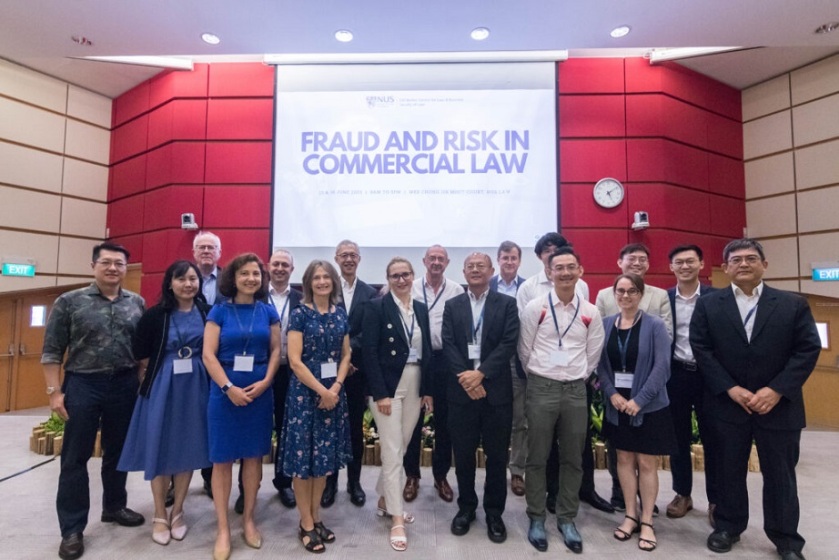
UGA Law Professor Bruner presents “Managing Fraud Risk in the Age of AI” at the National University of Singapore (NUS)

Professor Christopher Bruner, the Stembler Family Distinguished Professor in Business Law and a newly appointed Faculty Co-Director of the Dean Rusk International Law Center, presented “Managing Fraud Risk in the Age of AI” at the National University of Singapore (NUS) in June.

Bruner’s talk was part of a conference titled Fraud and Risk in Commercial Law, organized by Professors Paul Davies (University College London) and Hans Tjio (NUS) and hosted by the EW Barker Centre for Law & Business at the NUS Faculty of Law.

Below is Bruner’s presentation abstract:

Artificial Intelligence (AI) applications are widely expected to revolutionize every dimension of business. This paper explores current and potential impacts of AI on corporate management of fraud risk in both operational and compliance contexts. Much attention has been paid to the operational efficiencies that AI applications could enable in numerous industry settings, and such systems have already become central to a range of services in certain industries – notably finance. Heavy reliance on algorithmic processes can be expected to give rise, however, to a range of risks, including fraud risks. New forms of internal fraud risk, emanating from intra-corporate actors, as well as external fraud risk, emanating from extra-corporate actors, are already placing greater demands on the compliance function and requiring greater corporate investment in responsive AI capacity to keep pace with the evolving risk management environment. At the same time, these developments have already begun to prompt reevaluation of conventional legal theories of fraud that took shape, in commercial and financial contexts alike, by reference to human actors, as opposed to algorithmic processes.

The paper begins with an overview of growing operational reliance upon increasingly sophisticated AI applications across various industry settings, reflecting the increasingly data-intensive nature of modern business. It then explores forms of internal and external fraud risk that may arise from efforts to exploit weaknesses in operational AI, which efforts may themselves involve sophisticated deployment of malicious extra-corporate AI applications – ‘offensive AI’, as the cyber security industry describes it. This can in turn be expected to require responsive corporate efforts in the form of ‘defensive AI’, and the paper describes burgeoning efforts along these lines, as well as the increasing pressure to devote substantial resources and managerial attention to these dynamics that may arise from both corporate law and commercial realities. Finally, the paper analyzes shortcomings of conventional legal theories of fraud in this context. Here the paper assesses the difficulty of applying concepts such as deception, scienter, reliance, and loss causation to algorithmic processes lacking conventional capacity for intentionality and defying conventional explanation as to how inputs and outputs logically relate – a reflection of the AI ‘black box’ problem. The paper concludes with proposals to reform corporate oversight duties to incentivize managerial attention to these issues, and to reform conventional legal theories of fraud to disincentivize malicious AI applications.