Now available online, chapter on international criminal law & children

I’ve just posted at SSRN the chapter I published at the beginning of the year in The Cambridge Companion to International Criminal Law, edited by Professor William A. Schabas.

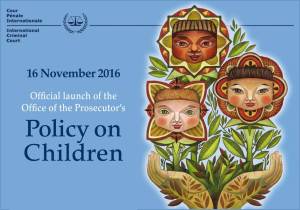
The chapter, entitled “Children,” policyaims to look back at developments in the area since World War II, and then to cast a forward glance at the comprehensive approach now under way at the International Criminal Court – where, incidentally, the ICC Office of the Prosecutor Policy on Children will be launched on November 16, 2016. I was privileged to help with drafting in my capacity as Special Adviser to the Prosecutor on this issue. (prior posts) The date coincides with the start of the annual meeting of the ICC Assembly of States Parties.
Here’s the abstract for my article:

cambridgeThis chapter, which appears in The Cambridge Companion to International Criminal Law (William A. Schabas ed. 2016), discusses how international criminal law instruments and institutions address crimes against and affecting children. It contrasts the absence of express attention in the post-World War II era with the multiple provisions pertaining to children in the 1998 Statute of the International Criminal Court. The chapter examines key judgments in that court and in the Special Court for Sierra Leone, as well as the ICC’s current, comprehensive approach to the effects that crimes within its jurisdiction have on children. The chapter concludes with a discussion of challenges to the prevention and punishment of such international crimes.

SSRN e-journals where this abstract may be found (thanks to always-welcome assistance from TJ Striepe of Georgia Law’s Alexander Campbell King Law Library) include the University of Georgia School of Law Legal Studies Research Paper Series and the Dean Rusk International Law Center Research Paper Series.
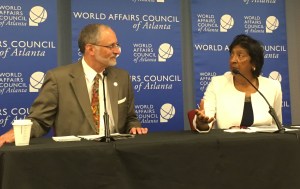
Distinguished jurist Pillay discusses state sovereignty, human rights

duo“The biggest violators of human rights are states themselves, by commission or omission.”

This quote by Navi Pillay aptly summarized her talk on “National Sovereignty vs. International Human Rights.” Pillay, whose renowned legal career has included posts as U.N. High Commissioner for Human Rights and as a judge on the International Criminal Court and the International Criminal Tribunal for Rwanda, spoke this morning at the University of Georgia School of Law Atlanta campus.

Elaborating on the quote above, Pillay decried national legislation aimed at restricting the activities – and with it the effectiveness – of local nongovernmental organizations. Such anti-NGO laws already have passed in Russia and are pending in Pillay’s home state of South Africa, among other countries. That said, she welcomed new means of speaking law to power; in particular, social media that permit human rights advocates to reach millions. Also welcomed were accountability mechanisms that the United Nations has developed in recent decades, such as Universal Periodic Review by the Human Rights Council, reporting processes of treaty bodies, and reports by special rapporteurs.

amann_pillayI was honored to give welcoming remarks at the breakfast. Georgia Law’s Dean Rusk International Law Center, which I lead, cosponsored this Georgia WILL event with the World Affairs Council of Atlanta and Georgia State University’s Global Studies Institute. (We owe special thanks to Judge Dorothy Toth Beasley for her hospitality this week.)

Conversing with Pillay was World Affairs Council President Charles Shapiro. They began by speaking of Pillay’s childhood in Durban, where she grew up the daughter of a bus driver. She spoke of how testifying as a 6-year-old in the trial of a man who’d stolen money from her helped spark her desire to become a lawyer – and how donations from her community helped make that dream a reality.

Shapiro then asked about capital punishment, noting a scheduled execution. Pillay acknowledged the absence of any universal treaty outlawing the death penalty, but found evidence of U.N. opposition both in the decision not to permit the penalty in U.N. ad hoc international criminal tribunals and in the growing support for the oft-repeated U.N. General Assembly resolution calling for a moratorium on capital punishment.

“It started with just 14 states against the death penalty, and is now more than 160,” said Pillay, who currently serves on the International Commission against the Death Penalty.

img_0335On this and other issues, she said, advocates endeavor to encourage states first to obligate themselves to respect and ensure human rights, and then to implement the undertakings they have made in this regard:

“The United Nations was formed by states. It is a club of governments. Look how steadily they have adopted treaties and agreed to be bound by them. That doesn’t mean we are transgressing sovereignty.”

70 years ago, landmark international criminal law judgment at Nuremberg

This weekend marks the 70th anniversary of the Judgment of the International Military Tribunal at Nuremberg, a moment recorded in this New York Times front page:

at0070_7s

The judgment established that humans, and not only states, may be held responsible for violations of international law – a principle that the General Assembly endorsed in 1950. Recognition that individual acts mattered in the international law soon opened the way for recognition that acts committed against individuals also mattered. The Nuremberg Judgment thus stands as a foundational moment in the international human rights movement, as was recognized inter alia in a 1982 article by Georgia Law Professor Louis B. Sohn, when he was Emily & Ernest Woodruff Chair in International Law, a position I am now honored to hold.

Another Georgia Law professor who’s written about Nuremberg is my colleague Harlan Grant Cohen; these works include: ‘Undead’ Wartime Cases: Stare Decisis and the Lessons of History (2010); Historical American Perspectives on International Law (2009); The American Challenge to International Law: A Tentative Framework for Debate (2003).

My own writings, available here, include studies of the meaning of genocide and essays on women who worked as prosecutors, defense lawyers, and staff (no judges) at postwar trials in Nuremberg and Tokyo. “Women at Nuremberg” is a subject that many IntLawGrrls have addressed, not to mention many more posts on all aspects of international criminal law and international human rights law.

Role of “commentaries” key to significance of ICRC project

The role of “commentaries” in the shaping of contemporary international law proved a recurring question in the just-concluded morning public plenary of today’s conference, “Humanity’s Common Heritage: 2016 Commentary on the First Geneva Convention.”

img_0266First broaching the issue was the keynote, Jean-Marie Henckaerts (right). A Georgia Law alumnus, he’s the Legal Adviser at the International Committee of the Red Cross who’s leading the ICRC’s multiyear effort to produce 21st C. commentaries on the meaning of the core instruments of international humanitarian law; that is, the four Geneva Conventions of 1949 and their subsequent Protocols Additional. Joining him were participants in the panel that followed: speakers Major-General Blaise Cathcart, Judge Advocate General of the Canadian Armed Forces, NYU Law Professor Ryan Goodman, Emory Law Professor Laurie R. Blank, and Oxford Law Professor Dapo Akande, plus the moderator, yours truly, Associate Diane Marie Amann. I’ve the honor of serving as director of the Dean Rusk International Law Center at the University of Georgia School of Law, which is sponsoring the event along with the ICRC and the Georgia Journal of International & Comparative Law.

Soon to appear in print, the 2016 Commentary is available online here. At that website, the 2016 Commentary is situated alongside an earlier version, published in the 1950s by ICRC jurist Jean Pictet – and there’s a rub.

“Commentaries are not unusual,” Henckaerts remarked, adding that tomes exist commenting on nearly all the world’s treaties. Though true, the observation pretermits the sui generis status of the author of the 2016 Commentary – the ICRC, since 1863 a Geneva-based private organization that has led developments related to the shaping and compliance with international humanitarian law.

The earlier volumes “are ‘capital C,’ or maybe all caps,” Blank said. Others agreed, pointing not only to the ICRC’s unique status, but also to the fact that the Pictet commentaries  occurred when the intentions of the negotiating states parties – to quote Goodman, “what the framers had in mind” – were well within memory. Continuing her analogy, Blank said she regarded the 2016 effort as a “small c” commentary –  an extraordinary collection of expert analysis, but not exactly the same thing” as the Pictet effort.

Akande broadened the conversation, examining the ICRC commentaries within the context of public international law and treaty interpretation. Pictet’s work may enjoy “unjustifiable authority,” he said, adding that the constitutive nature of the new effort might outweigh any resulting loss of authoritative status. He then called upon the ICRC consistently to be “upfront” about how and why it arrived at its interpretive conclusions.

The points provoked multiple questions: How are treaties to be interpreted? What individuals or entities have authority to engage in interpretation? What weight do interpretations of states parties deserve – and with regard to universally ratified treaties like these, which states parties? What weight to a private organization like the ICRC? Nongovernmental organizations? And what about the victims of armed conflict – do their voices matter in this interpretive effort, and if so, how can victims be given voice?
The search for answers to these and many other questions continues this afternoon. In 3 consecutive closed sessions, about 2 dozen experts are discussing: (1) the Common Article 1 obligation to “ensure respect” for the Geneva Conventions; (2) protection of the wounded, sick, and other specially protected persons; and (3) classification of armed conflict.

Former ambassador to talk on foreign policy and US Presidential election

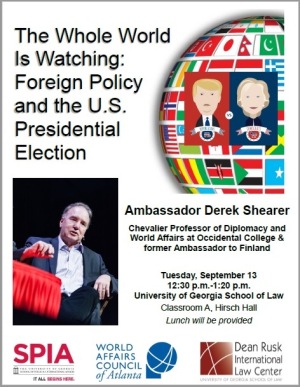
untitledIssues of foreign policy and national security remain foremost in many voters’ minds as the 2016 U.S. Presidential election has entered its final, post-Labor Day lap. We’re thus delighted to be welcoming an expert in this areas to our Athens campus next week:

Fresh from recent lectures in Oxford, Auckland, and Berlin, Ambassador Derek Shearer will deliver a public talk entitled “The Whole World Is Watching: Foreign Policy & the U.S. Presidential Election” at 12:30 p.m. this Tuesday, September 13, at the University of Georgia School of Law. Sponsoring the talk is Georgia Law’s Dean Rusk International Law Center; cosponsors are the World Affairs Council of Atlanta and the University of Georgia School of Public & International Affairs.

Shearer, whom I’ve long been privileged to call a colleague, is Chevalier Professor of Diplomacy and World Affairs at Occidental College in Los Angeles who served as an economics official in the U.S. Department of Commerce, and then as U.S. Ambassador to Finland from 1994 to 1997. He’s the author of several books and a frequent writer on and contributor to public policy discussions;  his articles have appeared in The New York Times, Wall Street Journal, and International Herald Tribune.

In addition to the talk, Shearer will speak to students in Election Law and Strategic Intelligence courses.

toigoWe’re also very pleased to welcome Sue Toigo (left), Chairman of Fitzgibbon Toigo Associates and Shearer’s wife. She’ll discuss corporate responsibility with Georgia Law Business Ethics students.

For additional details, e-mail ruskintlaw@uga.edu.

(Cross-posted from Diane Marie Amann)

Experts in Hague consultation on ICC prosecutors’ draft Policy on Children

fBopening

THE HAGUE, Netherlands – Experts gathered this week from around the world for a wide-ranging consultation on the International Criminal Court Office of the Prosecutor’s draft Policy on Children.

In her Opening Remarks to Monday’s consultation, Prosecutor Fatou Bensouda explained:

“This Policy, once finalised and adopted, will guide my Office in our ongoing efforts to address international crimes against or affecting children under the Rome Statute, as well as our interaction with children during the course of our work.

“The Policy will further provide clarity and transparency on how we intend to methodologically undertake this crucial work.

“Additionally, it is my hope that this Policy will also serve as a useful guide for national authorities and other actors in their respective endeavours to address crimes against and affecting children, and in their interactions with children in judicial processes.”

Released last month, the draft Policy:

► Reaffirms an oft-repeated commitment of the Prosecutor. To be precise, the Policy reinforces her Office’s concern for “children with weapons” – that is, persons under fifteen who have been recruited or used in armed groups, often called “child soldiers.” But it also details the Office’s concern for what the Prosecutor called “children affected by the weapons” – that is, all persons who, before their 18th birthday, endured crimes within the jurisdiction of the Court.

► Adopts a child-sensitive approach to its dealings with children. That approach recognizes children as both vulnerable and capable, as both needy and resilient – often, at the same time. The Policy pledges sensitivity to these realities according to the regulatory framework of the Rome Statute system, and also according to principles drawn from international instruments, like the 1989 Convention on the Rights of the Child, a treaty that enjoys near-universal ratification and is founding on 4 guiding principles:

  1. The child’s right to be treated without adverse discrimination;
  2. The right to life, survival, and development;
  3. The right to have the child’s best interests taken into account; and
  4. The child’s right to express views and have them considered.

The draft Policy on Children (available in full here) explicitly recognizes those principles and sets out the contours for respecting and ensuring them.

It thus enumerates crimes against and affecting children. Included are crimes of conscription and use, as well as child trafficking as enslavement and forcible transfer as genocide. Also included are crimes like persecution, if it targets children on the basis or age or birth, as well as attacks on schools.

The policy further details the approach of the Office with respect to children at all stages of the proceedings: preliminary examinations, investigations, prosecutions, sentencing, and reparations.

All these aspects received discussion at Monday’s consultation; some are reflected in tweets available at #EndCrimesAgainstChildren. The policy working group will be considered along with other public comments. The Office welcomes additional such comments, which should be sent via e-mail to OTPLegalAdvisorySection@icc-cpi.int no later than Friday, August 5, 2016. The Office anticipates final publication in October of this year.

It was an honor to take part in this consultation in my capacity as the Prosecutor’s Special Adviser on Children in & affected by Armed Conflict – and also to be accompanied at the consultation by one of my Georgia Law students, Chanel Chauvet. (We’re pictured below in front of a mural at the ICC’s new permanent premises.) A  rising 2L and Dean Rusk International Law Center Student Ambassador, Chanel just completed a weeklong Hague summer school on international humanitarian law.

chanel_dianeICC

(Cross-posted from Diane Marie Amann)

Hague flags invite global celebration of International Criminal Justice Day

flag3

THE HAGUE, Netherlands – International Criminal Justice Day isn’t till next Sunday, but The Hague is ready. Flags like the one depicted above greet visitors throughout city center.

Occurring every July 17, the Day coincides with the signing in 1998 of the Rome Statute of the International Criminal Court – a landmark moment in the movement to call perpetrators of international crimes to account. The court began operating on July 1, 2002, and since then has examined, investigated, prosecuted, or adjudicated cases arising in nearly 19 countries, from Afghanistan to Ukraine.

To mark this 18th anniversary of the Rome Diplomatic Conference, the ICC welcomes photos from around the world. The idea’s to create an image of the scales of justice and show its presence throughout the world by posting on social media with hashtags #JusticeMatters, #17July, and #ICC. Details here.

Further to that effort, yours truly looks forward to today’s roundtable consultation on the draft Policy on Children, opened for public comment last month by the ICC’s Office of the Prosecutor.

(Cross-posted from Diane Marie Amann)

Dean Rusk and the dissent channel

March 18, 1967. Afternoon. Secretary of State Dean Rusk conducts a briefing on Vietnam for state governors in the Fish Room of the White House.

At the White House, with President Lyndon B. Johnson in attendance, US Secretary of State Dean Rusk briefs US governors on the US-Vietnam War. The briefing took place March 18, 1967, not long before Rusk set up a “dissent channel” for State Department diplomats frustrated by US foreign policy. (photo credit)

In my current role as leader of the 38-year-old Dean Rusk International Law Center at the University of Georgia School of Law, I tend to take a close look at any reference to our Center’s namesake, Dean Rusk, who served as the only Secretary of State to Presidents John F. Kennedy and Lyndon B. Johnson.

And so it is with the US diplomatic topic du mois, the “dissent channel” at the Department of State.

This channel is much in the news these days, on account of a Page 1 New York Times story leaking a dissent-channel letter by 51 diplomats at State who want more use of force in Syria than President Barack Obama to date has authorized. (Worth-reading questions about the “leak” here.) And then there was yesterday’s Times story by Ellen Barry, about a dissent-channel “Blood Letter” that forestalled career advancement for the eponymous letter-writing diplomat.

Quite a surprise, amid all this, to read this explanation of the dissent channel, in a transcript of the June 17 Daily Press Briefing by a State Department spokesperson:

“This procedure, this vehicle has been in place since Secretary of State Dean Rusk was in office in 1971.”

Why a surprise? Because by 1971, Rusk was regaling Georgia Law students as the revered Sibley Professor of International Law.

At the briefing, an unnamed reporter took immediate issue with the spokesperson’s account:

QUESTION: And just – can we be clear about when it actually began? Because Rusk, I think, was gone by ’69 when the Nixon Administration came in. So I don’t think he was Secretary of State in 1971, but I could certainly be mistaken.

[ANSWER]: I think it was 1971 and —

QUESTION: Okay.

[ANSWER]: — my reading of the history said that Rusk had something to do with it. But I’m not going to quibble with you —

QUESTION: No, no.

[ANSWER]: — over the history of the program.

Uncharacteristic of these kind of transcripts, the spokesperson’s assertion is supported by a footnote [1]. It says only “William P. Rogers.” That’s the name of the man who became Secretary of State in 1969, after Rusk left government service for the last time. But a quick look at Rusk’s bio on the Department’s site would have confirmed the premise of the reporter’s question.

So what’s right, and wrong?

On the small point of timing, the spokesperson is wrong. But on the larger point of establishing a channel for dissent, unique among the world’s diplomatic services, the account is spot on. To quote a memorial published the year that Rusk died, in the Department’s own publication, Dispatch:

Dean Rusk left his mark not only on the nation and the world, but also on the Department of State as an institution. At a time of tremendous domestic social change, he encouraged minorities and women to enter the Foreign Service. He established the Dissent Channel and the Open Forum to give members of the Department alternative ways to make their foreign policy views known.

ICC Office of Prosecutor invites public comment on draft Policy on Children

draftpolicyIt is my great honor to note today’s release for public comment of the draft Policy on Children of the International Criminal Court Office of the Prosecutor.

Since my December 2012 appointment as Prosecutor Fatou Bensouda’s Special Adviser on Children in and affected by Armed Conflict, I’ve had the privilege of helping to convene consultations and taking part in the construction of this draft Policy. As part of that process, as noted on page 11 of the draft, we at the Dean Rusk International Law Center, University of Georgia School of Law, were honored in October 2014 to host the Prosecutor, members of her staff, and nearly 2 dozen other experts from academic, nongovernmental groups, and intergovernmental organizations. Our “Children & International Criminal Justice” conference featured a morning public plenary and Prosecutor’s keynote (pictured below), followed by an afternoon of closed-door breakout sessions. (Proceedings from that event, to appear in our Georgia Journal of International & Comparative Law, are nearing publication.)

Addressed in the draft Policy, which spans 37 pages, are:

► Overarching concerns, such as the nature of a child and childhood, the experiences of children in armed conflict and other contexts within the jurisdiction of the ICC, and how the Rome Statute of the ICC and other documents treat crimes against and affecting children; and

► Practical concerns, such as how the Office of the Prosecutor engages with children, in all aspects of its work, including preliminary examination, investigation, charging, prosecution, sentencing, reparations, and external relations.

As stated in the press release accompanying today’s publication:

In highlighting the importance of the Policy, Prosecutor Bensouda stated: “when I assumed 8_events2the role of Prosecutor in June 2012, one of the principal goals I set for the Office was to ensure that we pay particular attention not only to ‘children with arms’, but also ‘children affected by arms.’ This Policy demonstrates our firm commitment to closing the impunity gap for crimes against or affecting children, and adopting a child-sensitive approach in all aspects of our work bearing in mind their rights and best interests. It is also our hope that the Policy, once adopted, will serve as a useful guide to national authorities in their efforts to address crimes against children.”

The Office welcomes public comment on the draft. Such comments should be e-mailed to OTPLegalAdvisorySection@icc-cpi.int, no later than Friday, August 5, 2016.

Following revisions based on the comments, the Office of the Prosecutor expects to publish the final Policy on Children in November of this year.

(Cross-posted from Diane Marie Amann)

Emerging security challenges require norm development, State lawyer says

IMG_5540At first blush, today’s security challenges may seem familiar. Yet they are new – emerging, in U.S. State Department parlance – because of the novel ways in which those challenges present themselves.

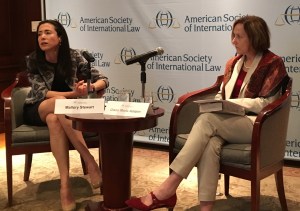
So explained Mallory Stewart (near right), Deputy Assistant Secretary of State for Emerging Security Challenges & Defense Policy, during her fascinating talk Monday at Tillar House, the Washington, D.C. headquarters of the American Society of International Law. We at Georgia Law’s Dean Rusk International Law Center were honored to join ASIL’s Nonproliferation, Arms Control & Disarmament Interest Group in cosponsoring Stewart’s talk, “Common Challenges to Diverse Security Threats.” (For the event video, see here.)

Stewart’s talk followed introductions by Kathleen A. Doty, Interest Group Co-Chair and our Center’s Associate Director for Global Practice Preparation, as well as opening remarks by yours truly (above, at right) respecting Dean Rusk’s arms control legacy.

Stewart pointed to technological change, in outer space and elsewhere, as one of the emerging challenges. Within this category was what is essentially garbage; that is, the debris left in outer space by state actors and, increasingly, nonstate/commercial actors, whose celestial flotsam and jetsam continue to orbit and present hazards to active satellites, space stations, and the like.

Another challenge is dual-use technology. Items as seemingly innocent as chlorine – a chemical essential to everyday cleaning – can become a security threat when deployed as a weapon, as is alleged to have happened during the ongoing conflict in Syria.

Yet another is ubiquity, the reality that technologies, such as cyber capabilities, are, literally, everywhere, and thus not easy to contain.

Containment – regulation – thus is difficult both to design and to effectuate. With regard to dual-use technologies, for instance, Stewart posed questions of intent: How, exactly, does one define and identify the moment that an innocent item is transformed into a weapon? What about attribution – in areas like cyberwarfare, how can the perpetrator be identified? How can attacks waged with such weapons be prohibited in advance?

Stewart gave due respect to the 20th C. arms control treaties that form the core portfolio of State’s Bureau of Arms Control, Verification & Compliance, where she practices. Nevertheless, stressing global interdependence, she stressed the need for more nimble forms of international lawmaking. To be precise, she looked to mechanisms of soft law, such as codes of conduct, as ways that states and other essential actors might develop norms for responsible behavior in the short term. In the longer term, if the internalization and implementation of such norms should prove successful, eventually legally binding treaties may result.

(Part 2 of a 2-part series; Part 1 is here.)