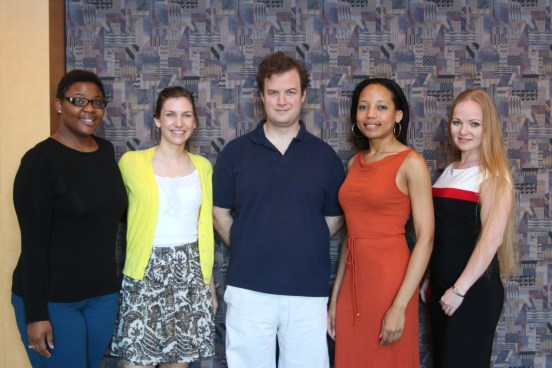
Professor West heads east: Upcoming media law lecture in Budapest

west-profileAmong the many University of Georgia School of Law professors whose work crosses national borders is Sonja R. West (right). In fact, Professor West will be traveling very soon to Hungary, to speak on Thursday, October 13, at the European Judicial Conference on Courts and Communication in Budapest, organized by Bíróság, Hungary’s National Office for the Judiciary.

Her talk, entitled “Improving Press Coverage of the Courts through Communication,” will examine various issues of failed communication between the press and the courts, as well as possible solutions.

It’s a topic well within her expertise. Professor West teaches courses in constitutional law, media law, and the Supreme Court at Georgia Law. Starting this spring, she will also teach media law at the university’s Grady College of Journalism, where she recently received a joint appointment. Her work on has been published in the reviews of Harvard, UCLA, Michigan law schools, among others. In recognition of her scholarship, the National Communication Association just awarded her its 2016 Franklyn S. Haiman Award for Distinguished Scholarship in Freedom of Expression.

She’s also has written for media outlets like Slate. Her other accomplishments include service as a law clerk to Supreme Court Justice John Paul Stevens and work as journalist in Illinois, Iowa, and Washington, D.C.

In addition to taking part in the judicial conference, Professor West plans to meet with Budapest-based alums of Georgia Law, and also with representatives from the Hungarian-American Fulbright Commission and faculty from the law faculty at Pázmány Péter Catholic University.

Become part of a 45-year tradition: Georgia Law Master of Laws (LLM)

2016brochure_coverwebIn 1973, a Belgian attorney became the first foreign-trained lawyer to earn a Master of Laws, or LLM, degree at the University of Georgia School of Law.

The tradition launched then continues today: Even as the our current LLM class of 2017 pursues studies, we work to build next year’s LLM student body. We welcome inquiries and applications for the Class of 2018.

As detailed in our brochure (online in booklet form here; in printable PDF here), Georgia Law LLMs may prepare to sit for a US bar examination, one among many concentrations:

  • Preparation for a U.S. Bar Examination
  • Business Law and Dispute Settlement
  • Family Law and Migration Law
  • Transnational, International, and Comparative Law
  • Public Institutions and the Law

It’s a vibrant program; see our Exchange of Notes blog posts here.

Members of that class will join an alumni/ae base of more than 450 Georgia Law LLMs, who have ties to 75 countries, on every continent in the world, and 10,000 alums overall. They include judges and law firm partners, leaders in governments and in intergovernmental and nongovernmental organizations, heads of corporate legal departments, and university professors.

Click here to join this tradition of excellence in international professional education, or here to apply now.

70 years ago, landmark international criminal law judgment at Nuremberg

This weekend marks the 70th anniversary of the Judgment of the International Military Tribunal at Nuremberg, a moment recorded in this New York Times front page:

at0070_7s

The judgment established that humans, and not only states, may be held responsible for violations of international law – a principle that the General Assembly endorsed in 1950. Recognition that individual acts mattered in the international law soon opened the way for recognition that acts committed against individuals also mattered. The Nuremberg Judgment thus stands as a foundational moment in the international human rights movement, as was recognized inter alia in a 1982 article by Georgia Law Professor Louis B. Sohn, when he was Emily & Ernest Woodruff Chair in International Law, a position I am now honored to hold.

Another Georgia Law professor who’s written about Nuremberg is my colleague Harlan Grant Cohen; these works include: ‘Undead’ Wartime Cases: Stare Decisis and the Lessons of History (2010); Historical American Perspectives on International Law (2009); The American Challenge to International Law: A Tentative Framework for Debate (2003).

My own writings, available here, include studies of the meaning of genocide and essays on women who worked as prosecutors, defense lawyers, and staff (no judges) at postwar trials in Nuremberg and Tokyo. “Women at Nuremberg” is a subject that many IntLawGrrls have addressed, not to mention many more posts on all aspects of international criminal law and international human rights law.

Seeking Global Practice Preparation Assistant: Georgia Law’s Dean Rusk International Law Center

sign2We’re looking for a great administrator here at the Dean Rusk International Law Center. To be precise, we’re looking for a Global Practice Preparation Assistant (aka Administrative Specialist I).

This person will support the Global Practice Preparation portfolio at the Center under the supervision of the Director for Global Practice Preparation and the Associate Dean for International Programs & Strategic Initiatives. The successful applicant will provide administrative, organizational, and logistical support for an array of Center programs, including conferences, lectures, and events, study abroad, Global Externships, faculty exchanges, visiting scholars, professional trainings, and research projects. Experience in event planning, demonstrated organizational ability, and social media or marketing skills are desirable.

The job includes the opportunity to interact with a diverse array of individuals, including students and scholars from the United States and abroad, distinguished visitors, faculty and staff, policymakers, and potential or actual donors. It also offers exposure to a wide range of international legal and policy issues. Accordingly, we particularly welcome applications from individuals with a demonstrated interest in international law, policy, and foreign affairs, and those with language skills and/or travel experience.

To apply, click here and follow registration/application instructions, inserting the posting number 20161972 in order to reach the vacancy.

We plan to fill this position asap, so if you’re interested, don’t delay!

Role of “commentaries” key to significance of ICRC project

The role of “commentaries” in the shaping of contemporary international law proved a recurring question in the just-concluded morning public plenary of today’s conference, “Humanity’s Common Heritage: 2016 Commentary on the First Geneva Convention.”

img_0266First broaching the issue was the keynote, Jean-Marie Henckaerts (right). A Georgia Law alumnus, he’s the Legal Adviser at the International Committee of the Red Cross who’s leading the ICRC’s multiyear effort to produce 21st C. commentaries on the meaning of the core instruments of international humanitarian law; that is, the four Geneva Conventions of 1949 and their subsequent Protocols Additional. Joining him were participants in the panel that followed: speakers Major-General Blaise Cathcart, Judge Advocate General of the Canadian Armed Forces, NYU Law Professor Ryan Goodman, Emory Law Professor Laurie R. Blank, and Oxford Law Professor Dapo Akande, plus the moderator, yours truly, Associate Diane Marie Amann. I’ve the honor of serving as director of the Dean Rusk International Law Center at the University of Georgia School of Law, which is sponsoring the event along with the ICRC and the Georgia Journal of International & Comparative Law.

Soon to appear in print, the 2016 Commentary is available online here. At that website, the 2016 Commentary is situated alongside an earlier version, published in the 1950s by ICRC jurist Jean Pictet – and there’s a rub.

“Commentaries are not unusual,” Henckaerts remarked, adding that tomes exist commenting on nearly all the world’s treaties. Though true, the observation pretermits the sui generis status of the author of the 2016 Commentary – the ICRC, since 1863 a Geneva-based private organization that has led developments related to the shaping and compliance with international humanitarian law.

The earlier volumes “are ‘capital C,’ or maybe all caps,” Blank said. Others agreed, pointing not only to the ICRC’s unique status, but also to the fact that the Pictet commentaries  occurred when the intentions of the negotiating states parties – to quote Goodman, “what the framers had in mind” – were well within memory. Continuing her analogy, Blank said she regarded the 2016 effort as a “small c” commentary –  an extraordinary collection of expert analysis, but not exactly the same thing” as the Pictet effort.

Akande broadened the conversation, examining the ICRC commentaries within the context of public international law and treaty interpretation. Pictet’s work may enjoy “unjustifiable authority,” he said, adding that the constitutive nature of the new effort might outweigh any resulting loss of authoritative status. He then called upon the ICRC consistently to be “upfront” about how and why it arrived at its interpretive conclusions.

The points provoked multiple questions: How are treaties to be interpreted? What individuals or entities have authority to engage in interpretation? What weight do interpretations of states parties deserve – and with regard to universally ratified treaties like these, which states parties? What weight to a private organization like the ICRC? Nongovernmental organizations? And what about the victims of armed conflict – do their voices matter in this interpretive effort, and if so, how can victims be given voice?

The search for answers to these and many other questions continues this afternoon. In 3 consecutive closed sessions, about 2 dozen experts are discussing: (1) the Common Article 1 obligation to “ensure respect” for the Geneva Conventions; (2) protection of the wounded, sick, and other specially protected persons; and (3) classification of armed conflict.

President taps Georgia Law alum for Cultural Property Advisory Committee

President Barack Obama is appointing Georgia Law alumnus James K. Reap to the U.S. Department of State Cultural Property Advisory Committee, according to a White House announcement issued Friday.

reap_web-150x150Reap, a Professor in the University of Georgia College of Environment + Design and affiliated faculty member of the university’s African Studies Institute, is a globally renowned expert on issues of cultural property and the protection of cultural heritage amid armed conflict and similar threats. He coordinates the university’s Master’s degree in Historic Preservation, as well as the dual J.D./M.H.P. Reap frequently takes part in initiatives of our Dean Rusk International Law Center; indeed, he’ll serve as an expert at this week’s Georgia Law-International Committee of the Red Cross conference entitled “Humanity’s Common Heritage: The 2016 Commentary on the First Geneva Convention.”

The many professional activities of Reap, a former Fulbright Scholar, include leadership positions in the International Council of Monuments and Sites, as well as the Lawyers’ Committee for Cultural Heritage Preservation and the U.S. Committee of the Blue Shield. He’s been active on preservation issues in Eastern and Southern Europe, Central Asia, Africa and the Middle East, and the Caribbean.

Georgia Law’s annual Advocate magazine features our Center

SAs_Spr16

This Spring 2016 photo depicts Pedro Dorado, our Center Fellow, who earned his LLM in 2015 and is a candidate for the Georgia Law JD degree in 2017, and 4 of our Student Ambassadors. At left are Danielle Glover and Taryn Arbeiter, both now 2Ls; at right are Chanel Chauvet, now a 2L, and Olga Gambini, who earned her Georgia Law LLM in 2014 and JD in 2016.

Very pleased that our Dean Rusk International Law Center is featured in the just-released Advocate, the annual magazine of the University of Georgia School of Law. Highlights of the volume include the May 2016 commencement address of alumna Sally Yates, now Deputy Attorney General of the United States, and much more. The article recounting our 2015-16 achievements – “Center undergoes exciting changes” – appears at page 24, along with a version of the photo above. It’s reprinted here in full.

Georgia Law’s 38-year-old Dean Rusk International Law Center continues to expand its collaborative efforts and increase opportunities for both students and faculty to focus on global legal issues.

Led by Associate Dean for International Programs and Strategic Initiatives & Woodruff Chair in International Law Diane Marie Amann, the center itself has a new, modernized look that also acknowledges the rich history of international scholars who have greatly influenced the direction of the law school. Artwork is a focal point, including portraits of former U.S. Secretary of State and Sibley Professor of International Law Emeritus Dean Rusk, the center’s namesake, and the inaugural holder of the Woodruff Chair in International Law, Louis B. Sohn, namesake of the center’s Sohn Library on International Relations.
At an October rededication ceremony, Kannan Rajarathinam (LL.M.’88), who serves as head of office for the United Nations Assistance Mission for Iraq, delivered a keynote address titled “The United Nations at 70: Pursuing Peace in the 21st Century.”

New to the center this year are Director of Global Practice Preparation Kathleen A. Doty, Administrative Assistant Martica Marín and Executive Administrator Elena Williams. They join Amann and Director of International Professional Education Laura Tate Kagel (J.D.’06). Assisting them are second-year student Pedro Dorado, the Dean Rusk International Law Center Fellow, and about one dozen other student ambassadors, who provide research and other support.

In addition to hiring new staff, the center broadened its adviser base. The Dean Rusk International Law Center Council, comprising faculty, alumni/alumnae and counselors, includes lawyers practicing in a variety of international and transnational law subfields throughout the world.
Center initiatives include study abroad in Europe and opportunities to obtain practice experience through the Global Externship At-Home and Global Externship Overseas. GEA offers placements within the United States in legal departments, government offices and nongovernmental organizations, while GEO offers summer placements in a variety of law-office settings around the world.

Numerous events are planned for the 2016–17 academic year. Among them is a Sept. 23 conference – sponsored by the center, the Georgia Journal of International & Comparative Law and the International Committee of the Red Cross – at which experts will examine the new Geneva Convention Commentary edited by ICRC Legal Advisor Jean-Marie Henckaerts (LL.M.’90).

Georgia Law Professor Milot calls on global drugs regulators to focus on athlete health, not punishment

Milot profileSports doping is much in the news with the start of the Olympics and Paralympics at Rio de Janeiro, Brazil. Numerous commentators call for stricter regulations; staking out a different position is Georgia Law Professor Lisa Milot, formerly a high-level junior cyclist and now a scholar on law and performance-enhancing drugs. In a Vice Sports article by Patrick Hruby entitled “The Drugs Won: The Case for Ending the Sports War on Doping,” Milot says:

“Athletes are risk-takers. There’s no way to get to the international level of sports without being willing to put your body on the line on a regular basis.”

The article discusses Milot’s position, advanced in her 2014 article “Ignorance, Harm, and the Regulation of Performance-Enhancing Substances,” published in the Harvard Journal of Sports & Entertainment Law. She argues that regulators should concentrate on reducing the harm from substances, rather than banning them altogether. She tells Hruby:

“What we should be doing now is gathering information in order to understand how these substances work on healthy bodies. Focusing on that, rather than punishment.”

On punishment, current news indicates that even international organizations charged with regulating global sports appear to disagree:

► The Montreal-based World Anti-Doping Agency, “established in 1999 as an international independent agency composed and funded equally by the sport movement and governments of the world,” issued a report calling for a blanket ban on Russian athletes at the Olympic Games, which opened Friday and go through August 21.

► The International Olympics Committee, the 122-year-old organization headquartered in Lausanne, Switzerland, has taken a much more measured approach, banning some but by no means all such athletes.

► The International Paralympic Committee, based in Bonn, Germany, banned Russia’s team en masse from its event, set to begin on September 7, no long after the Olympic Games wrap up.

► Meanwhile, athletes from a host of countries have been cited for positive drug tests, or tarred with suspicion that their achievements have been chemically enhanced.

This tangle makes both Hruby’s article and Milot’s scholarship must-reads.

GJICL publishes “Children and International Criminal Justice” issue

gjicl43_3

Very pleased to announce that papers from a Georgia Law conference “Children & International Criminal Justice” have just been published by our Georgia Journal of International & Comparative Law.

The conference was cosponsored by Dean Rusk International Law Center and the Georgia Law Project on Armed Conflict & Children, as well as the university’s African Studies Institute, the Planethood Foundation, and the American Society of International Law-Southeast.

About 2 dozen experts came to Athens, Georgia, from as far as Doha and Kinshasa, to discuss the topic at hand. In so doing, they assisted in the preparation of the International Criminal Court Office of the Prosecutor Policy on Children. As detailed in recent posts, available here and here, the public comment period for the draft of that Policy continues through August 5, 2016, with launch of the final document set for mid-November.

bensouda_me2_28oct14cropA keynote speech by ICC Prosecutor Fatou Bensouda (at right) highlighted our conference, and the text of her speech headlines the edition. Other writings link the work of the ICC to the 1989 Convention of the Rights of the Child, examine the experiences of children in armed conflict and similar situations. Student rapporteurs’ accounts of expert breakout sessions additionally treat a range of issues. All these papers contributed significantly to the Policy process.

The edition concludes with students’ notes apart from the conference; one of these, for which I was honored to serve as faculty adviser, examines the issue of child marriage.

Here, in full, is the table of contents for Volume 43, issue 3, with PDF links to each article:

Children and International Criminal Justice Conference

“Convening Experts on Children and International Criminal Justice,” by yours truly, Diane Marie Amann (above, at left), Associate Dean for International Programs & Strategic Initiatives and Emily & Ernest Woodruff Chair in International Law, and also Prosecutor Bensouda’s Special Adviser on Children in & affected by Armed Conflict

“Children and International Criminal Justice,” by Fatou Bensouda (above, at right), Prosecutor of the International Criminal Court

malone“Maturing Justice: Integrating the Convention on the Rights of the Child into the Judgments and Processes of the International Criminal Court,” by Linda A. Malone (right), Marshall-Wythe Foundation Professor of Law and Founding Director of the Human Security Law Center, William & Mary Law School
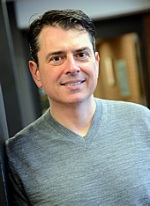
drumblm“Children, Armed Violence and Transition: Challenges for International Law & Policy,” by Mark Drumbl (left), Class of 1975 Alumni Professor of Law and Director of the Transnational Law Institute at Washington & Lee University School of Law

“Child Protection in Times of Conflict and Children and International Criminal Justice,” by Kerry L. Neal neal(right), Child Protection Specialist, Justice for Children, UNICEF, New York

“Expert Workshop Session: Regulatory Framework,” by Ashley Ferrelli, Eric Heath, Eulen Jang, and Cory Takeuchi (all Georgia Law graduates, who were members of GJICL)

“Expert Workshop Session: Child Witnesses: Testimony, Evidence, and Witness Protection,” by Chelsea Swanson, Elizabeth DeVos, Chloe Ricke, and Andy Shin (now Georgia Law graduates, all then were members of GJICL)

“Expert Workshop Session: The Global Child,” by Haley Chafin, Jena Emory, Meredith Head, and Elizabeth Verner (all Georgia Law graduates, who were members of GJICL)

Student Notes

“Changing the Game: The Effects of the 2012 Revision of the ICC Arbitration Rules on the ICC Model Arbitration Clause for Trust Disputes,” by Colin Connor

“Water, Water Everywhere, But Just How Much is Clean?: Examining Water Quality Restoration Efforts Under the United States Clean Water Act and the United States-Canada Great Lakes Water Quality Agreement,” by Jill T. Hauserman

“REACHing for Environmental and Economic Harmony: Can TTIP Negotiations Bridge the U.S.-EU Chemical Regulatory Gap?,” by Ashley Henson

“Child Marriage in Yemen: A Violation of International Law,” by Elizabeth Verner

(Cross-posted from Diane Marie Amann)
Rusk Councilmember Teri Simmons (JD89) elected to Sister Cities board

Simmons4282_Headshot_520x282Very pleased to congratulate Teri Simmons, a distinguished Georgia Law alumna and member of our Dean Rusk International Law Center Council, on her recent election to the Board of Directors of Sister Cities International.

As stated on its website,

“Sister Cities International was created at President Eisenhower’s 1956 White House summit on citizen diplomacy, where he envisioned a network that would be a champion for peace and prosperity by fostering bonds between people from different communities around the world.”

Ms. Simmons, who earned her J.D. from Georgia Law in 1989, embodies the network’s slogan, “Peace through People.” Her service to her alma mater has included appearances on careers panels as well as participation in our Center’s Council. She is a partner at the Atlanta law firm of Arnall Golden Gregory, where she leads the firm’s International Immigration and Naturalization Practice and serves as practice leader of its German Business Practice. Among her clients has been the Atlanta Committee for the 1996 Olympic Games.

60th Logo_concept 2She has chaired the Atlanta Sister Cities Commission, and also managed programs with Nuremberg, Germany, one of Atlanta’s 18 sister cities. Fluent in German, she has received honors including a Friendship Award from the German government and the Prize of Honor from the City of Nuremberg. Additionally, Ms. Simmons has chaired the state chapter and served on the board of the American Immigration Lawyers Association.

The announcement of her election appeared in the latest Diplomacy newsletter, distributed by Global Atlanta in partnership with our Center. Details on the partnership and newsletter subscription here; online Diplomacy archive here.