This is one in a series of posts by University of Georgia School of Law students, writing on their participation in our Global Governance Summer School or Global Externship Overseas initiative. Author of this post is Andrew Hedin, a member of the Class of 2020 who spent his 1L summer as a GEO, or Global Extern Overseas.

Malo! (“Hi” in Samoan.) This summer I lived in the tropical paradise of Samoa, working for the Secretariat of the Pacific Regional Environment Programme (SPREP). During my externship, I worked on environmental law issues and had the opportunity to attend a major conference in Fiji. Following my internship, I was invited to observe the first United Nations conference to work towards a treaty on the conservation and sustainable use of marine biodiversity on the high seas.

SPREP is an international governmental organization serving the fourteen island nations of the South Pacific, as well as five states with territories in the region, including the United States. Headquartered in Apia, the capital city of Samoa, SREP addresses environmental issues ranging from waste disposal to climate change to biodiversity. It also serves a data collection function, which facilitates identification and monitoring of environmental issues. The work of the organization is critical because the Pacific Island states encompass over fifteen million kilometers of marine territory, and are considered to be the largest source of marine biodiversity in the world. However, these ecosystems are fragile and have faced significant reduction due to increased human activity both within and outside the region.
 During my externship, I worked closely with SPREP’s legal counsel, and participated in various projects on topics like preventing the practice of shark finning and banning the use of non-reusable plastics. My most extensive assignment related to the implementation of the Nagoya Protocol on Access to Genetic Resources and the Fair and Equitable Sharing of Benefits Arising from their Utilization to the Convention on Biological Diversity. The Protocol seeks to ensure that there are predictable conditions for access to genetic material, and that the benefits of genetic resource research are shared with the country of origin. Thus, the Protocol requires parties to enter into a contract that obtains prior informed consent of the resource provider, clearly lays out the benefits to the providing community, and defines the scope of access for the user of the genetic resource. The Protocol also creates intellectual property rights in traditional knowledge associated with genetic material in order to protect indigenous communities’ use of local resources. I had the opportunity to assist in the drafting of model implementing legislation and contract templates, and to conduct an analyses of implementation issues in the Cook Islands and Tonga.
I was fortunate to travel with the access and benefits sharing team to Fiji to attend a conference on this topic hosted by the International Development Law Organization and the ABS Initiative. This provided a global context for my work; I learned about how the Nagoya Protocol was being implemented in other regions. It was also a tremendous opportunity to meet practitioners working in this area.
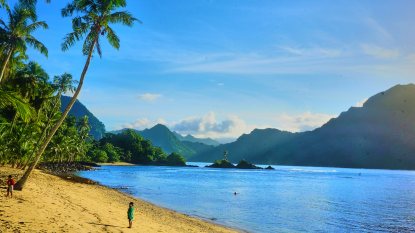 The opportunity to work on biodiversity was amplified by the chance to do so in Samoa. When I wasn’t working, I spent the summer exploring the natural wonders of the small island nation. Consisting of two main islands – Upolu and Savai’i – and eight small inlets, Samoa boasts an extensive coral reef ecosystem, pristine beaches, massive waterfalls, and miles upon miles of coconut trees. It is also home to 200,000 people, who keep alive one of the world’s oldest cultures. Family and community are integral to the Samoan way of life, and Samoans take great pride in maintaining traditions that have been passed down for thousands of years. One of these, familiar around the world, is the Samoan art of tatau, or tattooing. Practiced for more than 3000 years, the art involves tattooing from the waist to the knees, entirely by hand. The traditional tattoo is highly respected, symbolizing an individual’s determination, endurance, and ability to assume responsibility. While I did not get any tattoos, having the opportunity to see the incredible natural world of the Pacific renewed my resolve to forge a career in international environmental law to protect these valuable resources.
 After completing my internship with SPREP and returning to campus this fall, I was pleased to be selected by the American Society of International Law, of which the University of Georgia School of Law is an Academic Partner, to serve as an NGO observer at the United Nations. As noted in the most recent edition of the ASIL Newsletter, I attended the first Intergovernmental Conference for an international legally binding instrument, under the United Nations Convention on the Law of Sea, on the conservation and sustainable use of marine biological diversity of areas beyond national jurisdiction.
At the conference, I watched as state delegates, and representatives of intergovernmental and nongovernmental organizations debated the four foundational pillars of the potential agreement:
- accessing marine genetic resources and sharing in their benefits;
- area-based management tools;
- environmental impact assessments; and
- capacity building with associated marine technology sharing.
This experience was incredible because I observed firsthand how treaty negotiations begin. Although representatives discussed an array of issues and expressed many concerns, there was near-consensus on the importance of protecting the genetic diversity in our oceans. While this is no small task and there is a significant amount of work to be done, after observing the proceedings, I am optimistic that reaching an agreement is possible.
 While I knew that I was interested in international environmental law, before this summer I had never heard of the Nagoya Protocol. Now, I have an understanding of the contracts that govern access to genetic resources, and of their value to indigenous communities. I also built a network of professionals doing great work to advance this initiative. I am incredibly grateful for my time in Samoa and at the UN, and am excited to build on these experiences to pursue the conservation of biodiversity around the world for the benefit of generations to come.
 C. Donald Johnson, Director Emeritus of Georgia Law’s Dean Rusk International Law Center, just published an op-ed in The Hill, a publication based in Washington, D.C.

 Four students in the
  It has been an eventful year for me. In January 2018, during my last semester at the University of Georgia, I began a corporate in-house counsel externship – an experiential learning opportunity open to qualified Georgia Law LLM students – at
  IFSP was an enriching and exciting experience. It included training programs and networking events that introduced the participants to some of the brightest minds in the international legal market, in diverse practice areas. In particular, the networking opportunities were immense and may not be replicated in our lives on such a scale. I was pleased to selected to deliver the
  Pleased today to welcome back
  Later this week, international arbitration expert


 (
( Trade Secrets, Non-Compete

