
Center staffer Doty elected to leadership of ASIL Lieber Society

On the eve of the 111th Annual Meeting of the American Society of International Law, our staffer Kathleen A. Doty has been elected the Vice Chair of the Lieber Society, ASIL’s principal Interest Group pertaining to the laws of war.

Doty, who is Director of Global Practice Preparation here at the Dean Rusk International Law Center, University of Georgia School of Law, will serve a 3-year term. Her duties will include assisting the Lieber Society – named after Francis Lieber, who, on President Abraham Lincoln’s orders, wrote the 1st laws-of-war code – in organizing conferences and other discussions among practitioners, academics and policymakers in the law of armed conflict/international humanitarian law, and related laws.

Doty also serves as Chair of ASIL’s Nonproliferation, Arms Control and Disarmament Interest Group. Before joining our Center, she was an Assistant Counsel for Arms Control and International Law at the Office of the General Counsel, Strategic Systems Programs, at the U.S. Department of the Navy in Washington.

The Dean Rusk International Law Center frequently joins with ASIL in its initiatives, thanks to an Academic Partnership between the century-old learned society and the University of Georgia School of Law.

USC Shoah Foundation awards inaugural research fellowship to Associate Dean Amann

The first-ever Breslauer, Rutman and Anderson Research Fellowship has been awarded to Diane Marie Amann. Amann joined the University of Georgia School of Law in 2011, taking up the Emily & Ernest Woodruff Chair in International Law. She also has served, since 2015, as Georgia Law’s Associate Dean for International Programs & Strategic Initiatives.

Amann speaking at the 2016 launch of the International Criminal Court Office of the Prosecutor Policy on Children that she helped prepare in her role as the Prosecutor’s Special Adviser on Children in & affected by Armed Conflict.

The Breslauer, Rutman and Anderson Research Fellowship arises out of a recent gift to the Center for Advanced Genocide Research at the University of Southern California Shoah Foundation in Los Angeles.

Established by Steven Spielberg in the early 1990s, just after he completed his film Schindler’s List, the foundation contains extensive visual history archives. These include oral histories by numerous participants in the post-World War II trials in Europe. Those trials lie at the core of Amann’s scholarship on “Women at Nuremberg,” which explores the many roles women played in those proceedings, including prosecutors, defense counsel, journalists, witnesses, staffers, and defendants – everything except judges.

Among those whose oral histories may be found at these archives are two members of the U.S. prosecution team: Cecelia Goetz, who as part of the Krupp case became the only woman to deliver part of an opening statement at Nuremberg, and Belle Mayer Zeck, who helped to try the Farben case. As quoted at the USC Shoah Foundation website, Amann commented:

“I’m very interested in finding out what they remember and what they thought was important and what their feelings were about the Nuremberg project. It seems to me there’s a lost story about that era that would be worth uncovering to give a richer picture of what that period was about.”

Amann’s visit to USC will occur next January, during a research-intensive Spring 2018 semester during which she will continue to pursue a Ph.D. in Law at Leiden University in the Netherlands.

Distinguished alumna Ertharin Cousin joins our Center Council

We are deeply honored to announce that one of our distinguished international law alumnae, Ertharin Cousin, has become a member of our Dean Rusk International Law Center Council.

Cousin has just completed a five-year term as Executive Director of the United Nations’ World Food Programme. In that role, she led the world’s largest humanitarian organization. Founded in 1961, WFP has more than 11,000 staffers, who combat hunger and food insecurity on behalf of more than 80 million persons in 82 countries. (credit for photo above)

She earned her J.D. degree from the University of Georgia School of Law in 1982. While here, she took international law classes with our Center’s namesake, Dean Rusk, who was a Georgia Law professor for many years after serving in the Kennedy and Johnson administrations as the United States’ second-longest-serving Secretary of State. Cousin also holds a B.A. degree from the University of Illinois at Chicago, and was one of the first women to graduate from Lane Tech, a prestigious and traditionally male-only public high school in the same city.

She returned to Georgia Law’s Athens campus last month to receive our alum association’s Distinguished Service Scroll Award. While here, she discussed her work at WFP and her ongoing commitment to end hunger to a group of students now enrolled in international law classes. Cousin stressed that even as direct food aid was provided in the short term, over the long term communities must be given opportunities to provided for themselves, remarking:

“I never met a mother in all the places I’ve visited who wanted to stand in line to feed her children.”

Anticipating her departure from WFP, which took place on April 4, Cousin told students that she planned to continue strategizing to bring an end to hunger as a Visiting Fellow at Stanford’s Freeman Spogli Institute. She said:

“I’m just changing chairs.”

Immediately before taking up the post at WFP, Cousin served in Rome, by appointment of President Barack Obama, as the U.S. Ambassador to the United Nations Agencies for Food and Agriculture, and as head of the U.S. Mission to the U.N. Agencies in Rome. Her career also included many private- and public-sector posts. During the centennial Olympic Games, held in 1996 in Atlanta, she served as Senior Advisor to Secretary of State Warren Christopher.

In becoming a member of the Dean Rusk International Law Center Council, Cousin joins other Georgia Law graduates, faculty members, and friends who advise and support the work of the Center.
New book on arbitration by Professor Won Kidane, Georgia Law LLM alum

Pleased to announce the publication of a book by our alumnus, Won L. Kidane (left), an Associate Professor at Seattle University School of Law in Washington state.

The Culture of International Arbitration has just been released by Oxford University Press. It’s the 4th book by Kidane, who earned his Georgia Law LL.M. degree in 1997; in 2001, he earned a J.D. degree from the University of Illinois. He was a 2014 Fulbright Scholar in Ethiopia, where he’d completed his initial legal studies in 1993. Kidane practiced at two Washington, D.C., law firms and taught at Penn State’s Dickinson School of Law before joining the faculty at Seattle, where he teaches international arbitration and immigration law.

Here’s a description of his new book:

Although international arbitration has emerged as a credible means of resolution of transnational disputes involving parties from diverse cultures, the effects of culture on the accuracy, efficiency, fairness, and legitimacy of international arbitration is a surprisingly neglected topic within the existing literature. The Culture of International Arbitration fills that gap by providing an in-depth study of the role of culture in modern day arbitral proceedings. It contains a detailed analysis of how cultural miscommunication affects the accuracy, efficiency, fairness, and legitimacy in both commercial and investment arbitration when the arbitrators and the parties, their counsel and witnesses come from diverse legal traditions and cultures. The book provides a comprehensive definition of culture, and methodically documents and examines the epistemology of determining facts in various legal traditions and how the mixing of traditions influences the outcome. By so doing, the book demonstrates the acute need for increasing cultural diversity among arbitrators and counsel while securing appropriate levels of cultural competence. To provide an accurate picture, Kidane conducted interviews with leading international jurists from diverse legal traditions with first-hand experience of the complicating effects of culture in legal proceedings. Given the insights and information on the rules and expectations of the various legal traditions and their convergence in modern day international arbitration practice, this book challenges assumptions and can offer a unique and useful perspective to all practitioners, academics, policy makers, students of international arbitration.
Digital Commons upload extends reach of scholarship in Georgia Law journals

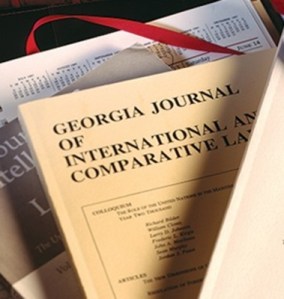
The Alexander Campbell King Law Library at the University of Georgia School of Law recently celebrated the upload, to the Digital Commons Repository, of all back issues of two of the law school’s reviews:

► The Georgia Journal of International and Comparative Law, started in 1971 as a student initiative supported by former U.S. Secretary of State and Georgia Law Professor Dean Rusk. GJICL publishes three time a year, featuring work by legal scholars and practitioners as well as student notes. The law school’s Dean Rusk International Law Center frequently cosponsors conferences with GJICL, as it did in September 2016 with “Humanity’s Common Heritage: Conference on the 2016 ICRC Commentary on the First Geneva Convention.” (additional posts on this event here)

► The Journal of Intellectual Property Law. Established in 1993, JIPL is among the oldest of the top 25 intellectual property law periodicals in the United States. JIPL publishes annual print volumes of two issues and online essays on areas of trade secrets, patents, trademarks, copyrights, internet law, and sports and entertainment law.

Scholarship related to international, comparative, and transnational law also often is posted at the Dean Rusk International Law Center Research Paper Series at SSRN. (prior post)

The just-completed online archive contains 44 years of GJICL scholarship and 23 years of JIPL scholarship, for a combined total of 1,721 uploaded items. At the end of last month, downloads from the two journals numbered nearly 190,000, from all countries in the world. The archive will continue to grow as future issues are added.

Distinguished alumnus Jean-Marie Henckaerts joins our Center Council

Honored to announce that one of our distinguished international law alumni, Dr. Jean-Marie Henckaerts, has become a member of our Dean Rusk International Law Center Council. Henckaerts earned his Master of Laws (LL.M.) degree here at the University of Georgia School of Law in 1990.
Based in Geneva, Switzerland, Henckaerts is Legal Adviser in the Legal Division of the International Committee of the Red Cross. In that capacity, he leads the unit in charge of ICRC’s ongoing project of updating its midtwentieth-century Commentaries on the 1949 Geneva Conventions and the Additional Protocols of 1977.

Last September, publication of the Commentary on the First Geneva Convention was marked by a daylong conference here in Athens. Henckaerts keynoted the event (above), and nearly 2 dozen other experts in international humanitarian law took part in public and closed-door discussions (prior posts). Cosponsoring with our Center were the ICRC and the Georgia Journal of International & Comparative Law, the 45-year-old review for which Henckaerts once served as an Associate Editor.

The Commentary on the Second Geneva Convention is due for release in early May, and will be launched via an event livestreamed from Geneva on May 4.

Henckaerts came to Georgia Law from Belgium, where he’d completed a Bachelor of Laws (LL.B.) at Vrije Universiteit Brussel. Thereafter, he moved to Washington, D.C., earning an S.J.D. degree in international law from George Washington University Law School.

As described in a post marking its inaugural meeting last year, the Dean Rusk International Law Center Council is made up of faculty members, alumni/ae, and others who advise and support the work of the Center.

Global migration topic of 2-day AILA event our alumna’s helping organize

On behalf of a member of our Dean Rusk International Law Center Council, we’re pleased to announce an upcoming event:

The American Immigration Lawyers Association Global Migration Section  will host a conference entitled “Global Immigration in a Protectionist World” June 20-21, 2017, in New Orleans, Louisiana.

Panel topics include: the future of immigration law from a global perspective, running a global practice, consular processing, European Union immigration directives in light of Brexit, cybersecurity, and global mobility options for LGBT clients.

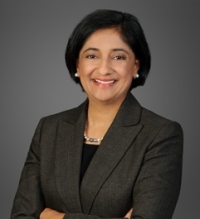
Alumna and Council member Anita E. J. Ninan (above), who is Of Counsel at Arnall Golden Gregory LLP in Atlanta and Advocate, Bar Council of Delhi, India, serves on the conference committee for this group – which, she writes, is

“the global outbound immigration section of AILA and includes foreign attorneys and legal practitioners as its members.”

Registration (early bird rates end May 10) and further details here.

Professor Wells publishes review of book on torts harmonization in Europe

Professor Michael Lewis Wells, who holds the Marion and W. Colquitt Carter Chair in Tort and Insurance Law here at the University of Georgia School of Law, has posted “Harmonizing European Tort Law and the Comparative Method: Basic Questions of Tort Law from a Comparative Perspective” at SSRN. The review of a book by a Viennese torts scholar is forthcoming in volume 9 of the peer-reviewed Journal of Civil Law Studies.

The manuscript, which forms part of our Dean Rusk International Law Center Research Paper Series at SSRN, may be downloaded here.

Here’s the abstract:

This is a book review of Basic Questions of Tort Law from a Comparative Perspective, edited by Professor Helmut Koziol. This book is the second of two volumes on “basic questions of tort law.” In the first volume, Professor Helmut Koziol examined German, Austrian, and Swiss tort law. In this volume Professor Koziol has assembled essays by distinguished scholars from several European legal systems as well as the United States and Japan, each of whom follows the structure of Koziol’s earlier book and explains how those basic questions are handled in their own systems.

This review focuses on Professor Koziol’s ultimate aim of harmonization, and on the contribution of these essays to that project. Harmonization of tort law across the member states is not just a matter of working out answers to such questions as the content of the liability rule or whether non-pecuniary harm should be recoverable. Harmonization raises an issue of European Union federalism. That question is not explicitly addressed in either volume, yet the value of the project, and prospects for its success, turn on the answer to it. I argue that Professor Koziol has not made a convincing case for EU displacement of member state tort law.

Georgia Law alum co-authors commentary on US surveillance law

Gary Ashcroft, who earned his J.D. degree cum laude from the University of Georgia School of Law just last year, has co-authored “Why Electronic Surveillance Reform is Necessary,” a commentary at Lawfare, a leading national security blog.

The post, which is drawn from a longer version here, argues for reform of the FISA (Foreign Intelligence Surveillance Act) Amendments Act of 2008, commonly known as Section 702, and relied upon by the country’s intelligence community, or “IC.” It concludes:

“Section 702 is a valuable intelligence tool that exhibits some significant deficiencies in its protections for U.S. persons in a law enforcement context and for U.S. competitive interests abroad. Policymakers should craft reforms that guard against the misuse of Section 702 by law enforcement and redefine the relationship between the IC and tech companies. As they do so, policymakers can ensure that Section 702 continues to fulfill its vital national security functions while also respecting the civil liberties and corporate interests of U.S. persons and companies. “

Ashcroft (above left) is a Fellow for National Security at Third Way, a centrist thinktank in Washington, D.C. While a law student, he served as Research Assistant to Professor Harlan G. Cohen, served as Director of Legislative Research for State Rep. Spencer Frye, interned at the ACLU of Georgia, and was a Google Policy Fellow, working on cyber issues, at D.C.’s American Enterprise Institute. Ashcroft wrote the Lawfare commentary with Mieke Eoyang, Vice President for Third Way’s National Security Program.

Georgia Law hosts Hendrix Lecture by arbitration expert, Geneva Professor Gabrielle Kaufmann-Kohler

The University of Georgia School of Law Dean Rusk International Law Center is honored to host the second annual Hendrix Lecture of the Atlanta International Arbitration Society at 6 p.m. Monday, March 27, 2017, at its Atlanta campus, 3475 Lenox Road N.E.

Delivering the lecture will be Gabrielle Kaufmann-Kohler (left), a Professor of Law at the Geneva University Law School in Switzerland. Known worldwide for her expertise in international arbitration, she has:

► Acted in over 200 international arbitrations, mainly as an arbitrator; and

► Appeared on numerous institutional arbitration panels, including those of the International Chamber of Commerce, International Centre for Settlement of Investment Disputes, American Arbitration Association, London Court of International Arbitration, Singapore International Arbitration Centre, and the China International Economic and Trade Arbitration Commission.

A partner at the Geneva law firm Lévy Kaufmann-Kohler, she formerly practiced law at Schellenberg Wittmer and Baker & McKenzie. She is a member of the Bars of Geneva and New York and of the American Arbitration Association, and  is the Honorary President of the Swiss Arbitration Association.

The Hendrix Lecture is named for Glenn P. Hendrix (right), a partner in the Atlanta office of Arnall Golden Gregory LLP and a founder of the Atlanta International Arbitration Society, also known as AtlAS. Georgia Law is among the founding member organizations of the Society, a non-profit organization that seeks to grow the international arbitration community in the southeastern United States.

This year’s Hendrix Lecture is jointly presented by AtlAS and the Dean Rusk International Law Center, and is part of the law school’s Georgia Women in Law Lead (Georgia WILL) initiative. It is cosponsored by Georgia Law’s Women Law Students Association and its International Law Society. Cooperating entities include the Atlanta Center for International Arbitration and Mediation, the Washington, D.C.-based American Society of International Law, JAMS, the Vienna International Arbitration Centre in Austria, and the International Institute for Conflict Prevention and Resolution in New York City.

Registration, snacks, and drinks will begin at 6:00 p.m., and the lecture will begin at 6:30. There will be a reception to follow. A few seats still remain; please register and join us!