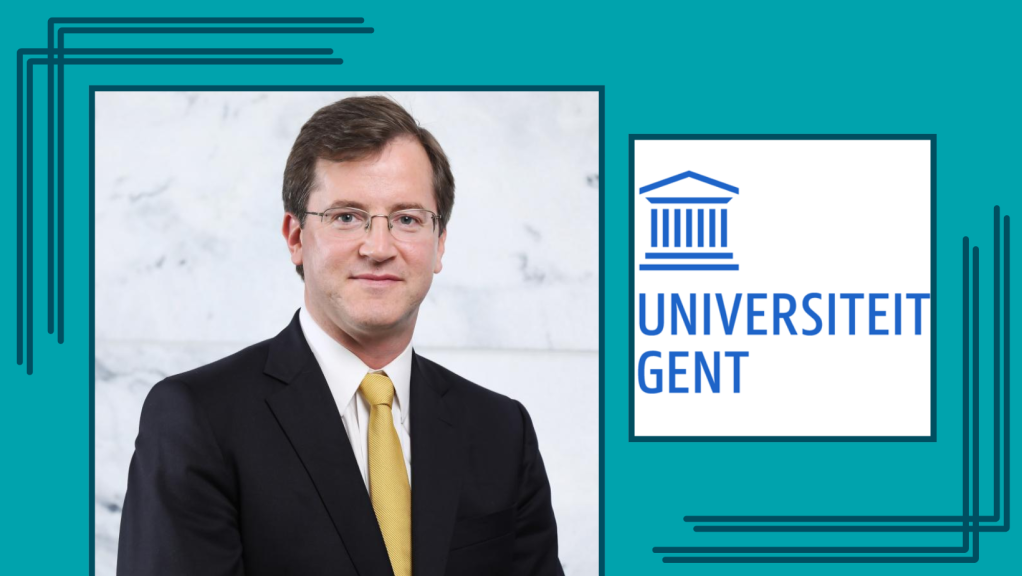
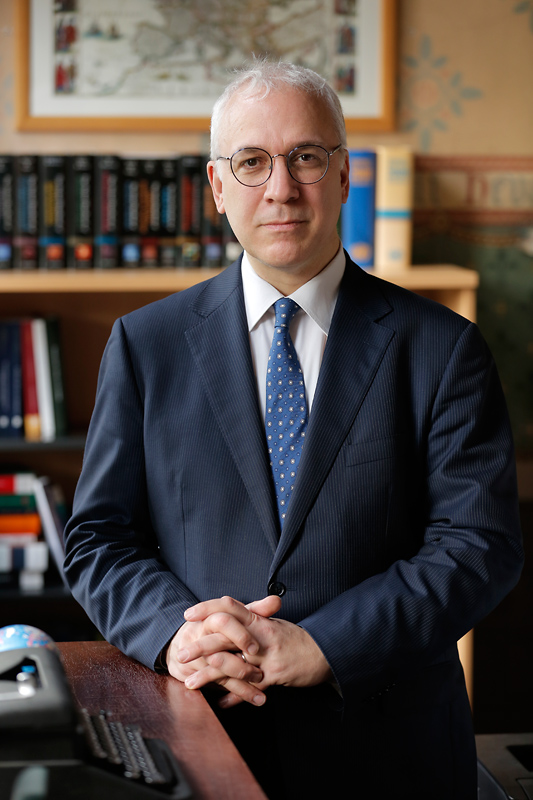
We at the University of Georgia School of Law Dean Rusk International Law Center are pleased to welcome a new Visiting Research Scholar: Johan Van den Cruijce (LL.M. ’94), Managing Director, Atlas Services Belgium (Orange group) in Brussels, Belgium. He is currently a Postdoctoral Research Fellow at Vlerick Business School (Belgium) and holds dual Ph.D.s in Applied Economics from the KU Leuven and Ghent University. His work focuses on the intersection of law, economics, and corporate finance—especially on how control rights and marketability restrictions affect the valuation of privately held firms.
Dr. Van den Cruijce brings over 25 years of international executive experience in governance, finance and law. He serves as Managing Director at Atlas Services Belgium (Orange group), where he is responsible for the global network of holding companies across Europe and the United States. His work includes M&A, corporate restructuring, treasury and tax strategy, and legal oversight of listed and unlisted entities. He also holds executive and non-executive directorships in Orange group companies in several countries (including Belgium, France, Italy, the Netherlands, Denmark, the U.K. and the U.S.).
Dr. Van den Cruijce has presented at leading international conferences and his academic research has been published in reputable peer reviewed journals. His recent work explores valuation discounts in illiquid markets, the legal-economic role of control in private firms, and the implications of corporate structure on firm value.
He is an alumnus of the University of Georgia School of Law and also holds an MBA degree from the KU Leuven and a law degree from the University of Antwerp. He has completed executive education programs at, amongst others, INSEAD, IESE Business School, London Business School, and Vlerick Business School.
Dr. Van den Cruijce is sponsored as a Visiting Research Scholar by Georgia Law Professor Christopher Bruner, Stembler Family Distinguished Professor in Business Law & Faculty Co-Director of the Dean Rusk International Law Center.
Today, we welcome a guest post by Daniel “Tripp” Vaughn, a member of the University of Georgia School of Law class of 2025. Vaughn participated in a semester-long international externship in spring 2025. The semester-long externships overseas initiative is an extension of the Center’s existing Global Externships Overseas and is offered jointly between the Center and the law school’s Clinical and Experiential Program. Vaughn’s post describes his experience as a legal extern with Van Bael & Bellis, a law firm working on EU and national competition law, EU trade and customs law, regulatory law, as well as Belgian business law. Vaughn was based in Brussels, Belgium, where he worked under Georgia Law alumnus Porter Elliott (J.D. ’96).This was Vaughn’s third Global Externship Overseas during his time at Georgia Law. He is now living in Leuven, Belgium, where he is pursuing a Master of Laws (LL.M.) degree at KU Leuven.
Last spring, I spent my final semester of law school working as a legal extern at Van Bael & Bellis (VBB), a Belgian law firm consisting of three offices in London, Brussels, and Geneva. VBB specializes in European and international legal work across three main categories: trade, antitrust, and corporate regulatory compliance. The firm’s composition truly represents its international focus, employing attorneys from more than 20 different countries. Just my office alone was shared with interns from Belgium, France, Ireland, Italy, Germany, and Spain.
This international diversity, strongly reminiscent of the city of Brussels itself, created a uniquely open-minded and welcoming atmosphere at the firm. Every day, whether through work projects or casual conversations, I learned more about countries and legal systems all across the world. The sheer breadth of nationalities, experiences, and perspectives held by VBB’s attorneys ensured that everyone in the office was still expanding their understanding of business and law. In this context, it was clear throughout the firm that questions were not only expected but also encouraged. As an extern, this atmosphere afforded me an incredible opportunity to add to my knowledge and experience before graduating law school.
This open mentality compounded the impact from my involvement in VBB’s extremely varied legal work, spanning from sanctions compliance and antidumping investigations to client alerts on upcoming legislation and updating internal materials on EU antitrust laws. I gained firsthand experience working on US-EU and EU-China trade disputes, including assessing tariffs and determining the correct classifications for products. When the EU proposed new legislation, I researched its impacts and together with expert attorneys wrote alerts for specifically affected clients as well as general takeaways. As part of my externship I also assisted many other tasks as well, including me in projects in over 20 different countries with different legal systems and approaches to corporate law.
However, of these many fascinating projects I had the opportunity to work on during my externship, sanctions compliance proved to be the most impactful and enduring. This work included researching involved parties of proposed transactions to ensure that the actions contemplated would pose minimal compliance risks from a sanctions perspective. While simple in concept, sanctioned parties would often go to great lengths to disguise their presence in transactions through strings of shell companies across the globe and the suppression of any information related to their ownership. Further complications often arose from the differences between UK, US, and EU sanction regimes, including the scope of sanctions, the jurisdiction of corresponding regulatory agencies, and the applicable penalties for noncompliance.
Despite these challenges, I began to increasingly enjoy the research and analysis required. Tracking down the ownership and control of various companies, which is often not openly disclosed information, consisted of sifting through media articles, social media posts, NGO reports, and other publicly accessible data such as ship transponders and locations. This process often felt like solving a particularly difficult puzzle, piecing together various clues to get a clearer picture of the involved parties and sanctions risks. Due to the lack of available information, many times the ownership or control of involved parties could not be definitively determined. However, it was incredibly satisfying when hours or days of research and seemingly unrelated shreds of information finally came together and yielded important conclusions.
I am extremely grateful for the experiences and opportunities given to me by Van Bael & Bellis. My time with the many talented attorneys at the firm opened my eyes to fields and career opportunities in international law that I never would have believed existed. As I am currently returning to Belgium for my Master of Laws (LL.M.) degree at KU Leuven, I am confident that my time with VBB will prove invaluable to me.
***
Applications are open for spring 2026 semester-long Global Externships Overseas (GEOs). All current 2Ls and 3Ls are invited to submit an application by September 15. For more information and the application, please email: ruskintlaw@uga.edu
Several University of Georgia School of Law students were involved in research and editing for the 13th edition of the 2024 Guide to Listing in Belgium, published earlier this year by a Georgia Law alumnus. This book provides an overview on the governance and regulatory landscape of listed companies in Belgium.
Johan Van den Cruijce (LL.M. ’94), Managing Director of Atlas Services Belgium, a company of the Orange group, co-authored the publication with his colleagues Nicolas Janssens de Bisthoven, Julie Van Opdenbosch, and Hilde Santens. Georgia Law students who have contributed to this version and to past editions include: Daniel “Tripp” Vaughn (J.D. ’25), Emina Sadic Herzberger (J.D., ’22), Starlyn Endres (J.D., ’22), and Alina Salgado (J.D., ’23).
Below is an abstract of the book:
The purpose of this Guide is to outline the specific issues and continuing obligations a listed company may be confronted with in Belgium. The point of reference for this Guide is the position of an issuer that is listed on a Belgian regulated market. A listing on a regulated market is subject to more conditions and triggers more ongoing obligations than a listing on any other trading venue. Insight into the organisation and functioning of a regulated market can thus ease the understanding of the regulatory framework of all other trading venues in Belgium.
This Guide deals with topics ranging from company law, corporate governance, finance and tax to opportunities for employee participation and the obligations and status of directors and executive managers. The Guide also covers the reasons and procedures for a possible de-listing, which is an issue that may become relevant to any listed company. Experience has shown that institutional investors and corporate governance rating agencies are keen to gain a deeper understanding of the rights and obligations of the various players that emerge in de-listing. This newly expanded 2024 edition also highlights the impact of important recent developments and insights in the fields of reporting, compliance, sustainability and valuation.
This Guideis conceived as a quick-reference document. All chapters can be consulted separately and the notes allow the reader to find additional information on the topics and issues discussed.
Profits from book sales will be donated to the Orange Belgium Fund, supporting projects that enhance digital inclusion in Belgium. This Fund is managed by the King Baudouin Foundation.
Christopher M. Bruner, Stembler Family Distinguished Professor in Business Law and Faculty Co-Director of the Dean Rusk International Law Center, gave the keynote address for a symposium on “Corporate Sustainability Due Diligence (CSDD), Sustainability, and Corporate Law” at Ghent University Law School in Belgium during May. Bruner’s keynote was titled “Developments and Debates on Corporate Sustainability in the US,” and the symposium was co-sponsored by the journal European Company Case Law (ECCL).
University of Georgia School of Law 2L Madison L. Graham was featured in National Juristregarding her experience studying abroad. During her 1L summer in 2023, Graham participated in both the Global Governance Summer School and the Global Externships Overseas initiative, administered by the Dean Rusk International Law Center. She reflects on her experiences in the National Jurist article titled “Studying Abroad Can Be Life Changing” written by Trevor Mason and published in the magazine’s Winter 2024 edition.
Graham discusses the impact of participating in international opportunities as a law student. Graham began her summer with the Global Governance Summer School, a 10-day study abroad presented through a partnership between Georgia Law and KU Leuven’s Centre for Global Governance Studies through which students study in Belgium and the Netherlands:
“As someone already interested in international law, it was really special to see other people who didn’t think that they were interested in it start to challenge their own perspectives, start to realize how ‘international’ law pervades domestic practice, and the scope of international opportunities that exist in the American legal context.
Also, I think it is really important for American law students to recognize and remember that there is an entire world out there handling the same legal challenges we are, and often in a different way.
To have the opportunity to learn from specialists in the field, and step into the courts and government offices of the legal systems we spend semesters learning about, was an incredible opportunity. Getting to do all of that and make new friends along the way was an experience I could not be more thankful for.
The opportunities it provides from an educational and professional perspective are unlike ones I have seen at any other law school, and something every student should consider doing.”
Upon completion of Global Governance Summer School, Graham started a legal externship placement at Van Bael & Bellis through the Global Externships Overseas initiative. Georgia Law alumni David Hull (J.D., ’83) and Porter Elliott (J.D., ’96) facilitate placements and supervise law students at this Brussels-based firm. Van Bael & Bellis specializes in domestic Belgian law matters, mergers and acquisitions, and focuses heavily on EU competition law, EU data privacy, and international trade law. Graham’s summer work focused on the latter three categories, assisting senior associates and partners prepare client memos, regulatory updates, research new EU and US legislation, and proofreading legal documents as a native-English speaker.
“Being challenged to understand a new law-making process helped me not only adapt my research skills to be able to learn what I need to about a ‘foreign’ legal framework, but also better understand effects on US legislative process and domestic policy, generally. Further, I was fortunate to be in a firm with lawyers from 20 different countries, so I was constantly being exposed to different ideas, cultural norms, problem-solving approaches, and even legal backgrounds (given those people that were coming from Civil Law-based countries).
My GEO helped me solidify and reaffirm my aspirations about possibly working abroad if I get the opportunity, and hopefully working in a public sector position. Further, though, it helped me improve my skills researching laws and regulations from other countries and legislative systems, which will benefit me no matter what international-law-focused position I could possibly end up in.
This experience also built my confidence in being able to move to a new place, make new friends, and succeed in a new professional environment. That is a big step for a lot of people post-grad, so having a trial period in an exceptionally new environment is a great trial experience and confidence booster. I also think that anytime you can work around people with that many different personal, cultural, and educational experiences will humble you in the very best way, by forcing you to challenge your preconceived notions about the world. I have always appreciated that challenge, but it’s so easy to forget. This summer was a great reminder and time of reflection for me, and one I think every law student needs.”
***
To learn more about international opportunities at the University of Georgia School of Law, visit our website here.
Applications are now open for the summer 2024 Global Governance Summer School, jointly presented by the University of Georgia School of Law’s Dean Rusk International Law Center and KU Leuven’s Leuven Centre for Global Governance Studies. Each summer, this short-term study abroad takes UGA Law students to Belgium and the Netherlands to explore global governance: the interaction of state, regional, and international legal regimes, plus individuals, corporations, intergovernmental and nongovernmental organizations, networks, and other non-state actors.
In summer 2023, the first summer GGSS ran since 2019, 17 students traveled to Europe for a week of lectures with KU Leuven professors. The first week of this for-credit course also included professional development briefings in Brussels at the European Parliament, where students were able to watch the final vote of the session cast, and a private law firm specializing in EU competition law. The programming then shifted to The Hague, Netherlands, where students received briefings at the International Criminal Court, the International Court of Justice, the International Residual Mechanism for Criminal Tribunals, and Leiden University.
The students in attendance had a variety of professional and academic motivations for participating in GGSS. For some, the professional connections, international experience, and expanded academic network will continue to benefit them as they pursue employment internationally. Erin Nalley, a current 2L who aims to work in international environmental law, stated how important the experiences of GGSS are for someone interested in an international career:
“The cultural, academic, and international experiences on this program were priceless and once in a lifetime. I made new friendships and professional connections on this trip that I most likely would not have made without GGSS.”
For others focusing their professional pursuits domestically, GGSS served as a unique professional development opportunity that will set them apart in their job search. Megan Jones, a current 2L interested in a business law career, reflected on the value of the knowledge she gained through her participation in GGSS:
“GGSS was a great opportunity for someone who sees themselves practicing domestically early in their legal career but still has an interest or desire to incorporate international aspects into their professional future. They say the best way to learn something is to immerse yourself in it, and that is exactly what GGSS is: an immersive experience that introduces you to the wide array of global opportunities the legal field has to offer.“
In addition to the UGA Law students, several graduate students at UGA in the law school’s Graduate Certificate in International Law participated in GGSS. Jasmine Underwood-Starling, a Ph.D. student in the Department of Sociology, noted that the benefits of GGSS are truly interdisciplinary:
“For any student interested in international, foreign, and comparative law, the GGSS is definitely worthwhile. The ability to go from classroom learning to then seeing the knowledge and practices in action the very next day is an invaluable experience. The program was truly inspiring.”
***
Applications for the summer 2024 Global Governance Summer School are now open. Current 1Ls, 2Ls, and graduate students are encouraged to apply. This 12-day, 3-credit summer school will explore global governance through the lens of comparative administrative law led by Kent Barnett, Associate Dean for Academic Affairs & J. Alton Hosch Professor of Law. GGSS will take place from May 20 – June 1, 2024. Students are encouraged to reference this instructional video for step-by-step information regarding how to create and successfully complete an application for GGSS in UGA’s Study Away Portal by the March 1 deadline. For more information, please plan to attend the Center’s International Opportunities Information Session on Tuesday, February 13 at 12pm, or email: ruskintlaw@uga.edu
Professor Jan Wouters, international law scholar and Director of the Leuven Centre for Global Governance Studies at Belgium’s KU Leuven, will give a lecture entitled “The European Union as a Global Actor: Potential and Challenges” at 1 p.m. this Thursday, January 26, in the Sanders Boardroom at the University of Georgia School of Law.
Wouters is Full Professor of International Law and International Organizations, Jean Monnet Chair ad personam EU and Global Governance, and founding Director of the Institute for International Law at the Leuven Centre for Global Governance Studies, an interdisciplinary research unit that holds the status within its university of both a Jean Monnet and KU Leuven Centre of Excellence. Additionally, Wouters is a visiting professor at Sciences Po and Paris-2 (Panthéon-Assas) in France, LUISS University in Italy, and the College of Europe in Belgium, as well as an adjunct professor of EU and human rights law Columbia University in New York. His most recent publications, all of them 2022 volumes which he co-edited, are: EU Industrial Policy in the Multipolar Economy; The G20, Development and the UN 2030 Agenda; Research Handbook on Global Governance, Business and Human Rights; and The Nexus Between Organized Crime and Terrorism.
LEUVEN & BRUSSELS – The morning opened with an introduction to the European Union, presented by Michal Ovadek, a research fellow at the Leuven Centre for Global Governance Studies. An expert in the European Union legislative process, he provided an overview of the European Union architecture, and outlined the primary challenges to democracy in Europe. The session was designed to prepare students to participate fully in the rest of the day’s activities: a conference devoted to a research project aimed at reinvigorating core values of the European Union.
From left, Gamble Baffert, Charles Wells, Leila Knox, Emily Doumar, Maria Lagares Romay, Blanca Ruiz Llevot, Steven Miller, Alicia Millspaugh, and Briana Blakely.
The RECONNECT: Reconciling Europe with its Citizens through Democracy and the Rule of Law project, established by the Leuven Centre for Global Governance Studies, is supported by funds from the EU’s Horizon 2020 Research & Innovation programme. As part of the larger project, the Leven Centre convened the International Conference on Democracy and the Rule of Law in the EU. It gathered experts to discuss contemporary challenges to European Union integration, including judicial independence and rule of law, free press, and democratic institutions in countries like Poland and Hungary.
The conference featured keynote remarks by Daniel Keleman, Professor of Political Science and Law and Jean Monnet Chair in European Union Politics at Rutgers University, and Koen Lenaerts, President of the Court of Justice of the European Union (right). Two policy roundtables also featured perspectives from academics and advocates from around Europe on democracy and rule of law in the European Union, respectively.
From left, Kathleen Garnett, Holly Stephens, Steven Miller, Alicia Millspaugh, Emily Snow.
Pleased today to welcome this post by University of Georgia School of Law student Lauren Brown, working this Spring 2019 semester in Mons, Belgium, in the legal department of a leading unit of the North Atlantic Treaty Organization. Pictured above right, she is the inaugural holder of this externship, administered by our law school’s Dean Rusk International Law Center in partnership with NATO Allied Command Transformation. Lauren arrived at Georgia Law with considerable background in security policy, and her experiences here have included a Summer 2017 Global Externship Overseas at the nongovernmental organization War Child Holland. She is due to receive her J.D. degree this May, and thereafter to become an Associate at the Washington, D.C., office of the law firm Squire Patton Boggs. Lauren recounts her ongoing NATO experience below.
The opportunity to work with the Allied Command Transformation (ACT) Legal Advisor’s Office at the North Atlantic Treaty Organization (NATO) Supreme Headquarters Allied Powers Europe (SHAPE) Staff Element Europe (SEE) has been a unique and exciting experience. At this halfway mark, I am very pleased with what I have been able to experience thus far, and I look forward to the coming weeks as the externship continues.
My observations can be broadly divided into three categories, legal experience, professional experience, and practical experience, each of which I discuss below.
Legal Experience
It is important to note that I have carefully crafted much of my previous and future working life to avoid two things: complex math and regulatory work. Accordingly, my hopes were somewhat dashed when I received my first assignment: Draft a data protection and privacy regulation.
The actual work, however, was absolutely fascinating. The ultimate challenge was to create a directive that provided sufficient data protection and privacy standards and that struck a balance among the disparate domestic standards. The work also involved coordination with existing data protection and privacy directives within other NATO bodies, in order to ensure the provisions allowed for a workable level of cohesion across policies.
The resulting effort felt very much like a logic puzzle, with each component capable of fitting, and the task being to figure out how to make it fit. The assignment was a tremendous introduction to the legal experience within the externship. It demonstrated that although focus and ambition are important, flexibility and an open mind are also critical. Without them, I would have missed an opportunity to participate in a fascinating project and expand my interests—even to include regulatory work.
Professional Experience
Before arriving at NATO, I had been extremely fortunate in that I’d had opportunities to work in several different cities, in several different professional environments. But I had never before experienced the working life of a military base. The primary adjustment has been the strictness of the adherence to decorum and hierarchy—and the impressive bureaucracy that accompanies such practice. In my time here, I have learned that even when the waters seem murky and the process opaque, there are always channels that move a little more swiftly, and success in such an organization appears to be directly related to one’s ability to identify and utilize such avenues.
Practical Experience
I have also enjoyed experiences that resonate beyond the professional sphere. Two such instances were particularly impactful:
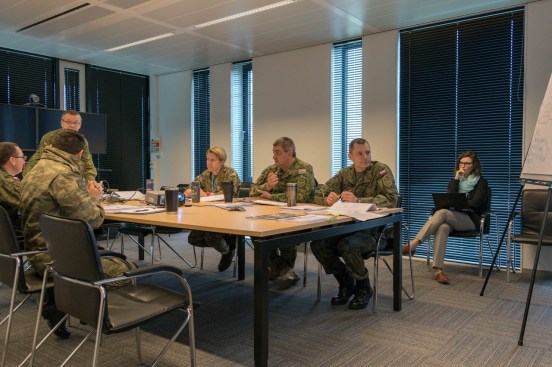
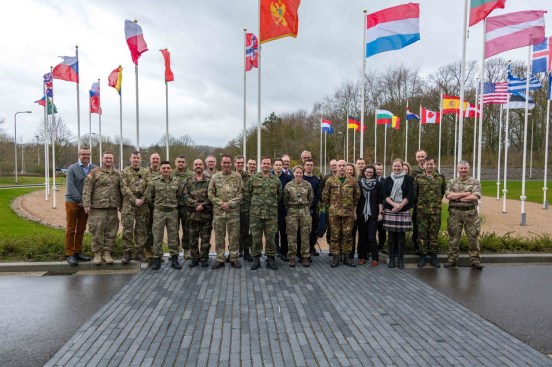
The first occurred during a training on rules of engagement at NATO Allied Joint Force Command (JFC) Brunssum in the Netherlands (site of the photos accompanying this post). By the time of this training, I had become accustomed to the presence of uniforms and their associated patches, which usually denote membership in a division or the service member’s assigned NATO unit. On the last day of the training, however, a new patch caught my eye: a large square stating the bearer’s blood type. The realization of when such a patch would be useful, and its place as a standardized part of the uniform, reminded me of a fact I had clearly forgotten: this exercise was not just theoretical. The reliance these men and women have on laws of armed conflict and rules of engagement dictate life and death choices in very real, and very dangerous, situations.
The second served largely the same realization; that is, it reinforced my understanding of the scale at which laws, and their functioning or not, can impact people. I met a friend in Paris for a weekend, and through a course of events that can sometimes happen during travel, we found ourselves marching with the so-called Yellow Vests calling for action against climate change. The group with which we marched was peaceful and numbered very close to 10,000. But a few hours later, we encountered the other group of Yellow Vests, the militant wing of violent rioters who burned or broke almost every structure they encountered. For me, the experience reiterated the idea that when laws or policies fail people, people may react. The rules that govern our social existence must be crafted and interpreted with care, and without negligence toward the future or the marginalized.
The patches and the protests were powerful reminders, both on an intimate and broader level, that what attorneys do matters. We cannot undertake our work with anything but a full appreciation for the privileges we enjoy and the responsibilities we bear.
I feel extremely fortunate for the opportunity to have such an experience while in law school, and I want to especially thank the NATO personnel with whom I have interacted in Belgium, including attorneys Lewis Bumgardner, Galateia Gialitaki, and Steven Hill, as well as Georgia Law professors Kathleen Doty and Diane Marie Amann, for making this externship possible.
This is one in a series of posts by University of Georgia School of Law students, writing on their participation in our Global Governance Summer School or our Global Externship Overseas initiative. Author of this post is 2L Hanna Karimipour (right), who spent her 1L summer as a GEO, or Global Extern Overseas.
I came to law school because I’ve always known that I wanted to work in international relations and on human rights issues. After spending my 1L year getting the basics of U.S. law down and taking one international law course, I was eager to gain meaningful exposure to international law practice at NPWJ. As I sat for my final exams, the thought of my upcoming externship, as well as all the Belgian frites and waffles I would eat, carried me through.
On arriving in Brussels, I was not disappointed. Right away, I was researching the actus reus for aiding and abetting liability for war crimes under Article 25(3)(c) of the Rome Statute of the International Criminal Court. I was struck by the challenges to international legal research. There is no single database that catalogues case law, and considering that the ICC is only sixteen years old, the available precedent is limited. Moreover, ad hoc criminal tribunals – in particular, the ICTY – may have helpful case law, for the issue I was working on, but the approaches of each court vary widely, and their case law can even be contradictory. Although at first I was overwhelmed, by the end of the summer I found the process of combing through cases, the text of the Statute itself, travaux préparatoires, academic articles, and books to be a thrilling and surprisingly fun process.
As a part of my GEO, I was also able to travel with NPWJ. I went on a two-day mission to Geneva, Switzerland to the Office of the UN High Commissioner on Human Rights. There, NPWJ was invited to represent civil society at the Joint UN/Parliamentary Assembly of the Mediterranean (PAM) Seminar on Human Rights for PAM Members of Parliaments. Also in Geneva, I visited the Palais des Nations to attend a panel on transitional justice in Tunisia. As someone whose childhood dream was to be a United Nations ambassador, it was utterly exciting to be in the Palais des Nations, right down an escalator from where the Human Rights Council was in session.
The highlight of my experience, however, came when I was able to gain experience in the field as part of a six-day mission to Gaziantep, Turkey. Gaziantep is located approximately 30 miles from the Syrian border – about half the distance from Athens to Atlanta! I assisted with a NPWJ training on negotiation for members of Syrian civil society. It was a powerful experience to contribute to giving organizations the tools to safeguard human rights and to ensure transitional justice occurs and in the midst of the conflict in Syria. During this mission, I had the opportunity to meet and interact with several Syrian people who are directly taking action to improve the situation. Before this summer, the possibility of doing human rights field work wasn’t even on my radar. Now, it is something I am seriously considering for after law school.
My GEO at NPWJ was one of the most valuable experiences I have had thus far in my education and career, and has reaffirmed my passion for human rights. Oh, and I got plenty of the frites and waffles, too. I am looking forward to continuing my exploration of international law on campus at Georgia Law.




 LEUVEN & BRUSSELS – The morning opened with an introduction to the European Union, presented by
 The conference took place in the Brussels’ beautiful Academy Palace, and opened with a welcome by
  The conference featured keynote remarks by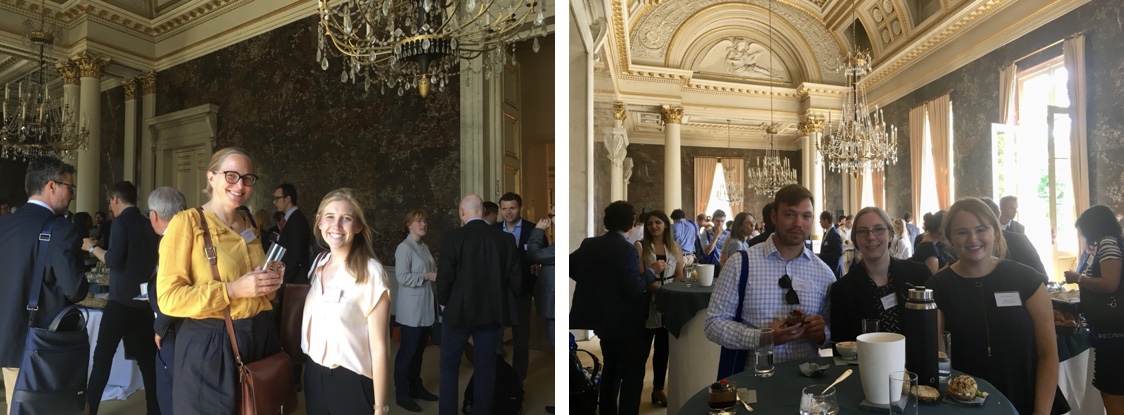
 This is one in a series of posts by University of Georgia School of Law students, writing on their participation in our
 exchange of notes