UN affiliate CIFAL Atlanta: Our new International Judicial Training partner

Cifal AtlantaBeginning this year, Georgia Law’s annual International Judicial Training will be offered in partnership with CIFAL Atlanta, an affiliate of the United Nations Institute for Training and Research, or UNITAR.

UNITAR_Vertical_Logo_35mm_Blue-Pantone279C-01-pngCIFAL Atlanta joins an International Judicial Training partnership forged in the late 1990s by Georgia Law’s 2016IJT_fullDSDean Rusk International Law Center and the Institute of Continuing Judicial Education of Georgia. For nearly 20 years, the trainings have provided provided a high-level learning experience to foreign judges. Included are seminars with distinguished Georgia Law faculty and visits to a variety of courts around the state.

As one of several training centers across the globe linked to UNITAR, CIFAL Atlanta works to build capacity among local governments and civil society leaders, with particular emphases on economic and infrastructure development, fair trade, and good governance.

The 2016 International Judicial Training, to be held November 27 to December 10, will advance Goal 16 of the United Nations 2030 Agenda for Sustainable Development, which is

E_SDG_Icons-16“dedicated to the promotion of peaceful and inclusive societies for sustainable development, the provision of access to justice for all, and building effective, accountable institutions at all levels.”

Leaders of the new collaboration, which extends the trainings’ global outreach, include two Georgia Law graduates: Chris Young, CIFAL Executive Director, and Laura Tate Kagel, Director of International Professional Education at the Dean Rusk International Law Center. They work alongside Richard Reaves, Executive Director of the Institute of Continuing Judicial Education of Georgia, who brings decades of experience in organizing continuing education seminars for judges. Reaves’ extensive contacts throughout Georgia create opportunities for informative exchanges between the international judges and their U.S. counterparts. In Kagel’s words:

reaves

In Georgia Law’s James E. Butler Courtroom, Richard Reaves talks with foreign judges during an International Judicial Training

“The International Judicial Training is more than simply an educational program. It can lead to significant reforms in terms of effective administration of justice and stimulate cross-cultural relationships that can bear fruit for years to come.”

Providing an example of this is Fernando Cerqueira Norberto, Secretary-General of ENFAM, the governing body of Brazilian judicial colleges. According to Cerqueira, Brazilian judges’ longstanding participation in the International Judicial Training correlates to the adoption in his country of innovations such as small claims courts, mediation procedures, and drug courts.

Judges and court personnel from all countries are welcome to apply for the 2016 International Judicial Training; further details and registration are available here.

Former Nigeria prosecutor’s LLM year features US practice experience

IMG_0526.Gladys ASHIRU_2_fb

Among the many talented foreign-trained lawyers set to earn Georgia Law’s Master of Laws (LLM) degree this month is Gladys Ashiru, who arrived with considerable experience as a prosecutor in Nigeria. She’s enriched this experience this year: in addition to her academic studies and a professional development trip, Gladys has worked as a volunteer prosecutor here in Athens.

Having immigrated to the United States, Gladys chose to put her career back on track by pursuing an LLM at Georgia Law. She says she was impressed by the collegiality she encountered during a visit to campus, and swayed by LLM graduates who spoke glowingly of their experience here.

Gladys’ strong interest in criminal law prompted Laura Tate Kagel, our Center’s Director of International Professional Education, to connect her with the Athens-based Office of the District Attorney for the Western Judicial Circuit, whose staff includes a number of Georgia Law alums. Assistant District Attorney Paige Otwell (JD 88) became Gladys’ mentor and introduced her to District Attorney Ken Mauldin (JD 80). After Gladys enrolled in Mauldin’s Spring 2016 Trial Practice course, he offered her the opportunity to observe and help out in the D.A.’s office. With the semester now at an end, Gladys recounts:

“It was an amazing experience for me. The internship broadened my horizons and exposed me to perspectives different from mine, especially in areas relating to jury selection and trials.”

After commencement on May 21, Ashiru plans to take the Georgia and New York bar exams, and also hopes to contribute to legal reform in Nigeria. Although she says that Georgia Law was challenging, she also found it rewarding, and calls it

“the best choice I made!”

Emerging security challenges require norm development, State lawyer says

IMG_5540At first blush, today’s security challenges may seem familiar. Yet they are new – emerging, in U.S. State Department parlance – because of the novel ways in which those challenges present themselves.

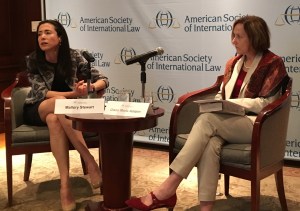
So explained Mallory Stewart (near right), Deputy Assistant Secretary of State for Emerging Security Challenges & Defense Policy, during her fascinating talk Monday at Tillar House, the Washington, D.C. headquarters of the American Society of International Law. We at Georgia Law’s Dean Rusk International Law Center were honored to join ASIL’s Nonproliferation, Arms Control & Disarmament Interest Group in cosponsoring Stewart’s talk, “Common Challenges to Diverse Security Threats.” (For the event video, see here.)

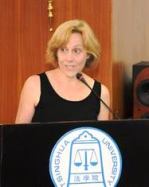
Stewart’s talk followed introductions by Kathleen A. Doty, Interest Group Co-Chair and our Center’s Associate Director for Global Practice Preparation, as well as opening remarks by yours truly (above, at right) respecting Dean Rusk’s arms control legacy.

Stewart pointed to technological change, in outer space and elsewhere, as one of the emerging challenges. Within this category was what is essentially garbage; that is, the debris left in outer space by state actors and, increasingly, nonstate/commercial actors, whose celestial flotsam and jetsam continue to orbit and present hazards to active satellites, space stations, and the like.

Another challenge is dual-use technology. Items as seemingly innocent as chlorine – a chemical essential to everyday cleaning – can become a security threat when deployed as a weapon, as is alleged to have happened during the ongoing conflict in Syria.

Yet another is ubiquity, the reality that technologies, such as cyber capabilities, are, literally, everywhere, and thus not easy to contain.

Containment – regulation – thus is difficult both to design and to effectuate. With regard to dual-use technologies, for instance, Stewart posed questions of intent: How, exactly, does one define and identify the moment that an innocent item is transformed into a weapon? What about attribution – in areas like cyberwarfare, how can the perpetrator be identified? How can attacks waged with such weapons be prohibited in advance?

Stewart gave due respect to the 20th C. arms control treaties that form the core portfolio of State’s Bureau of Arms Control, Verification & Compliance, where she practices. Nevertheless, stressing global interdependence, she stressed the need for more nimble forms of international lawmaking. To be precise, she looked to mechanisms of soft law, such as codes of conduct, as ways that states and other essential actors might develop norms for responsible behavior in the short term. In the longer term, if the internalization and implementation of such norms should prove successful, eventually legally binding treaties may result.

(Part 2 of a 2-part series; Part 1 is here.)

At Center event in D.C., reviewing namesake Rusk’s arms control legacy

outerspaceVisitors to Tillar House, the Washington, D.C., headquarters of the American Society of International Law, were treated yesterday to a superb overview of emerging security challenges by the U.S. State Department lawyer who leads that portfolio, Mallory Stewart. I was proud both to have Georgia Law’s Dean Rusk International Law Center cosponsor, and also to serve as discussant for this important event. This post and another tomorrow will outline the proceedings. (For the event video, see here.) Today’s post consists of my opening remarks, which aimed to to reacquaint the audience with to the role that our Center’s namesake, Dean Rusk, played in building the arms control framework within which Stewart and her colleagues work.

. . .

Everyone knows, of course, about Dean Rusk and Vietnam – of his role in championing a foreign conflict that claimed more than a million American and Vietnamese lives between 1965 and 1974. Everyone knows, too, of his pivotal role in averting nuclear catastrophe during the Cuban Missile Crisis of 1962, when Rusk famously said,

“We are eyeball to eyeball, and the other fellow just blinked.”

What may be less well known – or been forgotten – is likewise significant. That is Rusk’s role in the design and implementation of the international arms control regime that has prevailed since the United States dropped atomic bombs on Japan seven decades ago. An Army officer who served in Asia and then in the War Department in D.C., Rusk, like many of his generation, did not fault the military decision. Yet in his memoir, As I Saw It, he wrote (p.122):

“[W]e made a mistake with the Manhattan Project from its inception. We should have built in a political task force to consider the ramifications of using the bomb.”

That position is consistent with Rusk’s own work, first as a State Department diplomat who championed the United Nations, NATO, and other multilateral postwar efforts, and ultimately as the head of that Cabinet department, for the entirety of the Kennedy and Johnson administrations.

As Secretary of State, Rusk oversaw the establishment of the U.S. Arms Control and Disarmament Agency, a forerunner of the Bureau for which our principal speaker, Mallory Stewart, now works. Moreover, Rusk was instrumental in the drafting, negotiation, conclusion, or implementation of at least seven major arms control treaties.

ltbtruskOne was the 1963 Limited Test Ban Treaty, about which Rusk wrote (p. 259):

“[A]fter the Cuban missile crisis, it was important to demonstrate that the United States and Soviet Union could coexist. The test ban required careful and extensive negotiations, but we and they did sign a major agreement on the heels of the most horrendous crisis the world has seen. … Such is the legacy of what President Kennedy felt was his proudest achievement.”

The other treaties were the Antarctic Treaty, the Outer Space Treaty, the Treaty of Tlatelolco, the Nuclear Non-Proliferation Treaty, the Seabed Arms Control Treaty, and the Anti-Ballistic Missile Treaty. Many of them remain at the core of the U.S. arms control portfolio to this day. Yet with the same modesty that pervades his memoir, Rusk wrote (p. 353):

“On the whole, our record on arms control under Lyndon Johnson was respectable.”

He did allow himself a light pat on the back (p.353):

“In reviewing the accomplishments of the Kennedy-Johnson years, I claim only one for myself: that with the agreements negotiated and our constant talking with the Soviets, my colleagues and I helped add eight years to the time since a nuclear weapon has been fired in anger.”

Rusk’s commitment to extending that time continued long after he left government, in 1969, and joined the faculty at the University of Georgia School of Law. Professor Rusk spoke often about arms control, with students, with the larger community, and with the stream of colleagues who consulted with him at his new home. Indeed, as late as 1985 – less than a decade before his death – Rusk welcomed to Athens, Georgia, former British Prime Minister Edward Heath, former Secretary of Defense McGeorge Bundy, former Secretary of State Alexander Haig, and others for a televised discussion entitled “Forty Years Since Hiroshima: What Next for Mankind?”

Rusk’s 1990 memoir returned to that question. In the final chapter, entitled “Dean Rusk’s Message to the Young,” he wrote (p. 630):

“Your generation will discover in the decades ahead whether mankind can organize a durable peace in a world in which thousands of megatons are lying around in the hands of frail human beings. A world in which collective security – what my generation used to try to curb the obscenity of war – is withering away, and we are not even discussing what shall take its place.”

We are here today to put the lie to that last line – that is, to discuss those very issues of global security. I look forward to Ms. Stewart’s remarks.

(Tomorrow: Outline of Mallory Stewart’s remarks. Credit for photo at top, of Rusk signing the Outer Space Treaty; credit for photo above of Rusk, standing just to the left of the portrait as President Kennedy signs the Limited Test Ban Treaty)

May 2 Event in DC: Common Challenges to Diverse Security Threats: A Conversation with Mallory Stewart

On Monday, May 2, at 5:30 p.m. at Tillar House in Washington D.C., the Dean Rusk International Law Center will co-sponsor “Common Challenges to Diverse Security Threats: A Conversation with Mallory Stewart.”

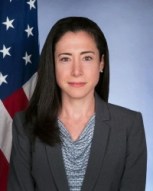
Mallory_Stewart_8x10_200_1The event will feature remarks by Mallory Stewart, Deputy Assistant Secretary for Emerging Security Challenges and Defense Policy at the U.S. Department of State. She is responsible for the management of the Office of Emerging Security Challenges and the Office of Chemical and Biological Weapons Affairs. Prior to this position, she served as an attorney in the Legal Adviser’s Office. In that role, she represented the United States before the Iran-U.S. Claims Tribunal, served on the U.S. delegation that negotiated the Ballistic Missile Agreements with Poland and Romania, and acted as the lead lawyer on the 2013 U.S.-Russian Framework for the Elimination of Syrian Chemical Weapons.

Stewart will explore the challenges common to the areas of space, cyber security, and chemical and biological weapons affairs, and the relevance of legal and/or political frameworks.tsinghua

Acting as moderator and discussant will be Diane Marie Amann, the University of Georgia School of Law’s Associate Dean for International Programs & Strategic Initiatives, Emily & Ernest Woodruff Chair in International Law.

The event, also sponsored by the Nonproliferation, Arms Control & Disarmament Interest Group of the American Society of International Law, that I chair, will have a reception following the substantive discussion. We welcome those in the DC area to join us. The event is free and registration is not required, but appreciated.

A world of issues addressed in new edition of Georgia Journal of International & Comparative Law

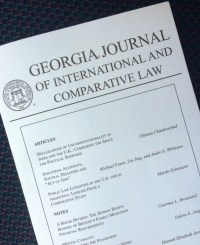
IMG_1031Four more than 4 decades, important articles on international, transnational, and comparative law and policy have found a publication home at Georgia law’s Georgia Journal of International and Comparative Law. Volume 43 Issue 2, the latest edition of GJICL, has just been released and is available online.

The volume begins with three articles, by five scholars from Asia, Europe, and South America:

31th_chintan

Declarations of Unconstitutionality in India and the U.K.: Comparing the Space for Political Response, by Chintan Chandrachud (left), candidate for Ph.D. in Law, University of Cambridge, England

faureIndustrial Accidents, Natural Disasters and “Act of God”, by: Professor Michael Faure (right), Professor of Comparative & International Environmental Law at Maastricht University’s Maastricht European Institute for Transnational Legal Research and Professor of Comparative Private Law & Economics at the Rotterdam Institute of Law and Economics, Erasmus liuSchool of Law, both in the Netherlands; Dr. Liu Jing (left), postdoctoral researcher in Research Institute of Environmental Law, School of Law, Center of Cooperative Innovation for Judicial Civilization, Wuhan University, China, and Behavioral Approach of Contract & Tort at Erasmus andriUniversity Rotterdam; and Dr. Andri Wibisana (right), Lecturer at the Faculty of Law Universitas Indonesia in Jakarta

oynPublic Law Litigation in the U.S. and in Argentina: Lessons From A Comparative Study, by Professor Martín Oyhanarte (left), Professor of Law at Universidad Austral and Universidad del Salvador  in Buenos Aires, Argentina

Three Notes, by alums who received their Georgia Law J.D.s in 2015, also appear in the volume:

broussardA House Divided: The Human Rights Burden of Britain’s Family Migration Financial Requirements, by Courtney L. Broussard (right), Staff Attorney, U.S. Court of Appeals for the Eleventh Circuit

jangMental Capacity: Reevaluating the Standards, by Eulen E. Jang (left), PSJD Fellow, National Association for Law Placement, Washington, D.C.

jarrellsHistory, TRIPS, and Common Sense: Curbing the Counterfeit Drug Market in Sub-Saharan Africa, by Hannah Elizabeth Jarrells (right), Associate Attorney at the Atlanta law firm of Ferrer Poirot Wansbrough Feller Daniel & Abney
Honoring Judge Ward, rights pioneer

ward2crop
Horace T. Ward, a human rights pioneer, died at age 88 over the weekend in Atlanta.

Described by the New Georgia Encyclopedia as “the first African American to challenge the racially discriminatory practices at the University of Georgia.” To be precise, he sought, unsuccessfully, to study law at the university. The law school paid tribute to him by way of this statement, issued today:

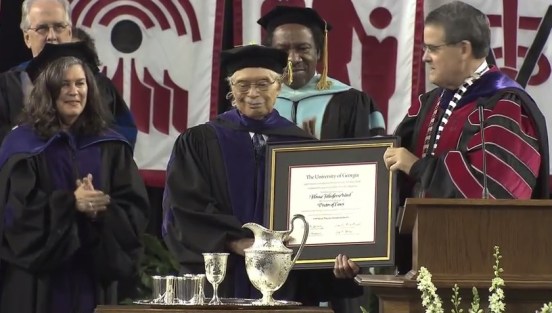
“We at the University of Georgia School of Law mourn the passing of a legal giant, the Honorable Horace Taliaferro Ward. A native of LaGrange, Georgia, he earned a bachelor’s degree from Morehouse College and a master’s degree from Atlanta University before applying to Georgia Law in 1950. His application was denied, and it would be eleven years before the University of Georgia admitted African Americans as students. In 2014, the University conferred an honorary Doctor of Laws degree upon Ward – by then, a distinguished federal judge who had represented Martin Luther King, Jr. and others as a civil rights attorney, served in the U.S. Army in Korea, and been a Georgia state legislator. We at Georgia Law remain grateful for Judge Ward’s gracious acceptance of this belated and well-deserved recognition, and we express our sincere condolences to his family.”

(Above, a screenshot from a video of the May 9, 2014, commencement ceremony: Judge Horace T. Ward accepts honorary Doctor of Laws degree from University of Georgia President Jere Morehead, as Rebecca White, then Georgia Law’s dean, looks on. Behind Ward is Maurice Daniels, dean of the university’s School of Social Work and author of a 2001 biography of the judge.)

Antiquities trafficking said to fuel transnational mayhem by Daesh et al.

davisetal

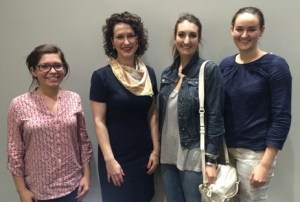
Alumna Tess Davis, 2d from left, met with Georgia Law 1Ls after her lecture; from left, Hannah Williams, Ava Goble & Karen Hays. Hannah will work on cultural heritage issues this summer through a Global Externship Overseas (GEO) at the Cambodia Ministry of Culture & Fine Arts, Department of Intangible Cultural Heritage.

“As long as there have been tombs, there have been tomb raiders.”

So began the terrific talk on trafficking that Tess Davis, Executive Director of the D.C.-based Antiquities Coalition, delivered to a rapt University of Georgia audience this week.

Having conceded the point quoted at top, Davis stressed that today the problem is much different and much greater. On the list of lucrative transnational organized crime, she asserted, antiquities trafficking places 3d, right behind arms trafficking and drug trafficking.

The threat is not simply one of criminal behavior, she continued. Rather, Davis stressed that profits from antiquities trafficking – profits believed to be in the millions of dollars – provide revenue vital for the nonstate actor waging armed conflict in Syria and Iraq. That entity calls itself “Islamic State” and is often labeled “ISIS” or “ISIL” in the media; taking a lead from diplomats in France and, recently, the United States, Davis preferred “Daesh,” the group’s Arabic acronym, for the simple reason that “they hate to be called that.”

Initially trained as an archeologist, Davis began to focus on legal means to combat antiquities trafficking while still a student at Georgia Law. Since earning her J.D. in 2009, she’s been a leader at the Lawyers’ Committee for Cultural Heritage and in the American Society of International Law Cultural Heritage & the Arts Interest Group, a researcher at Scotland’s University of Glasgow, a member of Georgia Law’s Dean Rusk International Law Center Council, and, as the photo above demonstrates, a mentor to Georgia Law students and other young lawyers interested in working in the field. Her efforts to help repatriate antiquities stolen from Cambodia earned multiple mentions in The New York Times.

Her talk drew links between the looting of cultural heritage during and after the 1970s Khmer Rouge reign of terror and current looting in the Middle East today. In both instances, she said, “cultural cleansing” – in the contemporary case, the destruction and thievery of monuments sacred to moderate Muslims and others – precedes and parallels efforts to erase and subjugate the humans who venerate those monuments. It’s a state of affairs documented in her Coalition’s new report, “Culture Under Threat.”

“The world failed Cambodia,”

Davis said, then expressed optimism at growing political will to do something about the Middle East. She advocated enactment of S. 1887, the Protect and Preserve International Cultural Property Act now working its way through Congress. The legislation, whose cosponsors include a Georgia U.S. Senator, David Perdue, is urgent: Davis estimated that U.S. buyers represent 43% of the current demand for looted Syrian antiquities.

Women’s voices cast in leading role at 33d annual Edith House Lecture

evansLeading Georgia Law’s annual celebration of its 1st woman law graduate this year was an extra special, and especially inspiring, alumna.
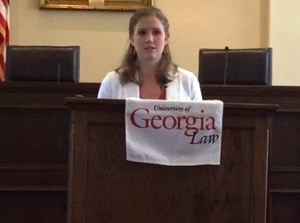
Delivering the 33d annual Edith House Lecture, Stacey Godfrey Evans (left) treated students, faculty, staff, and others in the law school community to a talk entitled “The Voice of a Woman Lawyer: Why it Matters and How to Use It.”

It’s a subject for which she’s well qualified, as 3L Hannah Byars (below right), leader of the Women Law Students Association, made clear. Byars related that after Evans earned her J.D. in 2003, she practiced as an associate at BigLaw firm, then opened a small firm with a handful of colleagues. Evans established her own firm, S.G. Evans Law LLC, in 2014. And since 2011, she’s represented District 42, in Smyrna, as a Democrat in the Georgia State Assembly.hannah

Evans opened her talk by reciting the still-low percentages of women at high levels of the legal profession and politics, then urged the women in her audience to let their voices be heard.

“When you change who is in the room, you change the conversation,”

Evans said at one point, and added that women should not fear to be controversial when the situation merits. She concluded by encouraging women to run for office.

houseIt was a fitting tribute to the namesake of this lecture series, depicted at left: Edith House (1903-1987), whose portrait hangs in the law school rotunda. She and another student in the Class of 1925 were Georgia Law’s 1st women graduates. House was co-valedictorian, and went on to a distinguished career, including a stint as the 1st woman U.S. Attorney in Florida. Thanks to a Women Law Students Association initiative (see this great online scrapbook at p. 53), lectures have been given each year in her honor since 1983.
Global legal research online at SSRN

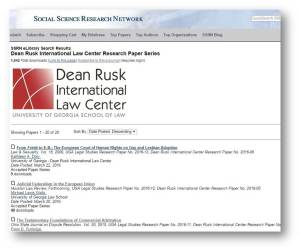
ssrn_shadowAs 2015-16 nears its close, we mark one of the new partnerships on which we embarked this academic year. In October, we began posting news of our scholarship at the Dean Rusk International Law Center Research Papers, a series in the vast Legal Scholarship Network of SSRN, the Social Science Research Network.

Our series highlights scholarly production at the University of Georgia Law, including writings by Georgia Law faculty and Center staff, as well as works appearing in our Georgia Journal of International & Comparative Law and other publications. All the contributions discuss issues of international, comparative, transnational, and foreign affairs law and policy. The series thus augments the decades-old tradition by which the Dean Rusk International Law Center serves Georgia Law’s nucleus global research, education, and service.

Among the works published to date:

► The Testamentary Foundations of Commercial Arbitration, 30 Ohio State Journal on Dispute Resolution (2015), by Dean Peter B. “Bo” Rutledge

► The Death of Deference and the Domestication of Treaty Law, Brigham Young University Law Review (forthcoming), by Professor Harlan Grant Cohen

► Judicial Federalism in the European Union, Houston Law Review (forthcoming), by Professor Michael Lewis Wells

Enforcing Immigration Equity, 84 Fordham Law Review 661 (2015), by Professor Jason A. Cade

A Hitchhiker’s Guide to the OECD’s International VAT/GST Guidelines, 18 Florida Tax Review 589 (2016), by Professor Walter Hellerstein

► Securing Child Rights in Time of Conflict, ILSA Journal of International & Comparative Law (forthcoming), by Associate Dean Diane Marie Amann

Toward Peace with Justice in Darfur: A Framework for Accountability, 18 U.C. Davis Journal of International Law and Policy 1 (2011), by Kathleen A. Doty, our Center’s Associate Director for Global Practice Preparation

View the papers are available online here or, even better, receive new postings through e-mail distribution by subscribing here.