
 It’s our pleasure to publish this post as part of our series inspired by “Humanity’s Common Heritage,” our recent conference on the 2016 ICRC Commentary on the First Geneva Convention. The author is Nicholas W. Mull, a Columbia Law LL.M. candidate who served till mid-2016 at the Pentagon, as an International & Operational Law Attorney, Head Operational Law Department, U.S. Marine Corps, Office of the Judge Advocate General of the Navy. Mull, a conference participant, writes:
The protected status of medical personnel and their units, transports, and establishments, when addressed by commentators, is typically focused on affirmative duties of combatants not to target medically protected persons and objects. However, equally important is the affirmative duty of medically protected persons to refrain 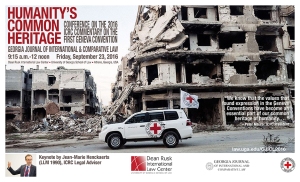 from “acts harmful to the enemy” and the extent of the right of self-defense. These are the concerns of medical providers in the field at the tactical level that are typically ignored.
These concerns are directly addressed in the ICRC’s recent updated commentary for the first Geneva Convention (GC I). While there are several opinions in the commentary that are, arguably, in error, for brevity, this post will only touch on one tactical concern. The commentary asserts that medical personnel may only carry “light individual weapons” without losing protected status, which is in error for several reasons:
- It purports a limit on the type of weapons to be used in self-defense; and
- It opines that protected status can be lost by virtue of an act that only presents a remote hypothetical harm to the enemy that can only come to fruition if the medical personnel purposefully engage in offensive hostilities.
As a preliminary issue, it is vital to interpret Article 21 of GC I, which provides for the sole reason by which protected medical personnel and establishments may lose protected status: commission, “outside their humanitarian duties, [of] acts harmful to the enemy.” The operative condition of “harmful to the enemy” requires a purposeful act that in of itself has caused harm to the enemy’s ability to conduct legitimate military operations. This is not to say that it is a high threshold to meet, but merely that it must actually cause a real definable present harm to the enemy and that it is intended to cause such harm, e.g. utilizing a field hospital to shelter “able-bodied combatants.” This standard should also be understood as more expansive than the direct participation in hostilities (DPH) standard used for determining the loss of protected status of civilians, specifically as it includes both direct and indirect actions. The generally expansive nature of this standard necessitated Article 22 of GC I, which covers actions that may not be considered as “acts harmful to the enemy” such as, inter alia, arming medical personnel.
Turning to the issue of arming medical personnel, the updated commentary concludes that medical personnel are only authorized to carry “light individual weapons” and that to possess crew-served weapons (CSW) results in the “loss of specific protection of the military medical unit.” The qualification of “light” and “individual” is a noticeable addition in the 2016 commentary that is absent from the 1952 Pictet Commentary. This addition presents unnecessary danger to medical personnel in contemporary conflicts of which reciprocity can no longer be presumed.
From a textual analysis, Article 22 makes no condition regarding the quality or quantity of the arms that medical personnel may posses; it only presents a limitation on the employment of the weapons for self-defense. Looking to the 1952 Pictet Commentary, it focuses exclusively on the purpose and permissible use of the arms.
Despite the clear meaning of the text of Article 22, which is free from ambiguity, the 2016 commentary draws an inappropriate analogy to Article 13 of Additional Protocol I (AP I), which states that the equipping of civilian medical personnel with “light individual weapons” would not be considered an act harmful to the enemy. Article 13 of AP I was not an attempt to clarify any ambiguity of Article 22, but was instead pertaining to a completely different class of personnel. Further, it is a highly illogical inferential leap to assume that States would want civilians being armed to the same degree as military medical personnel that are subject to the high standards of discipline of a uniformed service.
States must be able to arm their medical personnel to the degree as they see fit to counter the likely threats to medical personnel in a theatre of operations. Certainly, such arms may only be used in self-defense, but to limit medical personnel to side arms and small assault rifles while the enemy or “marauders” attack them with CSW and other anti-material weapons is unjust.  To paraphrase Pictet in his Commentary, it is not proper to require medical personnel to be the sacrificial lamb to unlawful actions of the enemy or criminals.
It is not hard for a combat experienced individual to envision situations in which medical personnel may have a need to defend themselves with CSW and anti-material weapons. For example, field hospitals may be present in a combat zone in which enemy tactics could include suicide vehicle borne improvised explosive devices (SVBIEDs). To personally defend themselves as well as their patients this scenario may require the use of a .50 caliber machine gun—a weapon primarily designed for anti-material purposes—to subdue the imminent threat to life.
Lastly, as previously noted, to lose the protected status medical personnel must purposefully commit an act that in of itself creates a present harm to the enemy. Arming medical personnel with CSW or other heavier weapons as necessary to counter likely threats to save their lives and the lives of their patients does not result in a present harm to the enemy. In fact, the only way it could be a present harm to the enemy is to presume that the medical personnel intend to violate the law by engaging in offensive hostilities. In reality, this only presents a remote hypothetical harm that does not meet the standard of being harmful to the enemy.
 It may not be the best policy choice to heavily arm medical personnel for the risk of confusion that can be created as to their protected status, especially if the situation is one in which medical personnel are not displaying Red Cross armlets, as is often the case with U.S. military medical personnel. But, this is ultimately a policy choice that should not be confused with status of law.
 Scholarship published in the Georgia Journal of International & Comparative Law
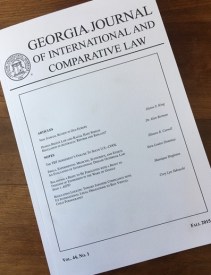 Issues circling the globe are featured in Volume 44 Issue 1 of the Georgia Journal of International and Comparative Law, or
  ► New Judicial Review in Old Europe, by
  ► Human Rights Law and Racial Hate Speech Regulation in Australia: Reform and Replace?, by Dr.
  ► The TBT Agreement’s Failure To Solve U.S.–COOL, an analysis of a World Trade Organization dispute respecting country-of-original labeling, by
  ► Ebola, Experimental Medicine, Economics, and Ethics: An Evaluation of International Disease Outbreak Law, by
  ► Balancing a Right to Be Forgotten with a Right to Freedom of Expression in the Wake of Google Spain v. AEPD, by
 We’re honored that the Georgia Law alumnus leading that project, Geneva-based ICRC legal adviser
  Dr. Henckaerts will be part of a public panel from 9:15 a.m.-12 noon in Georgia Law’s Hatton Lovejoy
  Courtroom. Speaking in that morning session will be: Oxford Law Professor
  moderator
  Amann
Amann Armed Conflict.




 Four more than 4 decades, important articles on international, transnational, and comparative law and policy have found a publication home at Georgia law’s Georgia Journal of International and Comparative Law. Volume 43 Issue 2, the latest edition of
 ► Industrial Accidents, Natural Disasters and “Act of God”, by: Professor
  School of Law, both in the Netherlands; Dr.
  University Rotterdam; and Dr.
  ► Public Law Litigation in the U.S. and in Argentina: Lessons From A Comparative Study, by Professor
  ► A House Divided: The Human Rights Burden of Britain’s Family Migration Financial Requirements, by
  ► Mental Capacity: Reevaluating the Standards, by
  ► History, TRIPS, and Common Sense: Curbing the Counterfeit Drug Market in Sub-Saharan Africa, by
  Delighted to announce the new managing board of the
  exchange of notes