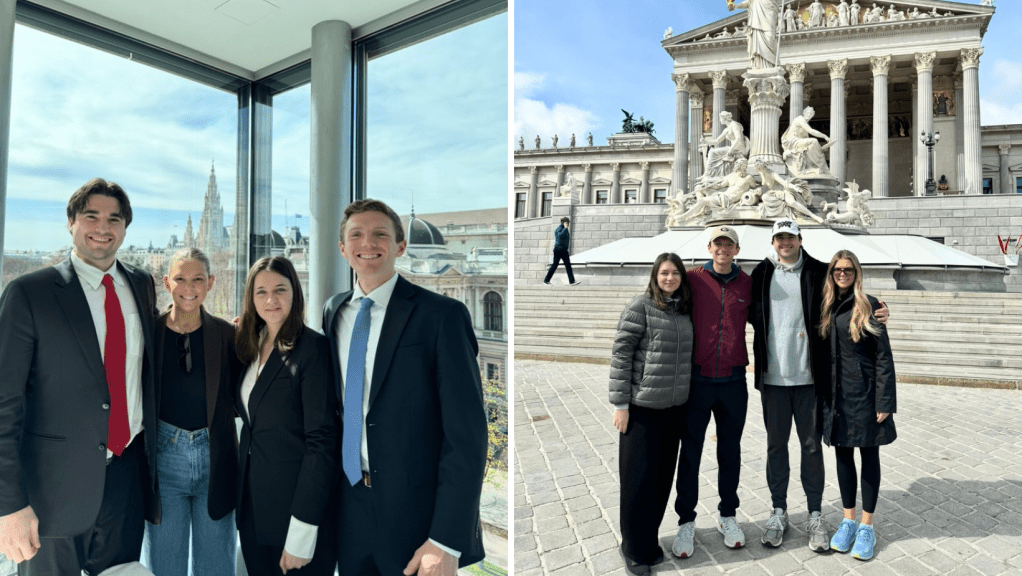
This year, 373 teams from 89 jurisdictions around the world competed in Austria. Alongside more than 2,500 students, the Georgia Law team competed for several days.
Reflecting on the last six months of Vis, Patrick shared,
“As a member of the Vis Moot team, I worked with my teammates to research, brief, and argue an international commercial arbitration case that reflected a real life issue. At the Vis competition in Vienna, we met and competed against teams from around the world who had all worked on the same case, which was such a unique experience. We were lucky to have the guidance, expertise, and support of Dean Rutledge. Overall, Vis exposed me to the global nature of commercial arbitration and gave me an increased appreciation of international law.“
To learn more about the Vis Moot team at Georgia Law, visit our website here.
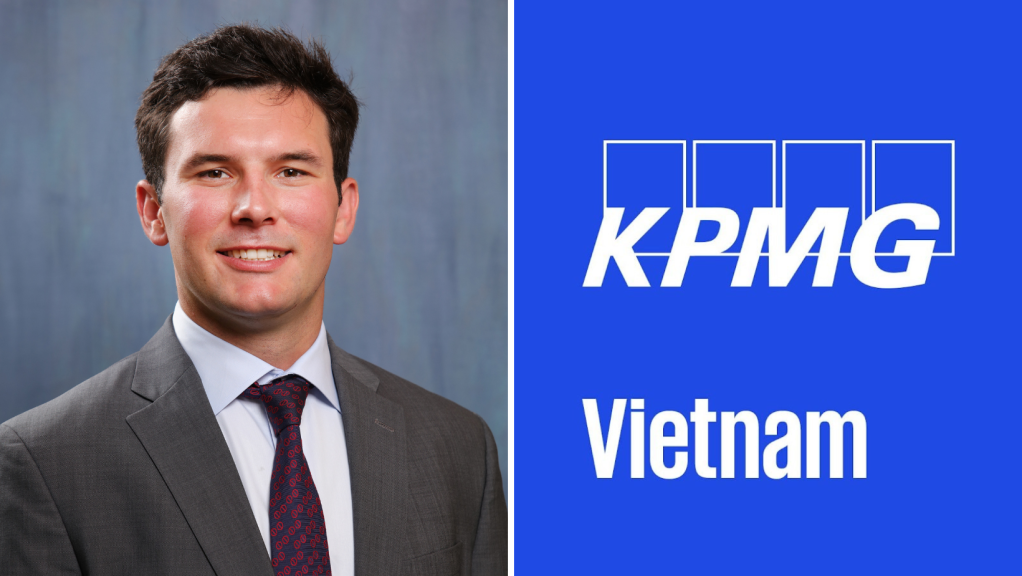
University of Georgia School of Law student Caden Pruitt, 2L, was selected as a recipient of the UGA Office of Global Engagement’s Asia-Georgia Internship Connection Scholarship to support his upcoming Global Externship Overseas (GEO) at KPMG Law in Ho Chi Minh City, Vietnam. Pruitt will be supervised at his externship by Georgia Law alumnus Binh Tran (J.D., ’11), Director at KPMG Law. In addition to the work he will complete as a legal extern, Pruitt will engage in a supervised research project with Professor Christopher M. Bruner, Stembler Family Distinguished Professor in Business Law & Faculty Co-Director of the Dean Rusk International Law Center.
Pruitt’s proposed research project will culminate in a note titled Vietnam: A guide to economic and legal developments,which will involve analyzing risks, opportunities, and the legal environment for foreign direct investors in Vietnam with consideration given to the interests of companies in Vietnam. The note will include three components: an analysis of the motivations for Foreign Direct Investments (“FDI”) in Vietnam, an analysis of the consumer market in Vietnam, and a proposal for contractual approaches to joint-value creation and mitigating risk. It will outline the legal framework for investments under Vietnamese law and will discuss contractual optimization for the resolution of disputes.
This scholarship funds student pursuing credit-bearing internships in southeast Asia for a duration of at least four weeks. Preference is given to students traveling to Cambodia, Indonesia, Japan, South Korea, Laos, Malaysia, Mongolia, the Philippines, Singapore, Taiwan, Thailand, and Vietnam.
This will be Pruitt’s second GEO; the summer of his first year at Georgia Law, he externed with Bodenheimer in Cologne, Germany, under the supervision of Georgia Law alumnus and Rusk Council member Dr. Christof Siefarth (LL.M., ’86).
In the article, Quinn discusses the Center’s focus on providing Georgia Law students with opportunities to globalize their legal education. She highlights the Center’s student-facing programming, including Global Governance Summer School, Global Externships Overseas, the NATO Externship, and semester-long exchanges with institutional partner O.P. Jindal Global University’s Jindal Global Law School. Explaining how the Center encourages all J.D. students to consider participating in these programs, Quinn states:
“We underscore to our students just how globalized the practice of law is— even [students] aspiring to work domestically can benefit from taking an international law course or gaining work experience abroad.”
Quinn provides information about the Center’s initiatives for foreign-educated law students and professionals, ranging from the 10-month Master of Laws (LL.M.) degree to the Visiting Researcher initiative. She notes that the Center’s events throughout the academic year, including the annual Georgia Journal of International and Comparative Law conference, offer opportunities for participation, particularly from alumni/ae and from interested professionals.
The article can be accessed in its entirety here. Global Atlanta is one of the Center’s institutional partners.
Quinn was named the permanent director of the Dean Rusk International Law Center after leading the unit for seven months on an interim basis. Quinn, who joined the School of Law in 2019, previously served as the associate director for global practice preparation. She was instrumental in developing the school’s partnership with India’s Jindal Global University, establishing the Graduate Certificate in International Law and transitioning the Global Governance Summer School into a credit-bearing program. Prior to joining the law school, Quinn worked with the UGA Office of Global Engagement and the U.S. Peace Corps in addition to serving as a director for the American School Language Institute in Morocco. She earned her B.A., B.F.A. and M.I.P. from UGA and her ED.M. from Harvard University.
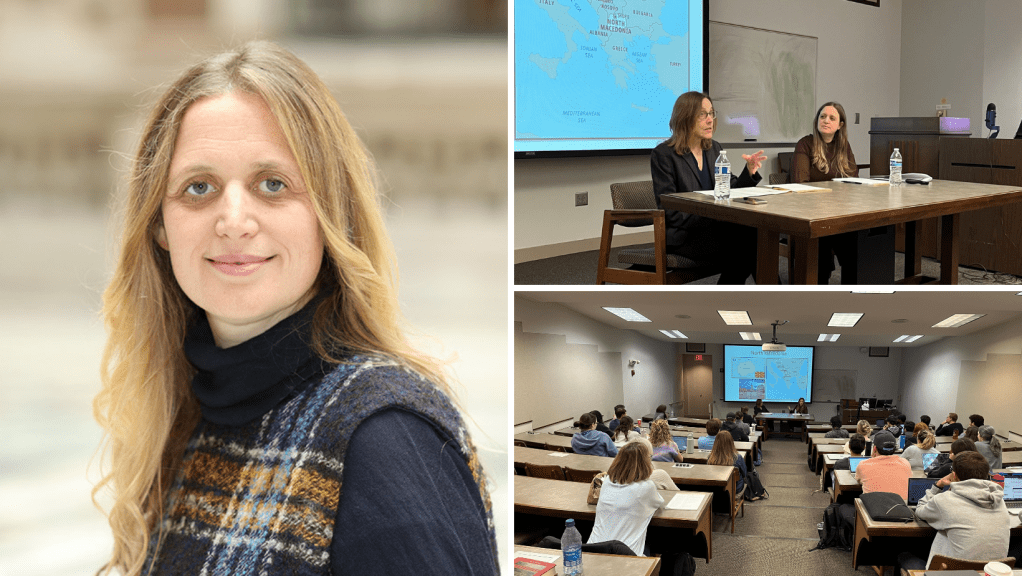
Galloway spoke with students about her diplomatic career, including her post as the United Kingdom’s Ambassador to North Macedonia. She was joined in conversation by Diane Marie Amann, Regents’ Professor of International Law, Emily & Ernest Woodruff Chair in International Law, Faculty Co-Director of the Dean Rusk International Law Center. Galloway’s talk was the most recent installment of the Dean Rusk International Law Center’s ongoing Consular Series, which presents students, staff, and faculty with global perspectives on international trade, cooperation, development, and policy.
Galloway assumed her current post as the British consul general in Atlanta in 2022, replacing former consul general Andrew Staunton. Staunton gave a presentation at Georgia Law in 2019 as part of the Center’s ongoing Consular Series. Galloway has more than 20 years of diplomatic experience; she started her career with the Foreign, Commonwealth and Development Office in 2000 and spent three years chairing the Maghreb working group at the European External Action Service. She has also held roles as the U.K. Permanent Representation to Brussels (2012-15), deputy head of the FCO’s International Organisations Department (2008-11) and head of the Darfur section of the Sudan unit in the FCO’s international development department (2007-08). Galloway spent a brief stint on a provincial reconstruction team in Helmand, Afghanistan, in 2006, that same year serving on the counter-terrorism review team in Her Majesty’s Treasury. Her only prior posting in the U.S. prior to her current role was a four-year assignment in Washington as second secretary in the political section at the British Embassy from 2002-06.
University of Georgia School of Law LL.M. student, N’guessan “Clément” Kouame, contributed to the most recent World Bank Report for Women, Business, and the Law (WBL) released on March 2. He served as a panelist contributor for Côte d’Ivoire, West Africa, reviewing the legal framework and landscape of the country regarding the improvement of women’s rights and women’s empowerment.
Women, Business and the Law (WBL) is a World Bank Group project collecting data on the laws and regulations that affect women’s economic opportunity. Since 2009, WBL has been enhancing the study of gender equality and informing discussions on improving women’s economic opportunities and empowerment. This is the second year in a row that Kouame will contribute to the WBL’s annual report. He provides sources, laws, and regulations to corroborate his answers and make recommendations and comments.
From the report’s overview:
Women, Business and the Law 2024 is the tenth in a series of annual studies measuring the enabling environment for women’s economic opportunity in 190 economies.
This edition of the report updates the Women, Business and the Law 1.0 index of eight indicators, structured around women’s interactions with the law as they begin, progress through, and end their careers: Mobility, Workplace, Pay, Marriage, Parenthood, Entrepreneurship, Assets, and Pension.
Women, Business and the Law 2.0 sets a new frontier for measuring the environment for women’s economic inclusion across three pillars: legal frameworks, measuring laws; supportive frameworks, measuring policy mechanisms to implement laws; expert opinions, shedding light on experts’ perception of women’s outcomes.
Women, Business and the Law 2.0 also introduces two new indicators: Safety, measuring frameworks addressing violence against women, and Childcare, measuring frameworks for the availability, affordability and quality of childcare.
Data in Women, Business and the Law 2024 are current as of October 1, 2023. By examining laws and policy mechanisms affecting the economic decisions women make as they go through different stages of their working lives, as well as the opinions of experts on the legal environment for women’s economic inclusion, Women, Business and the Law makes a contribution to policy discussions about the state of women’s economic opportunities.
University of Georgia School of Law Visiting Researcher Mine Turhan took part in the Spring 2024 Faculty Colloquium Series last month. Her presentation, “Right to be Heard in Administrative Procedure,” was the third of six talks this semester.
Turhan’s project at Georgia Law focuses on procedural due process rights, in particular the right to be heard before administrative agencies. Her talk began by describing the fundamentals of this right, followed by her findings about this right in comparative law, specifically focusing on the U.S. and EU countries. The final third of Turhan’s presentation looked at the right to be heard in Turkish law.
In addition to Turhan, this semester’s colloquium series includes Anne Tucker, Alyse Bertenthal, Alex Klass, Rachel Barkow, and Libby Adler. The series provides a forum for provocative and innovative legal scholarship and gives our law faculty the opportunity to collaborate on current legal research, exchange ideas and foster relationships with other institutions. It is made possible through the Kirbo Trust Endowed Faculty Enhancement Fund and the Talmadge Law Faculty Fund.
Turhan’s research is supported by a fellowship from the Scientific and Technological Research Council of Türkiye (TÜBİTAK) within the scope of the International Postdoctoral Research Fellowship Program. She is sponsored as a Visiting Research Scholar by Georgia Law Professor David E. Shipley, the Georgia Athletic Association Professor in Law. Her visit continues our Center’s long tradition of hosting scholars and researchers whose work touches on issues of international, comparative, or transnational law. Details and an online application to become a visiting scholar here.
Professor Diane Marie Amann recently presented her research on “Child-Taking” as a guest lecturer in a course on the Russo-Ukrainian War taught at Yale University this semester. Students from Yale’s law school, management school, and school of global affairs comprise the class, which is taught by Yale Law Professor Eugene R. Fidell and Margaret M. Donovan.
Amann is Regents’ Professor of International Law, Emily & Ernest Chair in International Law, and Faculty Co-Director of the Dean Rusk International Law Center here at the University of Georgia School of Law. She writes and teaches in areas including child and human rights, constitutional law, transnational and international criminal law, and global legal history.
Amann’s online guest lecture drew from her article, “Child-Taking,” soon to be published in the Michigan Journal of International Law. (Preprint draft available at SSRN.) As Amann theorizes it, child-taking occurs when a state or similarly powerful entity abducts children from their community and then endeavors to remake the children in its own image. This conduct, involving children taken from Ukraine, lies at the heart of the International Criminal Court warrants pending against President Vladimir Putin and another top Russian official. The article also examines other examples of the phenomenon, including the Nazis’ kidnappings of non-German children during World War II and the forced placement of Indigenous children into boarding schools in North America, Australia, and elsewhere.
Amann also has presented this scholarship at meetings of the American Society of International Law and at University College London Faculty of Laws and King’s College London Department of War Studies.
This month marks63 years since President John F. Kennedy established the United States Peace Corps.Three members of the University of Georgia School of Law community share about their service as Peace Corps volunteers and how their international experiences through the agency impact the work they do for the law school today.
Since President John F. Kennedy established the Peace Corps on March 1, 1961 to promote world peace and friendship, more than 240,000 Americans have served the United States and countries around the globe as volunteers– including three who currently work at the University of Georgia School of Law. Below, Sarah Ehlers, Georgia McPeak, and Sarah Quinn reflect on their work in the Peace Corps and the connections between their time abroad and the work that they do for Georgia Law.
***
Sarah Elhers, a clinic paralegal and Spanish interpreter for the Wilson Family Justice Clinic, the Community Health Law Partnership (HeLP) Clinic and the Business Law Clinic, served in Honduras from 1993-1995 as a health education volunteer. She worked with midwives and village health workers in an effort to reduce infant mortality. As a volunteer, Sarah received intensive language and cultural training that enabled her to work effectively in her host community. The Spanish language abilities that she honed in the Peace Corps continue to serve her in her work with Georgia Law.
My Peace Corps service led me to my current job as a bilingual paralegal/Spanish interpreter for the law school clinics not only because of my language skills but also due to my continued interest in serving as a bridge between communities. I feel very lucky that over 30 years later, my experience is still relevant!
Georgia McPeak, grants coordinator, served in Mali, West Africa (specifically, village of Sogolonbougou in the Koulikoro Region) from 1987-1990 as an Appropriate Technology Extension Agent. Generally, she helped local communities protect, conserve, and manage their natural resources. More specifically, she taught people how to build, operate, maintain, and repair fuel efficient cook stoves and bread ovens, water treadle pumps, and solar food dryers.
Everything I have done since I completed my Peace Corps service has been a direct result of having been a volunteer. Being in the Peace Corps helped me get accepted to graduate school, and getting my master’s degree helped launch my career in humanitarian relief. Working in humanitarian relief settings took me back to Africa and other places including Eastern Europe, Central America, and the Caribbean. A large part of my work overseas involved developing, writing, securing, and managing grants to assist refugees and internally displaced people. The experience I had managing grants is what eventually led to my position here at the law school as the Grants Coordinator. For me, Peace Corps was an incredibly formative and positive life-changing experience.
Sarah Quinn, director of the Dean Rusk International Law Center, served in Tameslouht, Morocco from 2011-2014 as a Youth Development volunteer. She was assigned a local dar chabab, or youth center, through the agency’s partnership with the Moroccan Ministry of Youth and Sports. There, she taught English to high school students and local association members, including a group of artisans. Sarah worked on several secondary projects throughout her service, including with Tameslouht’s first group of women artisans, and volunteering through a local non-profit focused on gender equity and girls’ empowerment.
My experience living and working abroad completely changed my worldview. Through the Peace Corps, I was able to learn the language, culture, and history of Morocco through the process of integrating into a rural community of about 6,000 people. While working with artisans and with a non-profit focused on girls empowerment, I saw firsthand how American foreign policy has the potential to positively impact communities and individuals on the ground in other countries– or completely miss the mark. The experience removed my ability to see things in a black and white binary, and I am now much more attuned to the shades of grey imparted by factors like cultural context and history. I also learned a new language, applied for (and received) my first grants, and made lifelong friends who continue to challenge and shape my understanding of current events around the world. My biggest takeaway from my Peace Corps experience is that more Americans need the opportunity to have transformative international experiences. It is because of this belief that I began working in the field of international education, and it is why I am so passionate about my current work encouraging law students to globalize their legal education.
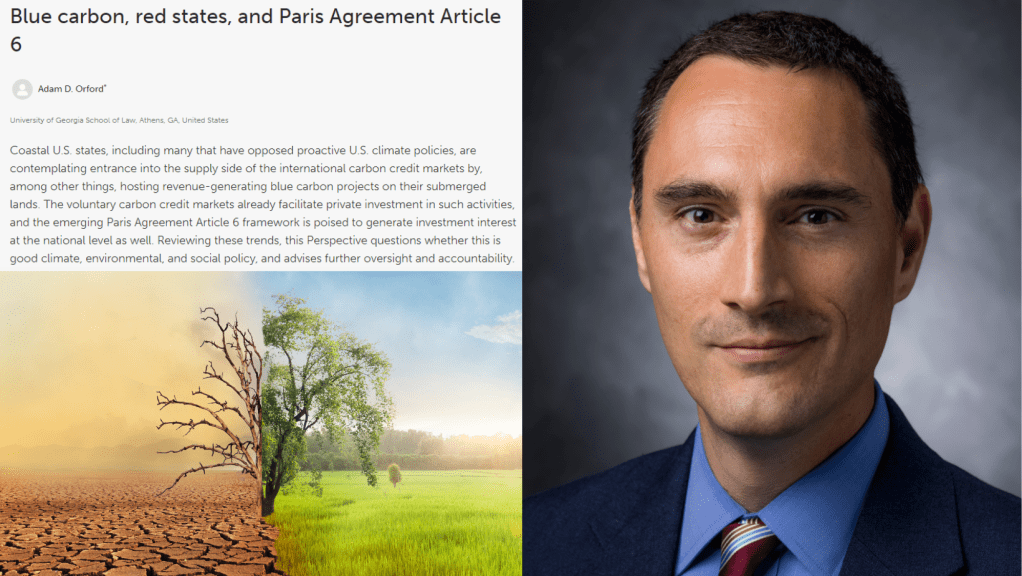
Coastal U.S. states, including many that have opposed proactive U.S. climate policies, are contemplating entrance into the supply side of the international carbon credit markets by, among other things, hosting revenue-generating blue carbon projects on their submerged lands. The voluntary carbon credit markets already facilitate private investment in such activities, and the emerging Paris Agreement Article 6 framework is poised to generate investment interest at the national level as well. Reviewing these trends, this Perspective questions whether this is good climate, environmental, and social policy, and advises further oversight and accountability.
Orford joined the University of Georgia School of Law in the fall of 2021. His interdisciplinary research investigates legal and policy approaches to environmental protection, human health and wellbeing, and deep decarbonization of the United States economy. He also participates in collaborative research initiatives across UGA, including as the lead of the Georgia element of the National Zoning Atlas and as a participant in ongoing investigations into the legal, political, environmental and social dimensions of new energy manufacturing and emerging carbon removal technologies.
Kalyani Ramnath, Assistant Professor in the Department of History at the Franklin College of Arts & Sciences and Assistant Professor (by courtesy) at the University of Georgia School of Law, recently discussed her first book (detailed in previous post here) at an event organized by the Dean Rusk International Law Center. Joining Ramnath in conversation about Boats in a Storm: Law, Migration, and Decolonization in South and Southeast Asia, 1942–1962 (Stanford University Press, 2023) were Diane Marie Amann, Regents’ Professor, Emily & Ernest Woodruff Chair in International Law, and Co-Director of the Dean Rusk International Law Center, and Laura Phillips-Sawyer, Jane W. Wilson Associate Professor in Business Law.
Drawing on archival materials from India, Sri Lanka, Myanmar, London, and Singapore, Kalyani Ramnath narrates how former migrants battled legal requirements to revive prewar circulations of credit, capital, and labor, in a postwar context of rising ethno-nationalisms that accused migrants of stealing jobs and hoarding land. Ultimately, Ramnath shows how decolonization was marked not only by shipwrecked empires and nation-states assembled and ordered from the debris of imperial collapse, but also by these forgotten stories of wartime displacements, their unintended consequences, and long afterlives.
Ramnath received her Ph.D. in history from Princeton University in 2018, and was a Prize Fellow in Economics, History, and Politics at the Center for History and Economics at Harvard University from 2018 – 2021. She also holds a bachelor’s degree in arts and law (B.A., LL.B. (Hons.) (JD equivalent) from the National Law School of India University (NLSIU) and a master’s degree in law (LL.M.) from the Yale Law School.




 exchange of notes